Efect of Temperature and Duration of Thermal Process on the Occurrence and Stability of Acrylamide in Chili Powder
Keywords:
Acrylamide, Occurrence, Stability, Chili powderAbstract
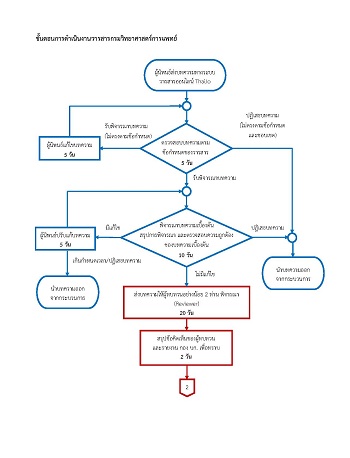
Chili powder is an agricultural commodity, which is commonly consumed, produced and used as a key ingredient in many food products. During 2007-2008, risk assessment of acrylamide (AA) in foods for Thais was conducted and found that chili powder had the highest mean levels of AA among foods subjected to the study and accounted for a third of dietary exposure to the AA, coming after potato crisps and potato starch. Consequently, to reduce acrylamide formation in chili powder, the efect of temperature and duration in chili powder processing was then investigated to obtain the processing condition with low acrylamide formation. Studies on the stability of acrylamide in chili powder was also examined to observe the trend in stability of AA in chili powder during storage at room temperature. Samples used in this study are Capsicum annuum Linn. The levels of acrylamide in fresh chili, dried chili (fresh chili heated at 60°C 9 h.) and chili powder (dried chili heated at 90, 110 and 130°C for various times) were analyzed by liquid chromatograph/triple quadrupole mass spectrometer (LC/MS-MS). The results showed that AA was not detected in both fresh and dried chili. Acrylamide was found at 0.07 - 6.48, 1.75 - 8.65 and 14.7 - 18.1 mg/kg in chili powder heated at 90°C for 20 - 300 min, 110°C for 20 -180 min and 130°C for 20 - 180 min, respectively. This study indicated that the main factor causing the occurrence of acrylamide in chili powder was temperature used in process. Thus, low-temperature long-time process should be applied instead of high-temperature short-time process to reduce levels of acrylamide in chili powder. Acrylamide formed in chili powder is not stable. The acrylamide in chili decreases exponentially, rapidly decreasing at the beginning of the process, and then dropping slowly until being constant.
References
สำนักมาตรฐานสินค้าเกษตรและอาหารแห่งชาติ กระทรวงเกษตรและสหกรณ์. มาตรฐานสินค้าเกษตร มกษ. 3004-2560 พริกป่น. ประกาศในราชกิจจานุเบกษา ฉบับประกาศและงานทั่วไป เล่ม 134 ตอนพิเศษ 99 ง (วันที่ 7 เมษายน 2560).
Mottram DS, Wedzicha BJ, Dodson AT. Acrylamide is formed in the Maillard reaction. Nature 2002; 419: 448-9.
Stadler RH, Blank I, Varga N, Robert F, Hau J, Guy PA, et al. Acrylamide form Maillard reaction products. Natures 2002; 419: 449-50.
Yasuhara A, Tanaka Y, Hengel M, Shibamoto T. Gas chromatographic investigation of acrylamide formation in browning model systems. J Agric Food Chem 2003; 51: 3999-4003.
Joint FAO/WHO food standard programme codex committee on food additives and contaminants, discussion paper on acrylamide. CX/FAC 06/38/35. Thirty-eighth session. Hague, Netherlands. 24-28 April 2006.
World Health Organization. Evaluations of the joint FAO/WHO expert committee on food additive (JECFA). Acrylamide. [Online]. [cited 2017 Jun 7]. Available from: URL: https://apps.who.int/foodadditives-contaminants-jecfa-database/chemical.aspx?chemID=5198.
World Health Organization, International Agency for Research on Cancer. IARC monographs on the evaluation of carcinogenic risks to humans. [Online]. [cited 2016 Nov 15]. Available from: URL: https://monographs.iarc.fr/ENG/Classiication/ClassiicationsAlphaOrder.pdf
The European Commission. Commission recommendation of 8 November 2013 on investigation into the levels of acrylamide in food. Oicial Journal of the European Union 2013; 2013/647/EU: L 301/15-17. [Online]. 2013 [cited 2016 Dec 23]; [3screens]. Available from: URL: https://eur-lex.europa.eu/legal-content/EN/TXT/PDF/?uri=CELEX:32013H0647&from=EN
กองโภชนาการ กรมอนามัย กระทรวงสาธารณสุข. ตารางแสดงคุณค่าทางโภชนาการของไทย. นนทบุรี : โรงพิมพ์ องค์การทหารผ่านศึก; 2544.
ลัดดาวัลย์ โรจนพรรณทิพย์, พรรณทิพย์ ตียพันธ์, มยุรี อุรารุ่งโรจน์, พนาวัลย์ กลึงกลางดอน. การประเมินความเสี่ยงของสารอะคริลาไมด์ในอาหารต่อคนไทย. วารสารวิชาการสาธารณสุข 2554; 20 (1): 38-50.
สำนักมาตรฐานสินค้าเกษตรและอาหารแห่งชาติ กระทรวงเกษตรและสหกรณ์. มาตรฐานสินค้าเกษตร มกษ. 3001-2553 พริกแห้ง. ประกาศในราชกิจจานุเบกษา ฉบับประกาศและงานทั่วไป เล่ม 127 ตอนพิเศษ 150 ง (วันที่ 28 ธันวาคม 2553).
Gokmen V, Senyuva HZ. A generic method for the determination of acrylamide in thermally processed foods. J Chromatography A 2006; 1120: 194-8.
Hoenicke K, Gatermann R. Studies on the stability of acrylamide in food during storage. J AOAC Int 2005; 88: 268-73.
Andrzejewski D, Roach JA, Gay ML, Mussser SM. Analysis of coffee for the presence of acrylamide by LC-MS/MS. J Agric Food Chem 2004; 52: 1996-2002.
Downloads
Published
How to Cite
Issue
Section
License

This work is licensed under a Creative Commons Attribution-NonCommercial-NoDerivatives 4.0 International License.