Development of Analytical Method for Sulfonamides residue in Animal tissues and Liver by HPLC Technique
Keywords:
Sulfonamides (SAs), animal tissue, liver, HPLC-UVAbstract
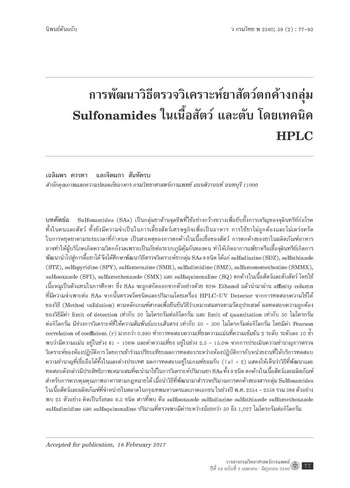
Sulfonamides (SAs) are antimicrobial drugs extensively prescribed for bacteriostatic infections in humans and animals and widely used in livestock production. Thus, any misuse or lack of adherence to withdrawal time may result in the presence of tissue residues. Drug residues in food products are of concern to consumers because they may compromise the human immune system causing an allergic reaction or contributing to the development of antibiotic-resistant pathogenic bacterial strains. The study for validation of an analytical method of 9 SAs including sulfadiazine (SDZ), sulfathiazole (STZ), sulfapyridine (SPY), sulfamerazine (SMR), sulfadimidine (SMZ), sulfamonomethoxine (SMMX), sulfisoxazole (SFI), sulfamethoxazole (SMX) and sulfaquinoxaline (SQ) in animal tissue and liver was conducted and developed by using pork as a representative matrix. This, SAs was extracted from sample with 80% ethanol and proceeded to specific of sulfonamides affinity column. SAs was detected and quantitatively determination by HPLC-UV detector. The method validation data were accepted and fitted-for-purpose. As a result of method validation, limit of detection was defined as 30 μg/kg and limit of quantitation was 50 μg/kg The linear working range was 50 - 500 μg/kg with the Pearson correlation of coefficient (r) more than 0.990. The accuracy and the precision as 2 levels by 10 duplicate analyst. Accuracy of the method was found to be in acceptable ranges of 61 - 106 and % precision shown is 2.5 - 15.0%. The results of participated in Proficiency Testing scheme performed by various PT providers were satisfying (|z| < 2). The performance of developed method for determination of 9 SAs residue in animal and product was found to be satisfactory to meet with legal requirement for quality in food industry. The survey research on Sulfonamides abuse from 368 samples of edible animal and product, sold in markets in Bangkok and private sector was conducted during 2011 - 2015. The results showed that 25 samples (6.5%) including sulfisoxazole sulfadiazine sulfathiazole sulfamethoxazole sulfadimidine and sulfaquinoxaline. The level found was from less than 50 to 1,027 μg/kg
References
Poirier LA, Doerge DR, Gaylor DW, Miller MA, Lorentzen RJ, Casciano DA, et al. An FDA review of sulfamethazine toxicity. Regul Toxicol Pharmacol 1999; 30(3): 217-22.
กำพล ศรีวัฒนกุล และคณะ. คู่มือการใช้ยาฉบับสมบูรณ์. พิมพ์ครั้งที่ 7. ปทุมธานี : บริษัทสกายบุ๊กส์ จำากัด; 2552. หน้า 153-156.
อโนชา อุทัยพัฒน์, นงลักษณ์ สุขวาณิชย์ศิลป์. เภสัชวิทยา เล่ม 2. กรุงเทพฯ : บริษัทไทยมิตรการพิมพ์; 2541. หน้า 1-25, 162-171.
Jawetz E. Sulfonamides & trimethoprim. In: Katzung BG. Basic & clinical pharmacology. 2nd ed. Los Altos, CA: Lange Medical Publications; 1984. p. 554-558.
USP veterinary pharmaceutical information monographs: sulfonamides. [online]. 2003; [cited 2006 Jul 26]. Avaliable from: URL: https://www.usp.org/audiences/veterinary/monographs/main.html.
21 CFR 520.2260a; U.S. national archives and records administration’s. electronic code of federal regulations. [online]. [cited 2006 Jun 21]. Available from: URL: https://www.ecfr.gov.
Huber WG. The impact of antibiotic drugs and their residues. In: Brandly CA, Gornelius C, editors. Advances in veterinary science and comparative medicine. New York: Academic Press; 1971. p. 101-132.
Wilson RC. Antibiotic residues and public health. In: Crawford LM, Franco DA, editors. Animal drugs and human health. USA: Technomic Publishihg; 1994. p. 63-80.
Donoghue DJ. Antibiotic residues in poultry tissue and eggs: human health concerns. Poultry Science. 2003; 82: 618-21.
พระราชบัญญัติอาหาร พ.ศ. 2522 ประกาศกระทรวงสาธารณสุข ฉบับที่ 303 (พ.ศ. 2550) เรื่องอาหารที่มียาสัตว์ตกค้าง. ราชกิจจานุเบกษา เล่มที่ 120 ตอนพิเศษ 47ง (ลงวันที่ 23 เมษายน 2546) หน้า 12.
Kao YM, Chang MH, Cheng CC, Chou SS. Chieu-Chen Cheng, Shin-Shou Chou. Multiresidue determination of veterinary drugs in chicken and swine muscles by high-performance liquid chromatography. J Food Drug Anal 2001; 9(2): 84-95.
Li B, Li C, Jiang H, Wang Z, Cao X, Zhao, et al. Purification of nine sulfonamides from chicken tissues by immunoaffinity chromatography using two monoclonal antibodies. J AOAC Int 2008; 91(6): 1488-93.
Eurachem Guide. The fitness for purpose of analytical methods: a laboratory guide to method validation and related topics. United Kingdom: LGC (Teddington) LTd; 1998. p. 61, 5-24.
กรมวิทยาศาสตร์การแพทย์ กระทรวงสาธารณสุข. แนวปฏิบัติการทดสอบความถูกต้องของวิธีวิเคราะห์ทางเคมีโดยห้องปฏิบัติการเดียว. นนทบุรี : กรมวิทยาศาสตร์การแพทย์ กระทรวงสาธารณสุข; 2549.
EURACHEM/CITAC Guide. Quantifying uncertainty in analytical measurement. 2nd ed. United Kingdom; 2000.
กรมวิทยาศาสตร์การแพทย์ กระทรวงสาธารณสุข. แนวปฏิบัติการประมาณค่าความไม่แน่นอนของการวัดทางเคมี. นนทบุรี : กรมวิทยาศาสตร์การแพทย์ กระทรวงสาธารณสุข; 2550.
Sheth HB, Sporns P. Development of a single ELISA for detection of sulfonamides. J Agric Food Chem 1991; 39(9): 1696-700.
Korsrud GO, Papich MG, Fesser ACE, Salisbury CDC, Macneil JD. Laboratory testing of the charm test II receptor assays and the charm farm test with tissues and fluids form hogs fed sulfamethazine, chlortetracycline, and penicillin G. J Food Prot 1996; 59(2): 161-6.
Ito Y, Oka H, Ikai Y, Matsumoto H, Miyazaki Y, Nagase H. Application of ion-exchange cartridge clean-up in food analysis: V. Simultaneous determination of sulphonamide antibacterials in animal liver and kidney using high-performance liquid chromatography with ultraviolet and mass spectrometric detection. J Chromatogr A 2000; 898(1): 95-102.
Hela W, Brandtner M, Widek R, Schuh R, Determination of sulfonamides in animal tissues using cation exchange reversed phase sorbent for sample cleanup and HPLC-DAD for detection. J Food Chem 2003; 83(4): 601-08.
Salisbury CD, Sweet JC, Munro R. Determination of sulfonamide residues in the tissue of food animals using automated precolumn derivatization and liquid chromatography with fluorescence detection. J AOAC Int 2004; 87(5): 1264-8.
Downloads
Published
How to Cite
Issue
Section
License

This work is licensed under a Creative Commons Attribution-NonCommercial-NoDerivatives 4.0 International License.