Risk Assessment of Heavy Metals in Fish and Shrimp from Songkhla Lake to Thais
Keywords:
Lead, Cadmium, Mercury, Aquatic animals, Songkhla LakeAbstract
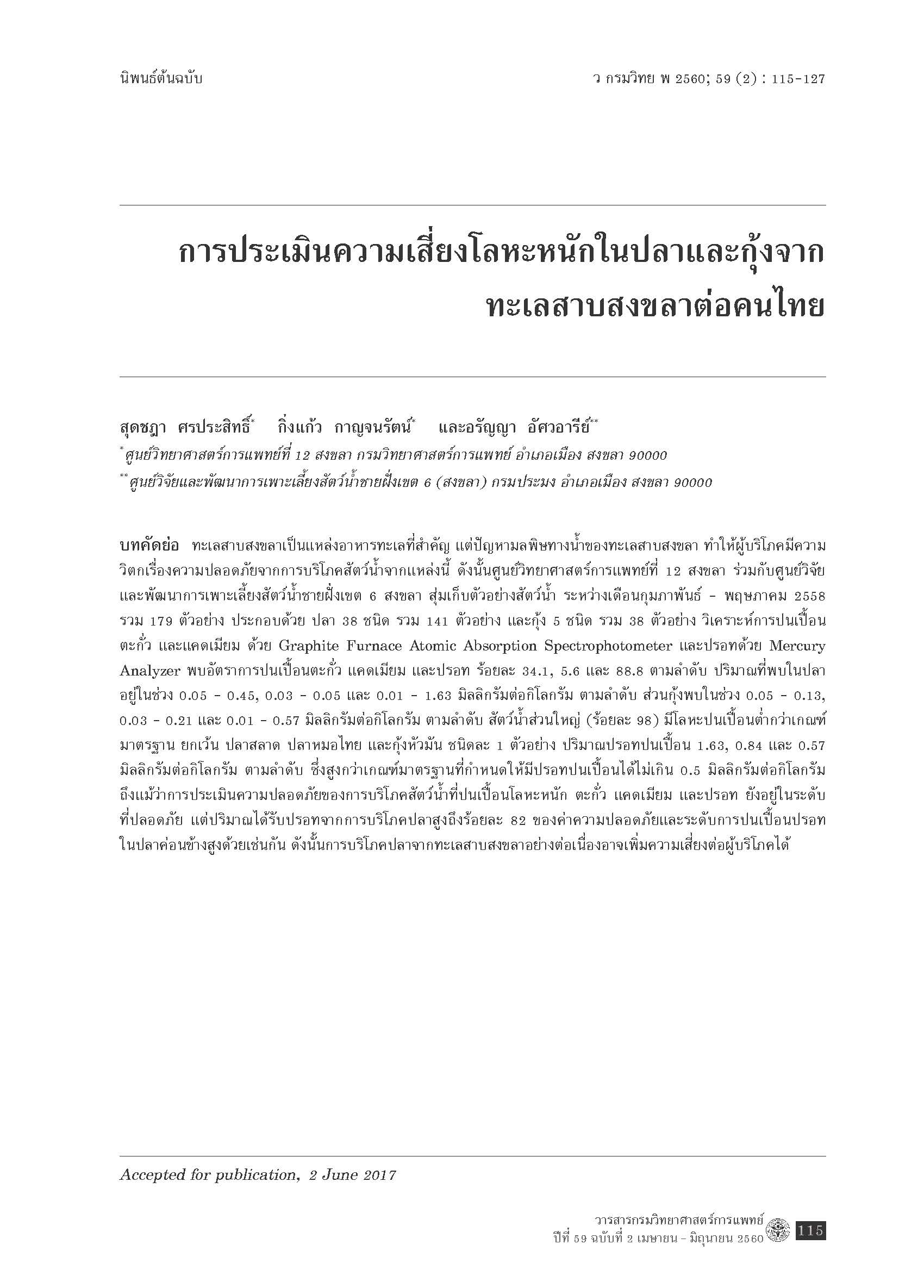
The Songkhla Lake (SKL) is an important source of seafood. However, the water pollution of SKL makes people aware about the safety for seafood consumption. Hence, in February-May 2015 The Regional Medical Sciences Center 12 Songkhla co-operate with Coastal aquaculture research and development center region 6 Songkhla collected 179 samples of aquatic animals, including 38 species (141 samples) of fish and 5 species (38 samples) of shrimp. All of samples were analyzed for lead (Pb) and cadmium (Cd) content by Graphite Furnace Atomic Absorption pectrophotometer, and mercury (Hg) by Mercury Analyzer. The results showed that the contamination of Pb, Cd and Hg in seafood were 34.1%, 5.6% and 88.8%, respectively, the amount of metals were ranging from 0.05 - 0.45, 0.03 - 0.05 and 0.01 - 1.63 mg/kg, respectively for fishes and ranging from 0.05 - 0.13, 0.03 - 0.21 and 0.01 - 0.57 mg/kg, respectively for shrimps. The level of Pb, Cd and Hg in most samples (98%) were within regulatory limits, except Bronze feather back, Climbing perch and Stork shrimp (one sample per species) contained 1.63, 0.84 and 0.57 mg/kg of mercury respectively, which higher than Thai regulatory limit (≤ 0.5 mg/kg). Although the exposure assessment of heavy metals in aquatic animal still safe to Thais but the level of Hg exposure was 82 percent of safety level and the level of Hg content in fishes were rather high. Therefore, the continuous consumption of fish from SKL may increase the risk to consumers.
References
จิราภา อุณหเลขกะ, และคณะ. การศึกษาปริมาณตะกั่ว แคดเมียม ดีบุก และปรอท ที่ปนเปื้อนในหอยแครงและหอยแมลงภู่บริเวณอ่าวไทยตอนใน ปี 2552. วารสารอาหารและยา 2552; 18(2): 15-22.
JECFA. Evaluation of certain food additives and contaminants. Seventy-third report of the joint FAO/WHO expert committee on food additives, Technical report series 960. Geneva: World Health Organization; 2011.
JECFA. Evaluation of certain food additives and contaminants: Sixty-seventh report of the joint FAO/WHO expert committee on food additives, Technical report series 940. Geneva: World Health Organization, 2007.
จงจิตร์ นีรนาทเมธีกุล. บันทึกทะเลสาบ ผลการศึกษาโครงการขุดลอกร่องน้ำทางเรือเดินในทะเลสาบสงขลา (ร่องใน). วารสารเม็ดทราย 2554; 7(1): 6-7.
สำนักสิ่งแวดล้อมภาคที่ 16. คุณภาพน้ำแหล่งน้ำผิวดินในพื้นที่ภาคใต้ตอนล่างฝั่งตะวันออก ครั้งที่ 1 ประจำาปีงบประมาณ 2556. [ออนไลน์]. 2558;[สืบค้น 9 ม.ค.2558]; [19 หน้า]. เข้าถึงได้ที่: URL: https://www.reo16.mnre.go.th/reo16/doc_announce/list.
กัลยา วานิชย์บัญชา. การวิเคราะห์สถิติ : สถิติสำหรับการบริหารและวิจัย พิมพ์ครั้งที่ 7. กรุงเทพฯ : โรงพิมพ์แห่งจุฬาลงกรณ์มหาวิทยาลัย; 2546.
Ihnat M., Determination of lead, cadmium, zinc, copper and iron in foods. Atomic absorption spectrophotometry after microwave digestion. In: George W.L., editor. Official Methods of Analysis of AOAC International. 19th ed. Gaithersburg: AOAC International; 2012. AOAC Official Method 999.10, p. 16-19.
Ihnat M., Mercury in fish. In: George W.L., editor. Official Methods of Analysis of AOAC International. 19th ed. Gaithersburg: AOAC International; 2012. AOAC Official Method 974.14, p. 37.
กัลยา วานิชย์บัญชา. การใช้ SPSS for Windows ในการวิเคราะห์ข้อมูล. พิมพ์ครั้งที่ 6. กรุงเทพฯ : คณะพาณิชยศาสตร์และการบัญชี จุฬาลงกรณ์มหาวิทยาลัย; 2547.
พระราชบัญญัติอาหาร พ.ศ. 2522 ประกาศกระทรวงสาธารณสุข ฉบับที่ 98 (พ.ศ. 2529). ราชกิจจานุเบกษา ฉบับพิเศษ เล่มที่ 103 ตอนที่ 23 (วันที่ 16 กุมภาพันธ์ 2529).
European Commission Regulation (EC) No. 1881/2006 of 19 December 2006 setting maximum levels for certain contaminants in foodstuffs. Official Journal of the European Union 2006; L 364/5-24.
สำนักมาตรฐานสินค้าเกษตรและอาหารแห่งชาติ. ข้อมูลการบริโภคอาหารของประเทศไทย. กรุงเทพฯ : โรงพิมพ์ชุมนุมสหกรณ์การแห่งประเทศไทย; 2549.
ศูนย์วิจัยทรัพยากรทางทะเลและชายฝั่งอ่าวไทยตอนล่าง กรมทรัพยากรทางทะเลและชายฝั่งกระทรวงทรัพยากรธรรมชาติและสิ่งแวดล้อม. ปลาในลุ่มน้ำทะเลสาบสงขลา. กรุงเทพฯ : ไอดีไซน์; 2552.
World Health Organization. Evaluations of the joint FAO/WHO expert committee on food additives (JECFA) LEAD. [online]. 2015; [cited 2015 Jun 11]; [1 screen]. Available from: URL: https://apps.who.intfood-additives-contaminants-jecfa-database/chemical.aspx?chemID=3511
Spry D.J., Wiener J.G. Metal bioavailability and toxicity to fish in low-alkalinity lakes: a critical review. Environ Pollut 1991; 71(2-4): 243-304.
UNEP and WHO. Guidance for identifying populations at risk from mercury exposure. Geneva, Switzerland: Department of Food Safety, Zoonoses and Foodborne Diseases; 2008.
สุฑารัตน์ สุขพันธ์. ปริมาณปรอทในเนื้อเยื่อสัตว์น้ำในทะเลสาบสงขลา. [วิทยานิพนธ์]. สาขาวิชาการจัดการสิ่งแวดล้อม, คณะบัณฑิตวิทยาลัย. สงขลา : มหาวิทยาลัยสงขลานครินทร์; 2549.
Boischio A.A., Henshel D. Fish consumption, fish lore and mercury pollution-risk communication for the Madeira River people. Environ Res Section A 2000; 84(2): 108-26.
Koli A.K., Sandhu S.S., Whitmore R., Disher A., Lagroon H. Comparative study of cadmium levels of shellfish and Finfish species. Environment international 1980; 4(5-6): 439-41.
Sompongchaiyakul P., Sirinawin W. Arsenic, chromium and mercury in surface sediment of Songkhla Lake system, Thailand. Asian J Water Environ Pollution 2007; 4(1): 17-24.
Downloads
Published
How to Cite
Issue
Section
License

This work is licensed under a Creative Commons Attribution-NonCommercial-NoDerivatives 4.0 International License.