Impact of washing procedures for reduction of pesticide residues in vegetables consumed raw on numbers of contaminated parasitic worms
Keywords:
Washing procedures, worm-type parasites, raw vegetablesAbstract
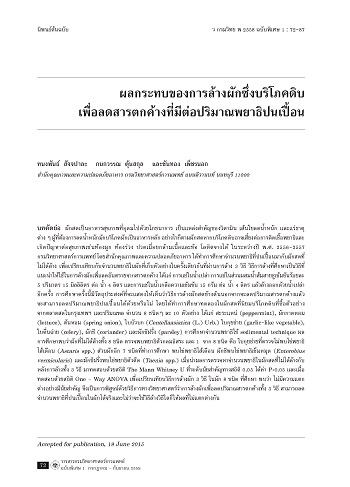
Raw vegetables are nutritious and healthy food owing to great source of vitamins, dietary fiber and minerals. However, the consumption of raw vegetable without proper washing is an important route in the transmission of parasitic diseases such as constipation, diarrhea, joint and muscle aches and pains, anemia. Therefore, during 2556-2557 B.E., Department of Medical Sciences undertook a study on the impact of washing procedures for reduction of pesticide residues in vegetables consumed raw on the numbers of contaminated parasitic worms. Eight kinds of vegetables consumed raw and 10 samples of each kind were collected to study for the changes of numbers of contaminated parasitic worms in unwashed and washed samples. The samples of peppermint, lettuce, spring onion, garlic-like vegetable Centellaasiatica (L.) Urb., celery, coriander and parsley were bought from the markets in Bangkok Metropolitan region. Among washing procedures recommended to reduce pesticide residures in raw vegetables, 3 washing procedures were selected. The selected procedures consisted of soaking for 10 minutes in water; in saline solution (15 grams NaCl in 4 liters of water) and in vinegar solution (15 milliliters of 5% vinegar in 4 liters of water) and followed by rinsing with water. Sedimentation Technique was used to determine the numbers of contaminated parasitic worms in the samples. The results showed that all kinds of unwashed vegetables studied were contaminated with free-living nematodes. One out of eight kinds of vegetables, the garlic-like vegetable, was not contaminated with Ascaris spp. egg, while the rest were contaminated. Coriander was contaminated with Enterobius vermicularis egg and parsley was contaminated with Taenia spp. egg. Mann-Whitney U test at significant level 0.05 was used to analyzed the results of study. It was found that all 3 washing procedures selected could significantly reduce the numbers of worm-type parasites contaminated in all kinds of vegetables used in this study. One-Way ANOVA test at significant level 0.05 proved that there was no significant difference in the numbers of worms after using 3 washing procedures in the same kind of vegetable. The study revealed scientific proof that the 3 washing procedures selected could reduce the numbers of worm-type parasites in raw vegetables with the same efficacy.
References
Beuchat LR. Ecological factors influencing survival and growth of human pathogens on raw fruits and vegetables. Microbes Infect 2002; 4(4): 413-23.
Slifko TR, Smith HV, Rose JB. Emerging parasite zoonoses associated with water and food. Int J Parasitol 2000; 30(12-13): 1379-93.
กรมวิชาการเกษตร. ล้างอย่างไรลดสารพิษ. จดหมายข่าวผลิใบ [ออนไลน์]. 2556; [ สืบค้น 28 พฤษภาคม 2558]; [1 หน้า ]. เข้าถึงได้จาก: URL: https://it.doa.go.th/pibai/pibai/n16/v_9-oct/borkor.html
อเนก หาลี, บุณยกฤต รัตนพันธุ์, วชิระ สิงห์คง. การศึกษาประสิทธิภาพของน้ำยาล้างผักชนิดต่างๆ สำหรับใช้ในท้องถิ่นเพื่อลดปริมาณสารปราบศัตรูพืชในผักคะน้า. วารสารวิจัย มข 2556; 18(4): 577-84.
สมสมัย ปาลกูล. การลดปริมาณสารมีพิษตกค้างใน/บนพุทรา.ข่าวสารวัตถุมีพิษ 2531; 15(4): 156-62.
ภารดี มามีชัย, ดำรงค์ เชี่ยวศิลป์. การสำรวจหนอนพยาธิติดต่อผ่านดินในผักสดในตลาดเขตเทศบาลเมือง จังหวัดนนทบุรี. สารเทคนิคการแพทย์จุฬา 2534; 5(16): 859-67.
ประยงค์ ระดมยศ, อัญชลี ตั้งตรงจิตร, วราห์ มีสมบูรณ์, ชูเกียรติ ศิริวิชยกุล, ฐิติมา วงศาโรจน์, ไพศาล อิ่มพันธ์, และคณะ. ปรสิตวิทยาหนอนพยาธิทางการแพทย์ ทฤษฎีและปฏิบัติการ. กรุงเทพฯ : โรงพิมพ์ชุมนุมสหกรณ์แห่งประเทศไทย; 2537.
Centers for Disease Control and Prevention. Parasites soil-transmitted helminthes (STHs). [online]. 2013 [cited 2015 May 18]; [1 screen]. Available from: URL: https://www.cdc.gov/parasites/sth/
World Health Organization. Guidelines for drinking-water quality volume 1: recommendations. 3rd ed. [online]. 2008 [cited 2015 June 4]; [668 screens]. Available from: URL: https://www.who.int/water_sanitation_health/dwq/gdwq3rev/en/
สำนักมาตรฐานสินค้าและระบบคุณภาพ กระทรวงเกษตรและสหกรณ์. มาตรฐานสินค้าเกษตร มกษ. 9001-2513 การปฏิบัติทางการเกษตรที่ดีของพืชอาหาร. กรุงเทพฯ : โรงพิมพ์ชุมนุมสหกรณ์การเกษตรแห่งประเทศไทย; 2556.
Codex Alimentarius Commission. CAC/RCP 53-2003. Code of hygienic practice for fresh fruits and vegetables. Geneva: FAO/WHO; 2003.
Downloads
Published
How to Cite
Issue
Section
License

This work is licensed under a Creative Commons Attribution-NonCommercial-NoDerivatives 4.0 International License.