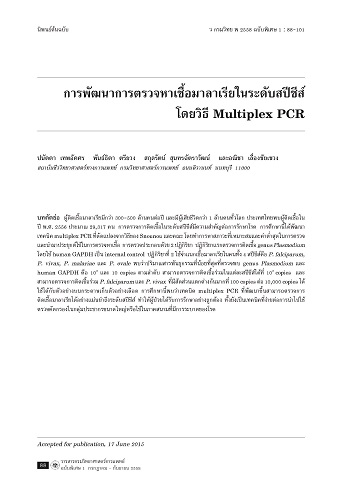
Development of multiplex PCR for Plasmodium species detection
Keywords:
multiplex PCR, Plasmodium sp., malaria detection, recombinant plasmid DNAAbstract
Malaria affects 300 to 500 million people annually worldwide and causes over 1 million deaths. In 2013, approximately 29,317 cases of malaria were reported in Thailand. Identification of the human malaria parasite species is important for early treatment of disease. In this study, multiplex PCR was developed by modification of technique described by Snounou et. al. The PCR reactions were optimized and determined for limit of detection. Then the developed method was applied for detection of parasites in sample with mix infection and eluted sample from collection card. The optimized condition had the first reaction for detection of genus Plasmodium using GAPDH as an internal control, the second reaction for identification of Plasmodium species, P. falciparum, P. vivax, P. malariae and P. ovale. The results showed the limit of detection for genus Plasmodium and human GAPDH at 103 copies and 10 copies, respectively. And the limit of detection for all four species was 103 copies per Plasmodium species. Furthermore, the multiplex PCR has shown ability to detect mixed infection of P. falciparum and P. vivax at detection threshold of 100 per 10,000 copies for the minority species of infection. In addition, this technique can be applied to blood sample on collection card. The results indicated that the developed multiplex PCR was a useful tool for species identification resulted in correct treatment. Furthermore, the method could easily be developed for mass screening and field surveillance.
References
กรมควบคุมโรค. โรคมาลาเรีย. [ออนไลน์]. 2557; [สืบค้น 4 ธ.ค. 2557]; [2 หน้า]. เข้าถึงได้จาก : URL: https://www.boe.moph.go.th/fact/Malaria.htm
Johnston SP, Pieniazek NJ, Xayavong MV, Slemenda SB, Wilkins PP, da Silva AJ. PCR as a confirmatory technique for laboratory diagnosis of malaria. J Clin Microbiol 2006; 44(3): 1087-9.
Brown AE, Kain KC, Pipithkul J, Webster HK. Demonstration by the polymerase chain reaction of mixed Plasmodium falciparum and Plasmodium vivax infections undetected by conventional microscopy. Trans R Soc Trop Med Hyg 1992; 86(6): 609-12.
Pieroni P, Millis CD, Ohrt C, Harrington MA, Kain KC. Comparison of the Parasite-F test and the ICT malaria Pf test with the polymerase chain reaction for the diagnosis of Plasmodium falciparum malaria in travellers. Trans R Soc Trop Med Hyg 1998; 92(2): 166-9.
Tham JM, Lee SH, Tan TMC, Ting RCY, Kara UAK. Detection and species determination of malaria parasites by PCR: comparison with microscopy and with Parasite-F and ICT malaria Pf test in clinical environment. J Clin Microbiol 1999; 37(5): 1269-73.
Weiss JB. DNA probes and PCR for diagnosis of parasitic infections. Clin Microbiol Rev 1995; 8: 113-30.
Isozumi R, Fukui M, Kaneko A, Chan CW, Kawamoto F, Kimura M. Improved detection of malaria cases in island settings of Vanuatu and Kenya by PCR that targets the Plasmodium mitochondrial cytochrome c oxidase III (cox3) gene. Parasitol Int 2015; 64(3): 304-8.
Blood parasites. In: World Health Organization. Basic laboratory methods in medical parasitology. Geneva: WHO; 1997. p.81.
Snounou G, Viriyakosol S, Zhu XP, Jarra W, Pinheiro L, do Rosario VE, et al. High sensitivity of detection of human malaria parasites by the use of nested polymerase chain reaction. Mol Biochem Parasitol 1993; 61(2): 315-20.
Lee PC, Chong ETJ, Anderios F, Lim YAL, Chew CH, Chua KH. Molecular detection of human Plasmodium species in Sabah using PlasmoNexTM multiplex PCR and hydrolysis probes real-time PCR. Malar J 2015; 14: 28-34.
Bialasiewicz S, Whiley DM, Nissen MD, Sloots TP. Impact of competitive inhibition and sequence variation upon the sensitivity of malaria PCR. J Clin Microbiol 2007; 45(5): 1621-3.
Mixson-Hayden T, Lucchi NW, Udhayakumar V. Evaluation of three PCR-based diagnostic assays for detecting mixed Plasmodium infection. BMC Res Notes 2010; 3: 88-94.
Mens P, Spieker N, Omar S, Heijnen M, Schallig H, Kager PA. Is molecular biology the best alternative for diagnosis of malaria to microscopy? A comparison between microscopy, antigen detection and molecular tests in rural Kenya and urban Tanzania. Trop Med Int Health 2007; 12(2): 238-44.
Gal S, Fidler C, Truner S, Lo YM, Roberts DJ, Wainscoat JS. Detection of Plasmodium falciparum DNA in plasma. Ann N Y Acad Sci 2001; 945: 234-8.
Roper C, Elhassan IM, Hviid L, Giha H, Richardson W, Babiker H, et al. Detection of very low level of Plasmodium falciparum infections using the nested polymerase chain reaction and a reassessment of the epidemiology of unstable malaria in Sudan. Am J Trop Med Hyg 1996; 54(4): 325-31.
Kimura M, Miyake H, Kim HS, Tanabe M, Arai M, Kawai S, et al. Species-specific PCR detection of malaria parasites by microtiter plate hybridization: clinical study with malaria patients. J Clin Microbiol 1995; 33(9): 2342-6.
Kho WG, Chung JY, Sim EJ, Kim MY, Kim DW, Jongwutiwes S, et al. A multiplex polymerase chain reaction for a differential diagnosis of Plasmodium falciparum and Plasmodium vivax. Parasitol Int 2003; 52(3): 229-36.
Padley D, Moody AH, Chiodini PL, Saldanha J. Use of a rapid, single-round, multiplex PCR to detect malarial parasites and identify the species present. Ann Trop Med Parasitol 2003; 97(2): 131-7.
Chew CH, Lim YAL, Lee PC, Mahmud R, Chua KH. Hexaplex PCR detection system for identification of five human Plasmodium species with an internal control. J Clin Microbiol 2012; 50(12): 4012-9.
Downloads
Published
How to Cite
Issue
Section
License

This work is licensed under a Creative Commons Attribution-NonCommercial-NoDerivatives 4.0 International License.