Contamination and reducing of parasite in fresh vegetables by washing
Keywords:
Contamination, parasites, fresh vegetablesAbstract
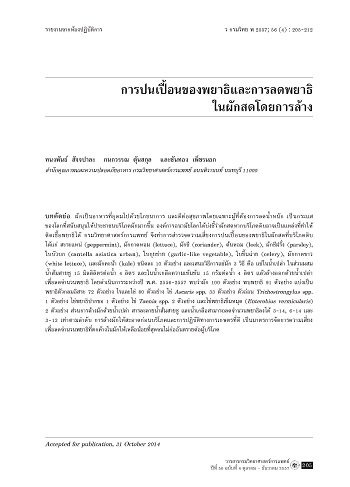
It is generally known that vegetables are nutritious and health foods, in particular, for the people who want to diet. Moreover, the people by global approach are encouraged to consume more of these produces. However, World Health Organization indicated that vegetable consumed raw may serve as vehicles for transmission of infectious parasites. Therefore, in 2556-2557 B.E., Department of Medical Sciences undertook the risk of parasitic contamination in 10 kinds and 10 samples each of fresh vegetable consumed raw which were coriander, centella asiatica urban, leek, parsley, celery, peppermint, lettuce, garlic-like vegetable, white lettuce and kale. The experiment included 3 wash-methods, soaking in water; saline solution (15 grams NaCl in 4 liters of water); vinegar solution (15 milliliters of vinegar in 4 liters of water) for 10 minutes which were compared to unwashed vegetable. The results shown that 100 fresh vegetables were parasitic contamination 91 samples. The contamination could be sorted as free-living nematodes 72 samples, mites/eggs 80 samples, Ascaris spp. eggs 33 samples, larva of Trichostrongylus spp. 1 sample, hook worm eggs 4 samples, Taenia spp. eggs 2 samples, and Enterobius vermiculaaris eggs 2 samples. The three wash-methods soaking in water, vinegar solution and saline solution could reduce the parasite numbers 3-14, 6-14 and 3-13 times when compared to unwashed vegetable respectively. Risk management to this matter would be The Good Agricultural Practices at growing areas and washing vegetable thoroughly before consuming which would leave too few parasites to cause illness.
References
Food Safety Unit, World Health Organization. Surface decontamination of fruits and vegetables eaten raw: a review. Geneva: World Health Organization; 1998.
World Health organization. Chapter 5: Infectious diseases of potential risk for travellers. [online]. 2009; [cited 2014 Apr 30]; [4 screens]. Available from: URL: http://www.who.int/ith/ITH2009Chapter5.pdf?ua=1
กลุ่มพัฒนาการมีส่วนร่วมเครือข่าย กองสนับสนุนสุขภาพภาคประชาชน. การถ่ายทอดชุดความรู้ด้านการคุ้มครองผู้บริโภคด้านผลิตภัณฑ์และบริการสุขภาพ : กินให้เป็นเน้นผักผลไม้. นนทบุรี : กรมสนับสนุนบริการสุขภาพ กระทรวงสาธารณสุข; 2554.
ภารดี มามีชัย, ดำรงค์ เชี่ยวศิลป์. การสำรวจหนอนพยาธิติดต่อผ่านดินในผักสดในตลาด เขตเทศบาลเมืองจังหวัดนนทบุรี. สารเทคนิคการแพทย์จุฬา 2534; 5(16): 859-67.
Radomyos P, Sirivichayakul C, Waikagul J, Krudsood S, Takeuchi T, Kojima S, et al. Atlas of medical parasitology: with 434 colour illustrations. Bangkok: Faculty of Tropical Medicine, Mahidol University; 2004.
Center for Decease Control and Prevention. Parasites-Soil-transmitted Helminths (STHs). [online]. 2013; [cited 2014 Jul 8]; [1 screen]. Available from: URL: http://www.cdc.gov/parasites/sth/
Decoded science. Parasitic protozoa on fruits and vegetables. [online]. 2014; [cited 2014 Jul 7]; [4 screens]. Available from: URL: http://www.decodedscience.com/parasitic-protozoa-on-fruits-andvegetables/27502
สำนักงานมาตรฐานสินค้าเกษตรและอาหารแห่งชาติ กระทรวงเกษตรและสหกรณ์. มาตรฐานสินค้าเกษตร มกษ. 9001-2556 การปฏิบัติทางการเกษตรที่ดีสำหรับพืชอาหาร. กรุงเทพฯ : โรงพิมพ์ชุมนุมสหกรณ์การเกษตรแห่งประเทศไทย; 2556.
Codex Alimentarius Commission. Code of hygienic practice for fresh fruits and vegetables, CAC/RCP 53-2003. Rome/Geneva: FAO/WHO; 2013.
Driessen S. Food Safety, Handling fresh fruits and vegetables safely. University of Minnesota Extension [online]. 2013; [cited 2014 Oct 7]; [3 screens]. Available from: URL: http://www.extension.umn.edu/food/food-safety/preserving/fruits/handling-fresh-fruits-and-vegetables-safely/
Downloads
Published
How to Cite
Issue
Section
License

This work is licensed under a Creative Commons Attribution-NonCommercial-NoDerivatives 4.0 International License.