Validation of Polymerase Chain Reaction Method for the Detection of Legionella pneumophila
Keywords:
Polymerase chain reaction, Legionella pneumophila, Legionaires’ disease, mip gene, Water sourcesAbstract
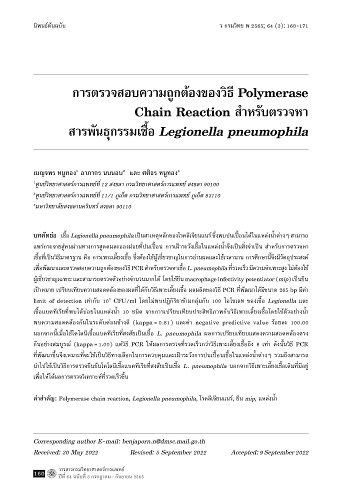
Legionella pneumophila, the main cause of Legionnaires’ disease, is found in various water sources. The bacterium is spread to humans through the inhalation of contaminated aerosols. Surveillance of pathogens in water sources is therefore essential. The standard method for the detection
of L. pneumophila is culture. This requires an expert to read the results, and it takes a long time. This study aimed to develop and validate a PCR method for rapid detection of L. pneumophila with high specificity but without the requirement for specialists. Many samples were tested using the macrophage infectivity potentiator (mip) gene as the target, and the results were compared with the culture method to measure consistency. The PCR product of the developed PCR method was 265 bp, with a limit of detection equal to 102 CFU/mL, without cross-reactivity with 100 isolates of Legionella and 10 common waterborne bacteria. Comparing the effectiveness with culture using water samples, the results showed a well-correlated agreement (kappa = 0.81) and a negative predictive value of 100%. In addition, when bacterial colonies suspected of being L. pneumophila were used, the comparison results indicated a perfect agreement (kappa = 1.00). However, the PCR method provided the results eight times faster than the culture method. Thus, the developed PCR method is suitable as an alternative method for the surveillance and the control of L. pneumophila contamination in water resources. It can also be used as a method for the confirmation of suspected L. pneumophila bacterial colonies in addition to the existing culture method for faster analysis results.
References
Brenner DJ, Steigerwalt AG, McDade JE. Classification of the Legionnaires’disease bacterium: Legionella pneumophila, genus novum, species nova, of the family Legionellaceae, familia nova. Ann Intern Med 1979; 90(4): 656-8.
Heuner K, Swanson M. Legionella: molecular microbiology. Norfolk, UK: Caister Academic Press; 2008.
Yu VL, Plouffe JF, Pastoris MC, Stout JE, Schousboe M, Widmer A, et al. Distribution of Legionella species and serogroups isolated by culture in patients with sporadic community acquired legionellosis: an international collaborative survey. J Infect Dis 2002; 186: 127-8.
โรม บัวทอง, รุ่งนภา ประสานทอง, วิวัตน์ ศีตมโนชน์, ทวีศักดิ์ เนตรวงศ์, ธาริยาเสาวรัญ, ขจรเดช จันทะยานี และคณะ. การระบาดของโรคลีเจียนแนร์ในนักท่องเที่ยวชาวยุโรป ภายหลังจากการเดินทางมาท่องเที่ยวในจังหวัดภูเก็ต ธันวาคม 2549 - มกราคม 2550: บทบาทของการสอบสวนสิ่งแวดล้อมในประเทศที่เกิดเหตุ. รายงานการเฝ้าระวังทางระบาดวิทยาประจำสัปดาห์ 2556; 44: S38-46.
World Health Organization (WHO). Legionella and the prevention of legionellosis. Geneva: WHO; 2007.
Centers for Diseases Control and Prevention. Legionella (Legionnaires’ disease and pontiac fever). [online]. 2021; [cited 2022 Jan 27];[1 screen]. Available from: URL: http://www.cdc.gov/legionella/index.html.
Fields BS, Benson RF, Besser RE. Legionella and Legionnaires’ disease: 25 years of investigation. Clin Microbiol Rev 2002; 15(3): 506-26.
Correia AM, Ferreira JS, Borges V, Nunes A, Gomes B, Capucho R, et al. Probable person-to-person transmission of Legionnaires’ disease. N Engl J Med 2016; 374(5): 497-8.
ไพรัช ศรีไสว, สงคราม ทรัพย์เจริญ, เบญจะ เพชรคล้าย, วิบูลย์ศรี พิมลพันธุ์, อรุณรัตน์ ร่มพฤกษ์. ลีจิโอเนลโลสิส รายงานผู้ป่วยรายแรกในประเทศไทย. สารศิริราช 2527; 36: 269-77.
Tishyadhigama P, Dejsieilert S, Srisawai P. Environmental surveillance of Legionella pneumophila in Thailand. J Med Assoc Thai 1995; 78: 57-71.
Dooling KL, Toews KA, Hicks LA, Garrison LE, Bachaus B, Zansky S, et al. Active bacterial core surveillance for Legionellosis United States, 2011–2013. MMWR 2015; 64(42): 1190-3.
Chen DJ, Procop GW, Vogel S, Yen-Lieberman B, Richter SS. Utility of PCR, culture, and antigen detection methods for diagnosis of legionellosis. J Clin Microbiol 2015; 53(11): 3474-7.
Yuan Y, Zheng G, Lin M, Mustapha A. Detection of viable Escherichia coli in environmental water using combined propidium monoazide staining and quantitative PCR. Water Res 2018; 145: 398-407.
Hsu WB, Wang JH, Chen PC, Lu YS, Chen JH. Detecting low concentrations of Shigella sonnei in environmental water samples by PCR. FEMS Microbiol Lett 2007; 270(2): 291-8.
Lee SH, Lee C, Lee KW, Cho HB, Kim SJ. The simultaneous detection of both enteroviruses and adenoviruses in environmental water samples including tap water with an integrated cell culture-multiplex-nested PCR procedure. J Appl Microbiol 2005; 98(5): 1020-9.
Wagner C, Khan AS, Kamphausen T, Schmausser B, Unal C, Lorenz U, et al. Collagen binding protein Mip enables Legionella pneumophila to transmigrate through a barrier of NCI-H292 lung epithelial cells and extracellular matrix. Cell Microbiol 2007; 9(2): 450-62.
Collins S, Jorgensen F, Willis C, Walker J. Real-time PCR to supplement gold-standard culture-based detection of Legionella in environmental samples. J Appl Microbiol 2015; 119(4): 1158-69.
Gruas C, Llambi S, Arruga MV. Detection of Legionella spp. and Legionella pneumophila in water samples of Spain by specific real-time PCR. Arch Microbiol 2014; 196: 63-71.
Centers for Diseases Control and Prevention (CDC). Procedures for the recovery of Legionella from the environment. Atlanta, GA: CDC; 2005.
Luo R, Li Y, Lin X, Dong F, Zhang W, Yan L, et al. A colorimetric assay method for invA gene of Salmonella using DNAzyme probe self-assembled gold nanoparticles as single tag. Sens Actuator B-Chem 2014; 198: 87-93.
Fischer G, Bang H, Ludwig B, Mann K, Hacker J. Mip protein of Legionella pneumophila exhibits peptidyl-prolyl-cis/trans isomerase (PPlase) activity. Mol Microbiol 1992; 6(10): 1375-83.
Fiume L, Sabattini BMA, Poda G. Detection of Legionella pneumophila in water samples by species-specific real-time and nested PCR assays. Lett Appl Microbiol 2005; 41(6): 470-5.
Templeton KE, Scheltinga SA, Sillekens P, Crielaard JW, van Dam AP, Goossens H, et al. Development and clinical evaluation of an internally controlled, single-tube multiplex real-time PCR assay for detection of Legionella pneumophila and other Legionella species. J Clin Microbiol 2003; 41(9): 4016-21.
Benitez AJ, Winchell JM. Clinical application of a multiplex real-time PCR assay for simultaneous detection of Legionella species, Legionella pneumophila, and Legionella pneumophila serogroup 1. J Clin Microbiol 2013; 51(1): 348-51.
Wilson DA, Yen-Lieberman B, Reischl U, Gordon SM, Procop GW. Detection of Legionella pneumophila by real-time PCR for the mip gene. J Clin Microbiol 2003; 41(7): 3327-30.
Yang G, Benson R, Pelish T, Brown E, Winchell JM, Fields B. Dual detection of Legionella pneumophila and Legionella species by realtime PCR targeting the 23S-5S rRNA gene spacer region. Clin Microbiol Infect 2010; 16(3): 255-61.
Dusserre E, Ginevra C, Hallier-Soulier S, Vandenesch F, Festoc G, Etienne J, et al. A PCR-based method for monitoring Legionella pneumophila in water samples detects viable but noncultivable legionellae that can recover their cultivability. Appl Environ Microbiol 2008; 74(15): 4817-24.
Downloads
Published
How to Cite
Issue
Section
License
Copyright (c) 2022 BULLETIN OF THE DEPARTMENT OF MEDICAL SCIENCES

This work is licensed under a Creative Commons Attribution-NonCommercial-NoDerivatives 4.0 International License.