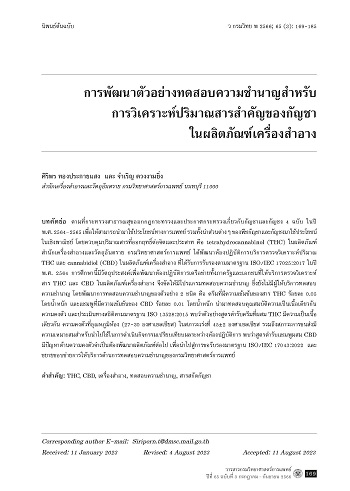
Proficiency Testing Sample Development for Active Ingredients Determination of Cannabis in Cosmetic Products
Proficiency Testing for Cannabis in Cosmetic Products
Keywords:
THC, CBD, Cosmetic, Proficiency testing, Cannabis extractAbstract
During 2021–2022, the Ministry of Public Health issued four ministerial regulations related to cannabis (marijuana) and hemp (kanchong) for medical and commercial uses of parts of such plants, while regulating the amounts of psychotropic substances, i.e. tetrahydrocannabinol (THC) and cannabidiol (CBD). The Bureau of Cosmetics and Hazardous Substances (BCHS) within the Department of Medical Sciences, recognizing the need to enhance THC and CBD testing capabilities in cosmetic products at its laboratories, aimed to provide services using ISO/IEC 17025:2017 accredited test methods of 2021. Furthermore, they sought to establish a network of THC and CBD testing laboratories for cosmetic products in both government and private sectors. The proficiency testing program was introduced to assess the competence of these laboratories. Currently, there is no THC and CBD proficiency testing program available domestically or internationally for cosmetic products. To address this, two cosmetic proficiency testing samples were developed: a cream formula with a THC concentration of 0.05% w/w and a shampoo with a CBD concentration of 0.01% w/w. These samples underwent testing and were statistically evaluated for homogeneity and stability according to ISO 13528:2015. The results indicated that the THC in the cream samples exhibited satisfactory homogeneity and stability under three experimental conditions: room temperature (27−30 °C), accelerated temperature (45±2 °C), and transportation conditions. However, the CBD in the shampoo samples did not meet the requirements for homogeneity and stability. Thus, further product improvement is needed to fulfill a requirement for ISO/IEC 17043:2022 certification and expanding the scope of proficiency testing services of the Department of Medical Sciences.
References
พระราชบัญญัติเครื่องสำอาง พ.ศ. 2558. ราชกิจจานุเบกษา เล่ม 132 ตอนที่ 86 ก (วันที่ 8 กันยายน 2558)หน้า 5.
Fortune Business Insides. Market research report: cosmetics market. [online]. 2021; [cited 2022 Nov 20]; Available from: URL: https://www.fortunebusinessinsights.com/cosmeticsmarket-102614.
Atakan Z. Cannabis, a complex plant: different compounds and different effects on individuals. Ther Adv Psychopharmacol 2012; 2(6): 241-54.
กระทรวงสาธารณสุข. ประกาศกระทรวงสาธารณสุข เรื่อง ระบุชื่อยาเสพติดให้โทษในประเภท 5 พ.ศ. 2565. ราชกิจจานุเบกษา เล่ม 139 ตอนพิเศษ 35 ง (วันที่ 9 กุมภาพันธ์ 2565). หน้า 8.
ประกาศกระทรวงสาธารณสุข เรื่อง สมุนไพรควบคุม (กัญชา) พ.ศ. 2565. ราชกิจจานุเบกษา เล่ม 139 ตอนพิเศษ 137 ง (วันที่ 16 มิถุนายน 2565). หน้า 9.
ประกาศกระทรวงสาธารณสุข เรื่อง การใช้ส่วนของกัญชาในเครื่องสำอาง พ.ศ. 2564. ราชกิจจานุเบกษา เล่ม 138 ตอนพิเศษ 105 ง (วันที่ 17 พฤษภาคม 2564). หน้า 1.
ประกาศกระทรวงสาธารณสุข เรื่อง การใช้สารสกัดที่มีสารแคนนาบิไดออลจากกัญชาและกัญชงในเครื่องสำอาง พ.ศ. 2564. ราชกิจจานุเบกษา เล่ม 138 ตอนพิเศษ 105 ง (วันที่ 17 พฤษภาคม 2564). หน้า 4.
ISO/IEC 17025:2017. General requirements for the competence of testing and calibration laboratories. 3rd ed. Geneva, Switzerland: International Organization for Standardization; 2017.
ISO/IEC 17043:2010. Conformity assessment — general requirements for profi ciency testing. Geneva, Switzerland: International Organization for Standardization; 2010.
ISO 13528:2015. Statistical methods for use in proficiency testing by interlaboratory comparison. 2nd ed. Geneva, Switzerland: International Organization for Standardization; 2015.
สำนักเครื่องสำอางและวัตถุอันตราย. SOP 06-02-396: การตรวจวิเคราะห์สาร Δ9-tetrahydrocannabinol และ Cannabidiol โดยวิธี UPLC แก้ไขครั้งที่ 1, 18 พฤษภาคม 2566. นนทบุรี: กรมวิทยาศาสตร์การแพทย์ กระทรวงสาธารณสุข: 2566.
Horwitz W. Evaluation of analytical methods used for regulation of foods and drugs. Anal Chem 1982; 54(1): 67-76.
Cosmetics Europe. Guidelines on stability testing of cosmetic products. [online]. 2004; [cited 2022 Nov 1]; [10 screens]. Available from: URL: https://www.cosmeticseurope.eu/files/5914/6407/8121/Guidelines_on_Stability_Testing_of_Cosmetics_CE-CTFA_-_2004.pdf.
Wang M, Wang YH, Avula B, Radwan MM, Wanas AS, van Antwerp J, et al. Decarboxylation study of acidic cannabinoids: a novel approach using ultra-high-performance supercritical fluid chromatography/photodiode array-mass spectrometry. Cannabis Cannabinoid Res. [serial online] 2016; [cited 2022 Dec 29]; 1(1): [10 screens]. Available from: URL: https://www.ncbi.nlm.nih.gov/pmc/articles/PMC5549281/pdf/can.2016.0020.pdf.
Fućak T, Kreft S, Svedružić ŽM, Tavčar E. Mechanism and kinetics of CBDA decarboxylation into CBD in hemp. J Plant Biochem Biotechnol 2023; 32(3): 608-21.
Merrick J, Lane B, Sebree T, Yaksh T, O'Neill C, Banks SL. Identification of psychoactive degradants of cannabidiol in simulated gastric and physiological fluid. Cannabis Cannabinoid Res. [serial online] 2016; [cited 2022 Dec 29]; 1(1): [11 screens]. Available from: URL: https://www.ncbi.nlm.nih.gov/pmc/articles/PMC5576596/pdf/can.2015.0004.pdf.
Caprioglio D, Mattoteia D, Pollastro F, Negri R, Lopatriello A, Chianese G, et al. The oxidation of phytocannabinoids to cannabinoquinoids. J Nat Prod. [serial online] 2020; [cited 2022 Dec 29] 83(5): [5 screens]. Available from: URL: https://pubs.acs.org/doi/epdf/10.1021/acs.jnatprod.9b01284.
Downloads
Published
How to Cite
Issue
Section
License
Copyright (c) 2023 BULLETIN OF THE DEPARTMENT OF MEDICAL SCIENCES

This work is licensed under a Creative Commons Attribution-NonCommercial-NoDerivatives 4.0 International License.