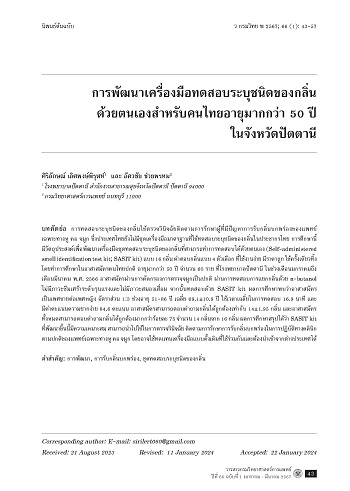
Development of Self-Administered Smell Identification Test kit for Thai People Aged over 50 Years in Pattani Province
Development of SASIT Kit for Thai People Aged over 50 Years in Pattani Province
Keywords:
Development, Olfaction disorder, Self-administered smell identification test kitAbstract
Smell identification testing is employed for diagnostic and treatment monitoring purposes by otolaryngologists in cases of olfactory dysfunction. However, Thailand has no standardized toolkit available for smell identification testing within the Thai population. Therefore, this study aimed to develop a self-administered smell identification test kit (SASIT kit) comprising 16 odors with a 4-choice response format. The SASIT kit was designed to be user- friendly, cost-effective, and disposable. The study was conducted with 60 normal Thai volunteers aged over 50 years at the Pattani Hospital from January to March 2023. Participants underwent a check for normal nasal conditions and passed the n-butanol smell test. Besides, they were initially screened to be free from severe depressive symptoms and cognitive impairment. Following these evaluations, participants were subjected to the SASIT kit. The results showed that male participants outnumbered female participants at a ratio of 1:3, with an age range of 51 to 86 years and an average age of 69.1±10.9 years. The average test duration was 16.9 minutes, with a difficulty level of approximately 84.6 points. The participants accurately responded to olfactory questions, with a mean SASIT score of 14±1.95. Moreover, most of the participants exhibited a correct olfactory response rate exceeding 75% for 14 out of the 16 smells. In conclusion, the developed SASIT kit is suitable for diagnosing and monitoring olfactory dysfunction within the clinical practices of otolaryngologists. This tool might be used to replace previously imported.
References
Desiato VM, Levy DA, Byun YJ, Nguyen SA, Soler ZM, Schlosser RJ. The prevalence of olfactory dysfunction in the general population: a systematic review and meta-analysis. Am J Rhinol Allergy 2021; 35(2): 195-205.
Ross GW, Petrovitch H, Abbott RD, Tanner CM, Popper J, Masaki K, et al. Association of olfactory dysfunction with risk for future Parkinson's disease. Ann Neurol 2008; 63(2): 167-73.
Doty RL. Olfaction in Parkinson's disease and related disorders. Neurobiol Dis 2012; 46(3): 527-52.
Postuma RB, Berg D, Stern M, Poewe W, Olanow CW, Oertel W, et al. MDS clinical diagnostic criteria for Parkinson's disease. Mov Disord 2015; 30(12): 1591-601.
Tabert MH, Liu X, Doty RL, Serby M, Zamora D, Pelton GH, et al. A 10-item smell identification scale related to risk for Alzheimer's disease. Ann Neurol 2005; 58(1): 155-60.
Serby M, Larson P, Kalkstein D. The nature and course of olfactory deficits in Alzheimer's disease. Am J Psychiatry 1991; 148(3): 357-60.
Lange R, Donathan CL, Hughes LF. Assessing olfactory abilities with the University of Pennsylvania smell identification test: a rasch scaling approach. J Alzheimers Dis 2002; 4(2): 77-91.
Duff K, McCaffrey RJ, Solomon GS. The Pocket Smell Test: successfully discriminating probable Alzheimer's dementia from vascular dementia and major depression. J Neuropsychiatry Clin Neurosci 2002; 14(2): 197-201.
Haehner A, Boesveldt S, Berendse HW, Mackay-Sim A, Fleischmann J, Silburn PA, et al. Prevalence of smell loss in Parkinson's disease--a multicenter study. Parkinsonism Relat Disord 2009; 15(7): 490-4.
Bylsma FW, Moberg PJ, Doty RL, Brandt J. Odor identification in Huntington's disease patients and asymptomatic gene carriers. J Neuropsychiatry Clin Neurosci 1997; 9(4): 598-600.
Hawkes CH, Shephard BC, Kobal G. Assessment of olfaction in multiple sclerosis: evidence of dysfunction by olfactory evoked response and identification tests. J Neurol Neurosurg Psychiatry 1997; 63(2): 145-51.
Keshavan MS, Vora A, Montrose D, Diwadkar VA, Sweeney J. Olfactory identification in young relatives at risk for schizophrenia. Acta Neuropsychiatr 2009; 21(3): 121-4.
Kobayashi M. The odor stick identification test for the Japanese (OSIT-J): clinical suitability for patients suffering from olfactory disturbance. Chem Senses 2005; 30(Suppl 1): i216-7
Doty RL, Shaman P, Kimmelman CP, Dann MS. University of Pennsylvania Smell Identification Test: a rapid quantitative olfactory function test for the clinic. Laryngoscope 1984; 94(2): 176-8.
Cain WS, Goodspeed RB, Gent JF, Leonard G. Evaluation of olfactory dysfunction in the Connecticut chemosensory clinical research center. Laryngoscope 1988; 98(1): 83-8.
Doty RL, Marcus A, Lee WW. Development of the 12-item Cross-Cultural Smell Identification Test (CC-SIT). Laryngoscope 1996; 106(3): 353-6.
Cho JH, Jeong YS, Lee YJ, Hong SC, Yoon JH, Kim JK. The Korean version of the Sniffin' stick (KVSS) test and its validity in comparison with the cross-cultural smell identification test (CC-SIT). Auris Nasus Larynx 2009;36(3): 280-6.
Hummel T, Sekinger B, Wolf SR, Pauli E, Kobal G. 'Sniffin' sticks': olfactory performance assessed by the combined testing of odor identification, odor discrimination and olfactory threshold. Chem Senses 1997; 22(1): 39-52.
Chaiyasate S, Roongrotwattanasiri K, Hanprasertpong N, Fooanant S. Normal smell identification score and N-butanol threshold in Thai adults. J Med Assoc Thai 2013; 96(3): 324-8.
Riyaparn K. Olfaction and influencing factors in Thai elderly. Chiangrai Medical Journal. 2019; 11(2): 100-5.
Kijjavijit T, Jagota P, Boonrod N, Kaewwilai L, Jitkritsadakul O, Bhidayasiri R. The use of Sniffin'Stick-16 smell identification test in Thai Parkinson's disease patients: a pilot study. In: Movement disorders. NJ, USA: Wiley-Blackwell; 2014. p. S48-S48.
Pinkaew B, Assanasen P, Bunnag C. Smell discrimination and identification scores in Thai adults with normosmia. Asian Biomed 2015; 9(6): 789-95.
Oleszkiewicz A, Schriever VA, Croy I, Hähner A, Hummel T. Updated Sniffin' Sticks normative data based on an extended sample of 9139 subjects. Eur Arch Otorhinolaryngol 2019; 276(3): 719-28.
Pitipakorn K. Development of Thai version of smell Identification test using 16 items of familiar odors with 4 descriptors. 50th anniversary RCOT academic conference 1/2021; May 5-7; Thailand 2021.
Ponsen MM, Stoffers D, Wolters EC, Booij J, Berendse HW. Olfactory testing combined with dopamine transporter imaging as a method to detect prodromal Parkinson’s disease. J Neurol Neurosurg Psychiatry 2010; 81(4): 396-9.
Berendse HW, Ponsen MM. Diagnosing premotor Parkinson’s disease using a two-step approach combining olfactory testing and DAT SPECT imaging. Parkinsonism Relat Disord 2009; 15(3): S26-30.
Izawa MO, Miwa H, Kajimoto Y, Kondo T. Combination of transcranial sonography, olfactory testing, and MIBG myocardial scintigraphy as a diagnostic indicator for Parkinson’s disease. Eur J Neurol 2012; 19(3): 411-6.
Calderón-Garcidueñas L, Franco-Lira M, Henríquez-Roldán C, Osnaya N, González- Maciel A, Reynoso-Robles R, et al. Olfactory dysfunction, olfactory bulb pathology and urban air pollution. Exp Toxicol Pathol 2010; 62(1): 91-102.
Kondo K, Kikuta S, Ueha R, Suzukawa K, Yamasoba T. Age-related olfactory dysfunction: epidemiology, pathophysiology, and clinical management. Front Aging Neurosci 2020; 12: 208. (16 pages).
Olofsson JK, Ekström I, Larsson M, Nordin S. Olfaction and aging: a review of the current state of research and future directions. Iperception 2021; 12(3): 1-24.
Downloads
Published
How to Cite
Issue
Section
License
Copyright (c) 2024 BULLETIN OF THE DEPARTMENT OF MEDICAL SCIENCES

This work is licensed under a Creative Commons Attribution-NonCommercial-NoDerivatives 4.0 International License.