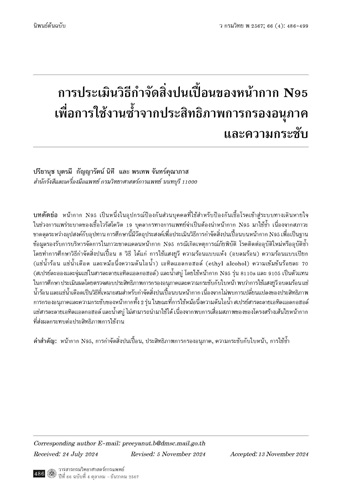
Assessment of N95 Mask Decontamination Methods for Reuse based on Filtration Efficiency and Fit Check
N95 Mask Decontamination Methods for Reuse
Keywords:
N95 mask, Decontamination, Filtration efficiency, Fit check, ReuseAbstract
Face masks, particularly N95, are the most important personal protective equipment (PPE) that can reduce the risk of airborne particles containing hazardous pathogens. During the COVID-19 outbreak, healthcare personnel was forced to reuse N95 masks because of a huge gap between demand and supply. Therefore, decontamination techniques for reusing N95 masks were investigated, providing useful databases in cases of catastrophic event, emerging or re-emerging infectious diseases occurrence. The decontamination methods including UV irradiation, dry heat (hot air oven), wet heat (hot water, boiling water, and autoclave), as well as 70% ethyl alcohol (sprayed and immersed with ethyl alcohol) and soap water, were examined on the 8110s and 9105 N95 mask models. The changes in filtration efficiency and fit check of the masks before and after decontamination steps were evaluated and discussed. The results revealed that UV irradiation, hot air oven, hot water and boiling water were the most promising approaches to decontaminate the N95 masks because there were no obvious changes in filtration efficiency or in the fit checks of both N95 mask models. While autoclaves, praying and immersing with ethyl alcohol, and soap water caused a significant reduction in the performance usability of N95 masks due to the deteriorative effects on the nanofiber structure.
References
Simpson JP, Wong DN, Verco L, Carter R, Dzidowski M, Chan PY. Measurement of airborne particle exposure during simulated tracheal intubation using various proposed aerosol containment devices during the COVID-19 pandemic. Anaesthesia 2020; 75(12): 1587-95.
Wang D, Sun BC, Wang JX, Zhou YY, Chen ZW, Fang Y, et al. Can masks be reused after hot water decontamination during the COVID-19 pandemic?. Engineering 2020; 6(10): 1115-21.
วิไลลักษณ์ เรืองรัตนตรัย, ปุณณิภา คงสืบ, เชาวรินทร์ คำหา, ศุภกิจ ศิริลักษณ์. การบริหารจัดการอุปกรณ์ป้องกันส่วนบุคคล (PPE) และหน้ากาก N95 สำหรับโรคติดเชื้อไวรัสโคโรนา 2019 (COVID-19) กรณีศึกษาในโรงพยาบาลศูนย์ 5 แห่ง. ว วิชาการสาธารณสุข 2564; 30(1): 137-50.
โรงพยาบาลเวชศาสตร์เขตร้อน คณะเวชศาสตร์เขตร้อน มหาวทิยาลัยมมหิดล. หน้ากากอนามัยชนิดต่างๆ. [ออนไลน์]. 2565; [สืบค้น 20 ก.ค. 2567]; [1 หน้า]. เข้าถึงได้ที่: URL: https://www.tropmedhospital.com/knowledge/mask.html.
สำนักงานสาธารณสุขจังหวัดลำพูน. ทำเนียบผู้ผลิต/จำหน่ายหน้ากาก N95 ในประเทศไทย. [ออนไลน์]. 2563; [สืบค้น 20 ก.ค. 2567]; [3 หน้า]. เข้าถึงได้ที่: URL: https://lamphunhealth.moph.go.th/web_ssj/webmanager/uploads/2020-03-02163706ppt.ทำเนียบผู้ผลิตN95.pdf.
พานิช อินต๊ะ. ประสิทธิภาพการกรองของหน้ากากอนามัย หน้ากากผ้า และหน้ากาก N95/KN95/FFP1/FFP2 ที่มีใช้ในช่วงที่โควิด 19 ระบาดในประเทศไทย. ว วิทยาศาสตร์และเทคโนโลยี 2564; 29(5): 904-18.
มณีรัตน์ องค์วรรณดี, พงศธร ชมดี. การประเมินประสิทธิภาพของวัสดุทำหน้ากากสำหรับกรองฝุ่นละอองขนาดไม่เกิน 2.5 ไมครอน. ว สิ่งแวดล้อม 2563; 24(3): 1–11.
Kobayashi LM, Marins BR, dos Santos Costa PC, Perazzo H, Castro R. Extended use or reuse of N95 respirators during COVID-19 pandemic: an overview of national regulatory authority recommendations. Infect Control Hosp Epidemiol 2020; 41(11): 1364-66.
Steinberg BE, Aoyama K, McVey M, Levin D, Siddiqui A, Munshey F, et al. Efficacy and safety of decontamination for N95 respirator reuse: a systematic literature search and narrative synthesis. Can J Anaesth 2020; 67(12): 1814-23.
Peters A, Palomo R, Ney H, Lotfinejad N, Zingg W, Parneix P, et al. The COVID-19 pandemic and N95 masks: reusability and decontamination methods. Antimicrob Resist Infect Control 2021; 10(1): 83. (16 pages).
Liao L, Xiao W, Zhao M, Yu X, Wang H, Wang Q, Chu S, et al. Can N95 respirators be reused after disinfection? How many times?. ACS Nano 2020; 14(5): 6348-56.
Park JJ, Seo YB, Lee J. Fit test for N95 filtering facepiece respirators and KF94 masks for healthcare workers: a prospective single center simulation study. J Korean Med Sci 2021; 36(21): e140. (11 pages).
Zorko DJ, Gertsman S, O'Hearn K, Timmerman N, Ambu-Ali N, Dinh T, et al. Decontamination interventions for the reuse of surgical mask personal protective equipment: a systematic review. J Hosp Infect 2020; 106(2): 283-94.
Probst LF, Guerrero ATG, Cardoso AIQ, Grande AJ, Croda MG, Venturini J, et al. Mask decontamination methods (model N95) for respiratory protection: a rapid review. Syst Rev 2021; 10(1): 219. (11 pages).
Faridi-Majidi R, Norouz F, Boroumand S, Nasrollah Tabatabaei S, Faridi-Majidi R. Decontamination assessment of nanofiberbased N95 masks. Environ Sci Pollut Res Int 2022; 29(53): 80411-21.
National Institute of Occupational Safety and Health (NIOSH). 42 CFR Part 84 respiratory protective devices. [online]. 1997; [cited 2024 Jul 20]; [2 screens]. Available from: URL: https://archive.cdc.gov/www_cdc_gov/niosh/npptl/topics/respirators/pt84abs2.html.
Occupational Safety and Health Administration. 29 CFR Part 1910.134 respiratory protection. [online]. 2016; [cited 2024 Jul 20]; [32screens]. Available from: URL: https://www.osha.gov/laws-regs/regulations/standardnumber/1910/1910.134.
Ontiveros CC, Sweeney CL, Smith C, MacIsaac S, Bennett JL, Munoz S, et al. Assessing the impact of multiple ultraviolet disinfection cycles on N95 filtering facepiece respirator integrity. Sci Rep 2021; 11(1): 12279. (9 pages).
Xiang Y, Song Q, Gu W. Decontamination of surgical face masks and N95 respirators by dry heat pasteurization for one hour at 70°C. Am J Infect Control 2020; 48(8): 880-2.
Mackenzie D. Reuse of N95 masks. Engineering 2020; 6(6): 593-6.
Juang PS, Tsai P. N95 respirator cleaning and reuse methods proposed by the inventor of the N95 mask material. J Emerg Med 2020; 58(5): 817-20.
Bopp NE, Bouyer DH, Gibbs CM, Nichols JE, Ntiforo CA, Grimaldo MA. Multicycle autoclave decontamination of N95 filtering facepiece respirators. Appl Biosaf 2020; 25(3): 150-6.
Fischer RJ, Morris DH, van Doremalen N, Sarchette S, Matson MJ, Bushmaker T, et al. Effectiveness of N95 respirator decontamination and reuse against SARS-CoV-2 virus. Emerg Infect Dis 2020; 26(9): 2253-5.
Lin TH, Chen CC, Huang SH, Kuo CW, Lai CY, Lin WY. Filter quality of electret masks in filtering 14.6–594 nm aerosol particles: Effects of five decontamination methods. PloS One 2017; 12(10): e0186217. (15 pages).
Rodriguez-Martinez CE, Sossa-Briceño MP, Cortés JA. Decontamination and reuse of N95 filtering facemask respirators: a systematic review of the literature. Am J Infect Control 2020; 48(12): 1520-32.
สำนักงานมาตรฐานผลิตภัณฑ์อุตสาหกรรม. มอก. 2480-2562 หน้ากากใช้ครั้งเดียวชนิด N95 ลดความเสี่ยงการติดเชื้อทางการแพทย์. กรุงเทพฯ: กองส่งเสริมและพัฒนาด้านการมาตรฐาน สำนักงานมาตรฐานผลิตภัณฑ์อุตสาหกรรม; 2562.
Centers for Disease Control and Prevention. Decontamination and reuse of filtering facepiece respirators. [online]. 2020; [cited 2024 Jul 20]; [12 screens]. Available from: URL: https://stacks.cdc.gov/view/cdc/90574.
American Cancer Society. UV (Ultraviolet) radiation and cancer risk. [online]. 2019; [cited 2024 Jun 26]; [9 screens]. Available from: URL: https://www.cancer.org/cancer/riskprevention/sun-and-uv/uv-radiation.html.
Rutala WA, Weber DJ, The Healthcare Infection Control Practices Advisory Committee (HICPAC). Guideline for disinfection and sterilization in healthcare facilities, 2008. [online]. 2024; [cited 2024 Jun 26]; [163 screens]. Available from: URL: https://www.cdc.gov/infection-control/media/pdfs/Guideline-Disinfection-H.pdf.
Grinshpun SA, Yermakov M, Khodoun M. Autoclave sterilization and ethanol treatment of re-used surgical masks and N95 respirators during COVID-19: impact on their performance and integrity. J Hosp Infect 2020; 105(4): 608-14.
Li L, Zhao X, Li Z, Song K. COVID-19: performance study of microplastic inhalation risk posed by wearing masks. J Hazard Mater 2021; 411: 124955. (9 pages).
Centers for International Environmental Law. Breathing plastic: the health impacts of invisible plastics in the air. [online]. 2023; [cited 2024 Oct 28]; [11 screens]. Available from: URL: https://www.ciel.org/breathing-plasticthe-health-impacts-of-invisible-plastics-inthe-air/.
Zhao B, Rehati P, Yang Z, Cai Z, Guo C, Li, Y. The potential toxicity of microplastics on human health. Sci Total Environ 2024; 912: 1689
Downloads
Published
How to Cite
Issue
Section
License
Copyright (c) 2024 BULLETIN OF THE DEPARTMENT OF MEDICAL SCIENCES

This work is licensed under a Creative Commons Attribution-NonCommercial-NoDerivatives 4.0 International License.