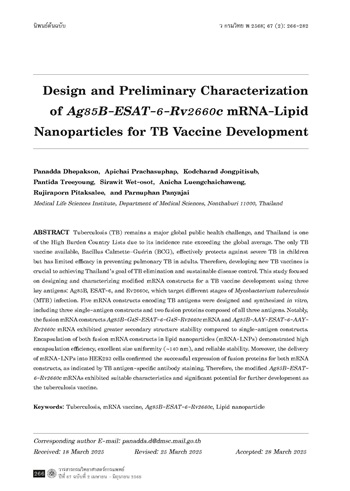
Design and Preliminary Characterization of Ag85B-ESAT-6-Rv2660c mRNA-Lipid Nanoparticles for TB Vaccine Development
Design and Characterization of Ag85B-ESAT-6-Rv2660c mRNA-LNPs
Keywords:
Tuberculosis, mRNA vaccine, Ag85B-ESAT-6-Rv2660c, Lipid nanoparticleAbstract
Tuberculosis (TB) remains a major global public health challenge, and Thailand is one of the High Burden Country Lists due to its incidence rate exceeding the global average. The only TB vaccine available, Bacillus Calmette–Guérin (BCG), effectively protects against severe TB in children but has limited efficacy in preventing pulmonary TB in adults. Therefore, developing new TB vaccines is crucial to achieving Thailand’s goal of TB elimination and sustainable disease control. This study focused on designing and characterizing modified mRNA constructs for a TB vaccine development using three key antigens: Ag85B, ESAT-6, and Rv2660c, which target different stages of Mycobacterium tuberculosis (MTB) infection. Five mRNA constructs encoding TB antigens were designed and synthesized in vitro, including three single-antigen constructs and two fusion proteins composed of all three antigens. Notably, the fusion mRNA constructs Ag85B-G4S-ESAT-6-G4S-Rv2660c mRNA and Ag85B-AAY-ESAT-6-AAY-Rv2660c mRNA exhibited greater secondary structure stability compared to single-antigen constructs. Encapsulation of both fusion mRNA constructs in lipid nanoparticles (mRNA-LNPs) demonstrated high encapsulation efficiency, excellent size uniformity (~140 nm), and reliable stability. Moreover, the delivery of mRNA-LNPs into HEK293 cells confirmed the successful expression of fusion proteins for both mRNA constructs, as indicated by TB antigen-specific antibody staining. Therefore, the modified Ag85B-ESAT-6-Rv2660c mRNAs exhibited suitable characteristics and significant potential for further development as the tuberculosis vaccine.
References
World Heatlh Organization. Global tuberculosis report 2024. Geneva: World Heatlh Organization; 2024.
Kiazyk S, Ball TB. Latent tuberculosis infection: an overview. Can Commun Dis Rep 2017; 43(3-4): 62-6.
Setiabudiawan TP, Reurink RK, Hill PC, Netea MG, van Crevel R, Koeken V. Protection against tuberculosis by Bacillus Calmette-Guérin (BCG) vaccination: a historical perspective. Med 2022; 3(1): 6-24.
กรมควบคุมโรค กระทรวงสาธารณสุข. แผนปฏิบัติการระดับชาติ ด้านการต่อต้านวัณโรค ระยะที่ 2 (พ.ศ. 2566 - 2570). นนทบุรี: กองวัณโรค กรมควบคุมโรค กระทรวงสาธารณสุข; 2566.
Liu W, Xu Y, Yan J, Shen H, Yang E, Wang H. Ag85B synergizes with ESAT-6 to induce efficient and long-term immunity of C57BL/6 mice primed with recombinant Bacille Calmette-Guerin. Exp Ther Med 2017; 13(1): 208-14.
van Dissel JT, Arend SM, Prins C, Bang P, Tingskov PN, Lingnau K, et al. Ag85B-ESAT-6 adjuvanted with IC31 promotes strong and long-lived Mycobacterium tuberculosis specific T cell responses in naïve human volunteers. Vaccine 2010; 28(20): 3571-81.
Nemes E, Geldenhuys H, Rozot V, Rutkowski KT, Ratangee F, Bilek N, et al. Prevention of M. tuberculosis infection with H4:IC31 vaccine or BCG revaccination. N Engl J Med 2018; 379(2): 138-49.
Aagaard C, Hoang T, Dietrich J, Cardona PJ, Izzo A, Dolganov G, et al. A multistage tuberculosis vaccine that confers efficient protection before and after exposure. Nat Med 2011; 17(2): 189-94.
Bekker LG, Dintwe O, Fiore-Gartland A, Middelkoop K, Hutter J, Williams A, et al. A phase 1b randomized study of the safety and immunological responses to vaccination with H4:IC31, H56:IC31, and BCG revaccination in Mycobacterium tuberculosis-uninfected adolescents in Cape Town, South Africa. EClinicalMedicine 2020; 21: 100313. (11 pages).
Jenum S, Tonby K, Rueegg CS, Rühwald M, Kristiansen MP, Bang P, et al. A Phase I/II randomized trial of H56:IC31 vaccination and adjunctive cyclooxygenase-2-inhibitor treatment in tuberculosis patients. Nat Commun 2021; 12(1): 6774. (13 pages).
Xue T, Stavropoulos E, Yang M, Ragno S, Vordermeier M, Chambers M, et al. RNA encoding the MPT83 antigen induces protective immune responses against Mycobacterium tuberculosis infection. Infect Immun 2004; 72(11): 6324-9.
Al Tbeishat H. Novel In Silico mRNA vaccine design exploiting proteins of M. tuberculosis that modulates host immune responses by inducing epigenetic modifications. Sci Rep 2022; 12(1): 4645. (19 pages).
Vostrosablin N, Lim S, Gopal P, Brazdilova K, Parajuli S, Wei X, et al. mRNAid, an open-source platform for therapeutic mRNA design and optimization strategies. NAR Genom Bioinform 2024; 6(1): lqae028. (9 pages).
McKenzie RE, Minnell JJ, Ganley M, Painter GF, Draper SL. mRNA synthesis and encapsulation in ionizable lipid nanoparticles. Curr Protoc 2023; 3(9): e898. (47 pages).
Gambaro R, Rivero Berti I, Limeres MJ, Huck-Iriart C, Svensson M, Fraude S, et al. Optimizing mRNA-loaded lipid nanoparticles as a potential tool for protein-replacement therapy. Pharmaceutics 2024; 16(6): 771. (23 pages).
Mathews DH, Sabina J, Zuker M, Turner DH. Expanded sequence dependence of thermodynamic parameters improves prediction of RNA secondary structure. J Mol Biol 1999; 288(5): 911-40.
Pochapski DJ, Carvalho Dos Santos C, Leite GW, Pulcinelli SH, Santilli CV. Zeta potential and colloidal stability predictions for inorganic nanoparticle dispersions: effects of experimental conditions and electrokinetic models on the interpretation of results. Langmuir 2021; 37(45): 13379-89.
Gergen J, Petsch B. mRNA-based vaccines and mode of action. Curr Top Microbiol Immunol 2022; 440: 1-30.
Al-Allaf FA, Tolmachov OE, Zambetti LP, Tchetchelnitski V, Mehmet H. Remarkable stability of an instability-prone lentiviral vector plasmid in Escherichia coli Stbl3. 3 Biotech 2013; 3(1): 61-70.
Chaudhary N, Weissman D, Whitehead KA. mRNA vaccines for infectious diseases: principles, delivery and clinical translation. Nat Rev Drug Discov 2021; 20(11): 817-38.
Karikó K, Muramatsu H, Welsh FA, Ludwig J, Kato H, Akira S, et al. Incorporation of pseudouridine into mRNA yields superior nonimmunogenic vector with increased translational capacity and biological stability. Mol Ther 2008; 16(11): 1833-40.
Feng X, Su Z, Cheng Y, Ma G, Zhang S. Messenger RNA chromatographic purification: advances and challenges. J Chromatogr A 2023; 1707: 464321. (14 pages).
Shi R, Liu X, Wang Y, Pan M, Wang S, Shi L, et al. Long-term stability and immunogenicity of lipid nanoparticle COVID-19 mRNA accine is affected by particle size. Hum Vaccin Immunother 2024; 20(1): 2342592. (11 pages).
Oberli MA, Reichmuth AM, Dorkin JR, Mitchell MJ, Fenton OS, Jaklenec A, et al. Lipid nanoparticle assisted mRNA delivery for potent cancer immunotherapy. Nano Lett 2017; 17(3): 1326-35.
Wu K, Xu F, Dai Y, Jin S, Zheng A, Zhang N, et al. Characterization of mRNA-LNP structural features and mechanisms for enhanced mRNA vaccine immunogenicity. J Control Release 2024; 376: 1288-99.
Ma Y, VanKeulen-Miller R, Fenton OS. mRNA lipid nanoparticle formulation, characterization and evaluation. Nat Protoc. [online]. 2025; [cited 2025 Mar 12]. Available from: URL: https://doi.org/10.1038/s41596-024-01134-4.
Lenk R, Kleindienst W, Szabó GT, Baiersdörfer M, Boros G, Keller JM, et al. Understanding the impact of in vitro transcription byproducts and contaminants. Front Mol Biosci 2024; 11: 1426129. (16 pages).
Rosa SS, Prazeres DMF, Azevedo AM, Marques MPC. mRNA vaccines manufacturing: challenges and bottlenecks. Vaccine 2021; 39(16): 2190-200.
Zhang Y, Xu JC, Hu ZD, Fan XY. Advances in protein subunit vaccines against tuberculosis. Front Immunol 2023; 14: 1238586. (14 pages).
Hu Z, Lu SH, Lowrie DB, Fan XY. Research advances for virus-vectored tuberculosis vaccines and latest findings on tuberculosis vaccine development. Front Immunol 2022; 13: 895020. (16 pages).
Lukeman H, Al-Wassiti H, Fabb SA, Lim L, Wang T, Britton WJ, et al. An LNP-mRNA vaccine modulates innate cell trafficking and promotes polyfunctional Th1 CD4+ T cell responses to enhance BCG-induced protective immunity against Mycobacterium tuberculosis. eBioMedicine 2025; 113: 105599. (16 pages).
Downloads
Published
How to Cite
Issue
Section
License
Copyright (c) 2025 BULLETIN OF THE DEPARTMENT OF MEDICAL SCIENCES

This work is licensed under a Creative Commons Attribution-NonCommercial-NoDerivatives 4.0 International License.