Prevalence of Dyslipidemia among Healthcare Personnel at Khong Chiam Hospital, Ubon Ratchathani, Thailand
Dyslipidemia in Healthcare Personnel of Khong Chiam Hospital, Thailand
Keywords:
Dyslipidemia, Total cholesterol, Triglycerides, HDL cholesterol, LDL cholesterolAbstract
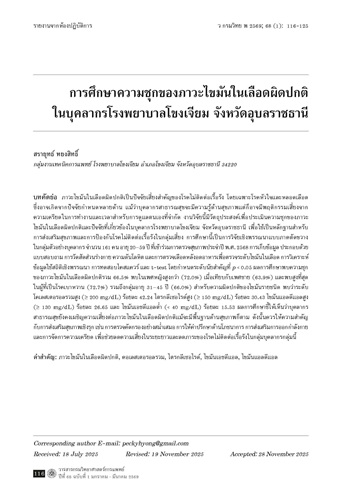
Dyslipidemia is a major risk factor for non-communicable diseases, particularly cardiovascular disease, and can be resulted from multiple determinants. Despite their health knowledge, healthcare personnel may have risky behaviors due to stressful work conditions and limited time for self-care. This study aimed to assess the prevalence of dyslipidemia and associated factors among healthcare personnel at Khong Chiam Hospital, Ubon Ratchathani, Thailand, to provide evidence for health promotion and prevention strategies for non-communicable diseases in at-risk groups. A cross-sectional descriptive study was conducted among 161 staff aged 20–59 years who participated in the annual health examination in 2025. Data collection included questionnaires, anthropometric measurements, blood pressure, and fasting blood samples for lipid profile analysis. Descriptive statistics, Chi-square test, and t-test were used, with a significance level set at p < 0.05. The overall prevalence of dyslipidemia was found 66.5%, higher in females (72.0%) than males (63.9%). The prevalence was highest among those with diabetes (72.7%) and in the age group 31–45 years (66.0%). Regarding lipid abnormalities, elevated total cholesterol (≥ 200 mg/dL) was found in 42.24%, hypertriglyceridemia (≥ 150 mg/dL) in 30.43%, high LDL-C (≥ 130 mg/dL) in 26.65%, and low HDL-C (< 40 mg/dL) in 15.53%. These findings indicated that healthcare workers were at considerable risk for dyslipidemia despite their professional background. Therefore, proactive health promotion, including regular screening, nutritional counseling, encouragement of physical activity, and stress management interventions should be prioritized to mitigate long-term risks and reduce the burden of non-communicable diseases among this population.
References
สถาบันวิจัยประชากรและสังคม มหาวิทยาลัยมหิดล. รายงานสุขภาพคนไทย พ.ศ. 2565. กรุงเทพฯ: สำนักงานกองทุนสนับสนุนการสร้างเสริมสุขภาพ; 2565.
Addisu B, Bekele S, Wube TB, Hirigo AT, Cheneke W. Dyslipidemia and its associated factors among adult cardiac patients at Ambo university referral hospital, Oromia region, west Ethiopia. BMC Cardiovasc Disord 2023; 23: 321. (12 pages).
Chen L, Li X, Du X, Liu W, Du J, Guo L, et al. Cross-sectional association of meal skipping with lipid profiles and blood glucose in Chinese adults. Nutrition 2021; 90: 111245. (8 pages).
Pot GK, Almoosawi S, Stephen AM. Meal irregularity and cardiometabolic consequences: results from observational and intervention studies. Proc Nutr Soc 2016; 75(4): 475–86.
Friedewald WT, Levy RI, Fredrickson DS. Estimation of the concentration of low-density lipoprotein cholesterol in plasma, without use of the preparative ultracentrifuge. Clin Chem 1972; 18(6): 499–502.
WHO Expert Consultation. Appropriate body-mass index for Asian populations and its implications for policy and intervention strategies. Lancet 2004; 363(9403): 157–63.
Campbell NRC, Burnens M, Whelton PK, Angell SY, Jaffe MG, Cohn J, et al. 2021 World Health Organization guideline on pharmacological treatment of hypertension: policy implications for the region of the Americas. Lancet Reg Health Am 2022; 9: 100219. (10 pages).
National Cholesterol Education Program (NCEP) Expert Panel on Detection, Evaluation, Treatment of High Blood Cholesterol in Adults. Third report of the National Cholesterol Education Program (NCEP) Expert Panel on detection, evaluation, and treatment of high blood cholesterol in adults (Adult Treatment Panel III) final report. Circulation 2002; 106(25): 3143–421.
Grundy SM, Stone NJ, Bailey AL, Beam C, Birtcher KK, Blumenthal RS, et al. 2018 AHA/ACC/AACVPR/AAPA/ABC/ACPM/ADA/AGS/APhA/ASPC/NLA/PCNA guideline on the management of blood cholesterol: a report of the American College of Cardiology/American Heart Association Task Force on Clinical Practice Guidelines. J Am Coll Cardiol 2019; 73(24): e285–e350.
อรพรรณ ธีระตระกูลชัย, อรพรรณ ชัยมณี. ความชุกและปัจจัยที่เกี่ยวข้องกับระดับไขมันในเลือดที่ผิดปกติในบุคลากรโรงพยาบาลนพรัตนราชธานี. ธรรมศาสตร์เวชสาร. 2560; 17(1): 9–17.
Wilson PWF, Polonsky TS, Miedema MD, Khera A, Kosinski AS, Kuvin JT. Systematic review for the 2018 AHA/ACC/AACVPR/AAPA/ABC/ACPM/ADA/AGS/APhA/ASPC/NLA/PCNA guideline on the management of blood cholesterol: a report of the American College of Cardiology/American Heart Association Task Force on Clinical Practice Guidelines. Circulation 2019; 139(25): e1144–e1161.
Asia Pacific Cohort Studies Collaboration. Cholesterol, diabetes and major cardiovascular diseases in the Asia-Pacific region. Diabetologia 2007; 50(11): 2289–97.
Miller M, Stone NJ, Ballantyne C, Bittner V, Criqui MH, Ginsberg HN, et al. Triglycerides and cardiovascular disease: a scientific statement from the American Heart Association. Circulation 2011; 123(20): 2292–333.
Chu L. Impact of long working hours on health based on observations in China. BMC Public Health. 2021; 21: 1347. (8 pages).
Peters SAE, Muntner P, Woodward M. Sex differences in the prevalence of, and trends in, cardiovascular risk factors, treatment, and control in the United States, 2001 to 2016. Circulation 2019; 139(8): 1025–35.
Aekplakorn W, Taneepanichskul S, Kessomboon P, Chongsuvivatwong V, Putwatana P, Sritara P, et al. Prevalence of dyslipidemia and management in the Thai population, national health examination survey IV, 2009. J Lipids 2014; 2014: 249584. (13 pages).
Downloads
Published
How to Cite
Issue
Section
License
Copyright (c) 2026 BULLETIN OF THE DEPARTMENT OF MEDICAL SCIENCES

This work is licensed under a Creative Commons Attribution-NonCommercial-NoDerivatives 4.0 International License.