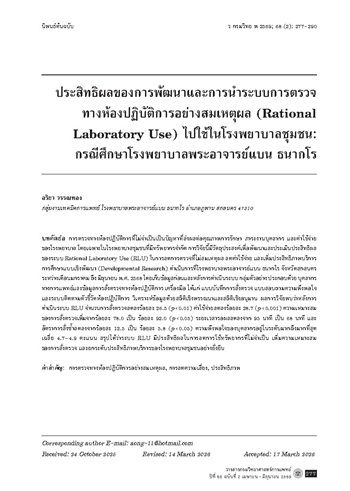
Effectiveness of Developing and Implementing a Rational Laboratory Test Ordering System in a Community Hospital: A Case Study of Phra Ajarn Baan Thanakaro Hospital
Keywords:
Rational Laboratory Use, Risk Reduction, EfficiencyAbstract
Unnecessary laboratory test ordering poses a significant challenge to healthcare systems, particularly in resource-limited community hospitals, as it increases healthcare costs, contributes to staff workload, and affects the overall quality of patient care. This study aimed to develop and evaluate the effectiveness of a Rational Laboratory Use (RLU) system in reducing inappropriate test ordering, decreasing expenditures, and enhancing service efficiency. A developmental research design was employed at Phra Ajarn Baan Thanakaro Hospital, Sakon Nakhon Province, from January to June 2025. Data were collected before and after system implementation. The study samples included healthcare personnel and laboratory test order records. Research instruments consisted of a test-ordering logbook, a satisfaction questionnaire, and a monitoring system for laboratory service indicators. Data were analyzed using descriptive and inferential statistics. The findings revealed that following RLU implementation, the number of laboratory test orders decreased by 26.5% (p < 0.01), and associated costs were reduced by 28.7% (p < 0.001). The appropriateness of test ordering increased from 78.0% to 92.0% (p < 0.05). Turnaround time was shortened from 95 minutes to 68 minutes, and duplicate orders declined from 12.5% to 5.8% (p < 0.05). Healthcare personnel expressed high to very high satisfaction with the system (mean score 4.7–4.9). In conclusion, the RLU system was effective in minimizing unnecessary resource utilization, improving the appropriateness of laboratory test ordering, and sustainably enhancing service efficiency in community hospital settings.
References
World Health Organization. The rational use of drugs: report of the conference of experts, Nairobi, 25–29 November 1985. Geneva: World Health Organization; 1987.
กรมวิทยาศาสตร์การแพทย์ กระทรวงสาธารณสุข. แนวทางการตรวจทางห้องปฏิบัติการทางการแพทย์อย่างสมเหตุผล (Rational Laboratory Use, RLU) ฉบับปรับปรุงครั้งที่ 3. [ออนไลน์]. 2566; [สืบค้น 19 ธ.ค. 2567]; [57 หน้า]. เข้าถึงได้ที่: URL: https://www3.dmsc.moph.go.th/page-view/108.
Wertheim BM, Aguirre AJ, Bhattacharyya RP, Chorba J, Jadhav AP, Kerry VB, et al. An educational and administrative intervention to promote rational laboratory test ordering on an academic general medicine service. Am J Med 2017; 130(1):47−53.
Zhi M, Ding EL, Theisen-Toupal J, Whelan J, Arnaout R. The landscape of inappropriate laboratory testing: a 15-year meta-analysis. PLoS One 2013; 8(11): e78962. (8 pages).
Kılıç E, Tetik BK, Kurt O. Evaluation of doctors’ knowledge of rational laboratory use: a descriptive study from Turkey. Konuralp Med J 2021; 13(3): 614−20.
Bindraban RS, Ten Berg MJ, Naaktgeboren CA, Kramer MH, Van Solinge WW, Nanayakkara PW. Reducing test utilization in hospital settings: a narrative review. Ann Lab Med 2018; 38(5): 402−12.
Levick DL, Stern G, Meyerhoefer CD, Levick A, Pucklavage D. Reducing unnecessary testing in a CPOE system through implementation of a targeted CDS intervention. BMC Med Inform Decis Mak 2013; 13: 43. (7 pages).
Sooriyakumar T. Towards appropriate laboratory test utilization: a narrative overview. Sri Lanka J Haematol. 2023; 15(2): 4−10.
Cassel CK, Guest JA. Choosing wisely: helping physicians and patients make smart decisions about their care. JAMA 2012; 307(17): 1801–2.
Buehler AM, Ascef BO, Oliveira Júnior HA, Ferri CP, Fernandes JG. Rational use of diagnostic tests for clinical decision making. Rev Assoc Med Bras 2019; 65(3): 452−9.
Serin H, Orhan B, Say M, Arslan H, Inal S, Inal B, Senes M. Evaluation of the implementation of the rational use of laboratory tests in the clinical chemistry laboratory. Turk J Biochem 2024; 49(4): 484−90.
วัฒนา แก้วแย้ม. การพัฒนาแนวทางการสั่งตรวจวิเคราะห์ทางห้องปฏิบัติการทางการแพทย์อย่างสมเหตุผลของโรงพยาบาลลําทับ จังหวัดกระบี่. ว วิจัยและพัฒนาสุขภาพศรีสะเกษ 2568; 4(1): 42–56.
โรงพยาบาลพระอาจารย์แบน ธนากโร. เอกสารสถิติห้องตรวจสิ่งส่งตรวจ ปีงบประมาณ. สกลนคร: โรงพยาบาลพระอาจารย์แบน ธนากโร; 2567.
กุศลาสัย สุราอามาตย์. การพัฒนารูปแบบการตรวจวิเคราะห์ทางห้องปฏิบัติการอย่างสมเหตุผลโรงพยาบาลจตุรพักตรพิมาน จังหวัดร้อยเอ็ด. ว วิจัยและพัฒนานวัตกรรมทางสุขภาพ 2567; 5(3): 302−13.
ตุลาพร อินทนิเวศน์. การพัฒนาระบบการตรวจทางห้องปฏิบัติการอย่างสมเหตุผลตามแนวทาง RLU ของโรงพยาบาลลําพูน. ว กรมวิทย พ 2567; 66 (3): 338−55.
เยาวรักษ์ จูตระกูล. การเพิ่มประสิทธิผลของการรายงานผลตรวจทางห้องปฏิบัติการเคมีคลินิกด้วยการการรายงานผลอัตโนมัติ:กรณีศึกษาของโรงพยาบาลอุดรธานี. ว เทคนิคการแพทย์ 2567; 52(2): 8998−9012.
พรพิมล จันทร์คุณาภาส, ไพรํา บุญญะฤทธิ์, วรนัดดา ศรีสุพรรณ, นุชน้อย ประภาโส, บรรณาธิการ. การพัฒนาระบบบริการสุขภาพ (service plan) สาขาพัฒนาระบบบริการให้มีการใช้ยาอย่างสมเหตุสมผล (service plan: rational drug use). นนทบุรี: กลุ่มงานพัฒนาระบบสนับสนุนบริการ สํานักบริหารการสาธารณสุข สํานักงานปลัดกระทรวงสาธารณสุข; 2559.
Downloads
Published
How to Cite
Issue
Section
License
Copyright (c) 2026 BULLETIN OF THE DEPARTMENT OF MEDICAL SCIENCES

This work is licensed under a Creative Commons Attribution-NonCommercial-NoDerivatives 4.0 International License.