Comparative Diagnostic Performance of the Acid Phosphatase Test and Seminal PSA Rapid Test in Forensic Sexual Assault Swab Samples at Udon Thani Hospital
Keywords:
Acid phosphatase test, Seminal PSA test, Sexual assault, Forensic swab, SemenAbstract
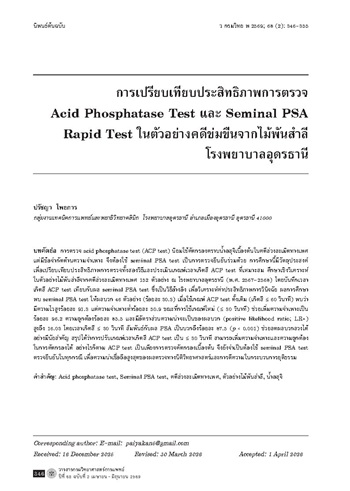
The acid phosphatase test (ACP test) is widely used as a presumptive screening method for detecting seminal stains in sexual assault investigations; however, its limited specificity necessitates confirmatory testing with the seminal PSA test. This study aimed to compare the diagnostic performance of the ACP test and the seminal PSA test and to evaluate an appropriate ACP reaction time cutoff for screening purposes. An analytical cross-sectional study was conducted using 152 forensic swab specimens from sexual assault cases submitted to Udon Thani Hospital during fiscal years 2024–2025. ACP reaction times were recorded and compared with seminal PSA test results as the reference method, and diagnostic parameters including sensitivity, specificity, positive predictive value (PPV), negative predictive value (NPV), accuracy, and likelihood ratios were calculated. The seminal PSA test was positive in 46 samples (30.3%). Using the conventional ACP positivity criterion (color development ≤ 60 seconds) yielded high sensitivity (91.3%) but low specificity (50.9%), whereas applying a shorter cutoff (≤ 30 seconds) markedly improved specificity to 96.2%, with an overall accuracy of 85.5% and a positive likelihood ratio (LR+) of 16.03. Samples with ACP reaction times ≤ 30 seconds were strongly associated with PSA positivity (87.5%, p < 0.001), indicating a substantial reduction in false-positive results. These findings suggest that adopting a shorter ACP reaction time cutoff (≤ 30 seconds) may improve specificity and overall diagnostic accuracy while maintaining the ACP test as a presumptive screening tool; nevertheless, confirmatory testing with the seminal PSA test remains essential in all cases to ensure the highest reliability of forensic interpretation.
References
Huguet A, Moreno M, Valdez P. Stability of semen markers in forensic samples. Int J Legal Med 2011; 125(3): 345−52.
Kearney A, Roberts B, Vernon J. Acid phosphatase reliability in forensic applications. Forensic Sci Int 2005; 148(1): 55−62.
Burns T, Harris S. Forensic detection of seminal fluid using PSA and enzymatic methods. J Forensic Sci 2018; 63(2): 210−8.
Ogunleye J, Musa N, Okafor C. Diagnostic specificity of prostate-specific antigen in sexual assault cases. Am J Forensic Med Pathol 2019; 40(1): 76−83.
ภาควิชานิติเวชศาสตร์ คณะแพทยศาสตร์ มหาวิทยาลัยเชียงใหม่. การตรวจหา Prostate Specific Antigen ในคดีความทางเพศ. เชียงใหม่: มหาวิทยาลัยเชียงใหม่; 2562.
โรงพยาบาลตํารวจ. แนวทางการตรวจพิสูจน์น้ำอสุจิในงานนิติวิทยาศาสตร์. กรุงเทพมหานครกรุงเทพฯ: สํานักงานตํารวจแห่งชาติ; 2564.
Hochmeister MN, Budowle B, Borer UV, Dirnhofer R. Evaluation of the acid phosphatase test in sexual assault investigations. Int J Legal Med 1999; 112(6): 379−84.
กรมวิทยาศาสตร์การแพทย์. คู่มือการตรวจพิสูจน์สารชีวภาพในงานนิติวิทยาศาสตร์. นนทบุรี: กระทรวงสาธารณสุข; 2556.
Downloads
Published
How to Cite
Issue
Section
License
Copyright (c) 2026 BULLETIN OF THE DEPARTMENT OF MEDICAL SCIENCES

This work is licensed under a Creative Commons Attribution-NonCommercial-NoDerivatives 4.0 International License.