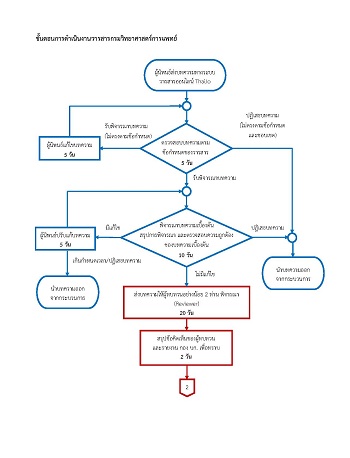
การพัฒนาและการประเมินประสิทธิภาพวิธี Real-Time PCR สำหรับการตรวจหายีน HLA-A*31:01 ในการคัดกรองทางเภสัชพันธุศาสตร์
การตรวจจีโนทัยป์ HLA-A*31:01 ด้วยวิธี Real-time PCR
คำสำคัญ:
เอชแอลเอ-เอ 31:01, เรียลไทม์พีซีอาร์, คาร์บามาซีพีน, อาการไม่พึงประสงค์จากยารุนแรง, เภสัชพันธุศาสตร์บทคัดย่อ
คาร์บามาซีพีน (Carbamazepine: CBZ) เป็นยากันชักที่ใช้กันอย่างแพร่หลายทางการแพทย์ในการรักษาโรคลมชัก โรคปวดเส้นประสาทใบหน้า และโรคอารมณ์สองขั้ว แม้ว่ายานี้จะมีประสิทธิภาพทางคลินิกสูง แต่สามารถก่อให้เกิดอาการไม่พึงประสงค์จากยารุนแรง (Severe Adverse Drug Reactions: SADRs) โดยเฉพาะกลุ่มอาการผื่นแพ้ยารุนแรงที่อาจเป็นอันตรายถึงชีวิต (Severe Cutaneous Adverse Reactions: SCARs) หลักฐานทางเภสัชพันธุศาสตร์ได้ยืนยันว่า HLA-B*15:02 รวมถึง HLA-B alleles ในกลุ่ม HLA-B75 serotype และ HLA-A*31:01 เป็นปัจจัยเสี่ยงทางพันธุกรรมที่เกี่ยวข้องกับการเกิด SADRs จากการใช้ยา CBZ ปัจจุบันในประเทศไทยมีการให้บริการตรวจ HLA-B*15:02/HLA-B75 อย่างแพร่หลายภายใต้ระบบประกันสุขภาพแห่งชาติ ในขณะที่การตรวจ HLA-A*31:01 ยังมีจำกัด ส่งผลให้การประเมินความเสี่ยงทางเภสัชพันธุกรรมยังไม่ครอบคลุม โดยเฉพาะอย่างยิ่งในประชากรที่พบ HLA-B*15:02 ในอัตราต่ำ แต่มีความชุกของ HLA-A*31:01 สูง ซึ่งสัมพันธ์กับกลุ่มอาการแพ้ยาที่หลากหลายและซับซ้อนกว่า การศึกษานี้มีวัตถุประสงค์เพื่อพัฒนาและประเมินประสิทธิภาพของวิธีตรวจ HLA-A*31:01 ด้วยเทคนิค Real-time PCR ผลการทดสอบในตัวอย่างดีเอ็นเอ 198 ตัวอย่าง ประกอบด้วย 14 ตัวอย่าง ที่มี HLA-A*31:01 และ 184 ตัวอย่าง ที่ไม่มี HLA-A*31:01 พบว่าวิธีนี้ให้ผลสอดคล้องกับวิธีตรวจอ้างอิงร้อยละ 100 และสามารถตรวจดีเอ็นเอได้ในช่วง 0.78–200.00 ng/ปฏิกิริยา แสดงถึงความแม่นยำสูง ใช้งานง่าย รวดเร็ว และเหมาะสมในการประยุกต์ใช้ในห้องปฏิบัติการทางคลินิก วิธีการตรวจนี้ช่วยเพิ่มความครอบคลุมในการคัดกรองความเสี่ยงทางพันธุกรรม และส่งเสริมความปลอดภัยของการใช้ยา CBZ ตามแนวทางการแพทย์แม่นยำ
เอกสารอ้างอิง
McCormack M, Alfirevic A, Bourgeois S, Farrell JJ, Kasperaviciute D, Carrington M, et al. HLA-A*31:01 and carbamazepine-induced hypersensitivity reactions in Europeans. N Engl J Med 2011; 364(12): 1134–43.
Wang CW, Preclaro IA, Lin WH, Chung WH. An updated review of genetic associations with severe adverse drug reactions: translation and implementation of pharmacogenomic testing in clinical practice. Front Pharmacol 2022; 13: 886377. (12 pages).
Biswas M, Ershadian M, Shobana J, Nguyen AH, Sukasem C. Associations of HLA genetic variants with carbamazepine-induced cutaneous adverse drug reactions: an updated meta-analysis. Clin Transl Sci 2022; 15(8): 1887–905.
Chung WH, Hung SI, Hong HS, Hsih MS, Yang LC, Ho HC, et al. Medical genetics: a marker for Stevens-Johnson syndrome. Nature 2004; 428(6982): 486.
Phillips EJ, Sukasem C, Whirl-Carrillo M, Müller DJ, Dunnenberger HM, Chantratita W, et al. CPIC guideline for HLA genotype and use of carbamazepine and oxcarbazepine: 2017 update. Clin Pharmacol Ther 2018; 103(4): 574-81.
Ozeki T, Mushiroda T, Yowang A, Takahashi A, Kubo M, Shirakata Y, et al. Genome-wide association study identifies HLA-A*31:01 as a genetic risk factor for carbamazepine-induced cutaneous adverse drug reactions in Japanese population. Hum Mol Genet 2011; 20(5): 1034–41.
Fukunaga K, Tsukagoshi E, Kurata M, Mizukawa Y, Niihara H, Morita E, et al. Differential effects of HLA-B*15:11 and HLAA*31:01 on carbamazepine-induced cutaneous adverse reactions. J Investig Dermatol 2024; 144(4): 908-11.
Dashti M, Malik MZ, Al-Matrouk A, Bhatti S, Nizam R, Jacob S, et al. HLA-B allele frequencies and implications for pharmacogenetics in the Kuwaiti population. Front Pharmacol 2024; 15: 1423636. (12 pages).
Jaruthamsophon K , Tipmanee V, Sangiemchoey A, Sukasem C, Limprasert P. HLA-B*15:21 and carbamazepine-induced Stevens-Johnson syndrome: pooled-data and in silico analysis. Sci Rep 2017; 7: 45553. (7 pages).
Yuliwulandari R, Kristin E, Prayuni K, Sachrowardi Q, Suyatna FD, Menaldi SL, et al. Association of HLA-B alleles with carbamazepine-induced Stevens-Johnson syndrome/toxic epidermal necrolysis in the Javanese and Sundanese populations of Indonesia: the important role of the HLA-B75 serotype. Pharmacogenomics 2017; 18(18): 1643-648.
Caudle KE, Dunnenberger HM, Freimuth RR, Peterson JF, Burlison JD, Whirl-Carrillo M, et al. Standardizing terms for clinical pharmacogenetics test results: consensus terms from the Clinical Pharmacogenetics Implementation Consortium (CPIC). Genet Med 2017; 19(2): 215-23.
Amstutz U, Shear NH, Rieder MJ, Hwang S, Fung V, Nakamura H, et al. Recommendations for HLA-B*15:02 and HLA-A*31:01 genetic testing to reduce the risk of carbamazepineinduced hypersensitivity reactions. Epilepsia 2014; 55(4): 496–506.
Erlich H. HLA DNA typing: past, present, and future. Tissue Antigens 2012; 80(1): 1–11.
Lind C, Ferriola D, Mackiewicz K, Heron S, Rogers M, Slavich L, et al. Next-generation sequencing: the solution for high-resolution, unambiguous human leukocyte antigen typing. Hum Immunol 2010; 71(10): 1033-42.
Xu Q, Li CY, Wang Y, Li HP, Wu BB, Jiang YH, et al. Role of PUF60 gene in Verheij syndrome: a case report of the first Chinese Han patient with a de novo pathogenic variant and review of the literature. BMC Med Genomics 2018; 11(1): 92. (5 pages).
Kubota Y, Tokunaga K. HLA typing using PCR methods. Methods Mol Biol 2018; 1802: 37–50.
Wang H, Tomczak K, Shaffer CM, Jeng LJ, White MJ, Truty R, et al. Performance comparison of real-time PCR and next-generation sequencing for pharmacogenomics testing. J Mol Diagn 2018; 20(4): 552–62.
Buchner A, Hu X, Aitchison KJ. Validation of single nucleotide variant assaysfor human leukocyte antigen haplotypes HLA-B*15:02 and HLA-A*31:01 across diverse ancestral backgrounds. Front Pharmacol 2021; 12: 713178. (12 pages).
Fernandes VC, Pretti MAM, Tsuneto LT, Petzl-Erler ML, Suarez-Kurtz G. Single nucleotide variants as proxies for HLAA*31:01 in native American populations. Front Pharmacol 2022; 13: 849136. (6 pages).
Department of Medical Sciences, Ministry of Public Health, Thailand. HLA - B75 genotyping by real-time PCR. [online]. 2024; [cited 2025 May 11]. Available from: URL: https://service.dmsc.moph.go.th/dmscservice/
Mahasirimongkol S, Somboonyosdech C, Kumperasart S, Wattanapokayakit S, Satproedprai N, Inunchot W, et al. HLA-B allelic distribution in samples from Thailand National Health Examination Survey. J Health Sci Thai 2014; 23(2): 191–200.
Anukul N, Jenjaroenpun P, Sirikul C, Wankaew N, Nimsamer P, Roothumnong E, et al. Ultrarapid and high-resolution HLA class I typing using transposase-based nanopore sequencing applied in pharmacogenetic testing. Front Genet 2023; 14: 1213457. (10 pages).
Nguyen DV, Vidal C, Chi HC, Do NTQ, Fulton R, Li J, et al. A novel multiplex polymerase chain reaction assay for detection of both HLA-A * 31:01/HLA-B * 15:02 alleles, which confer susceptibility to carbamazepineinduced severe cutaneous adverse reactions. HLA 2017; 90(6): 335-42.
ดาวน์โหลด
เผยแพร่แล้ว
รูปแบบการอ้างอิง
ฉบับ
ประเภทบทความ
สัญญาอนุญาต
ลิขสิทธิ์ (c) 2025 วารสารกรมวิทยาศาสตร์การแพทย์

อนุญาตภายใต้เงื่อนไข Creative Commons Attribution-NonCommercial-NoDerivatives 4.0 International License.