
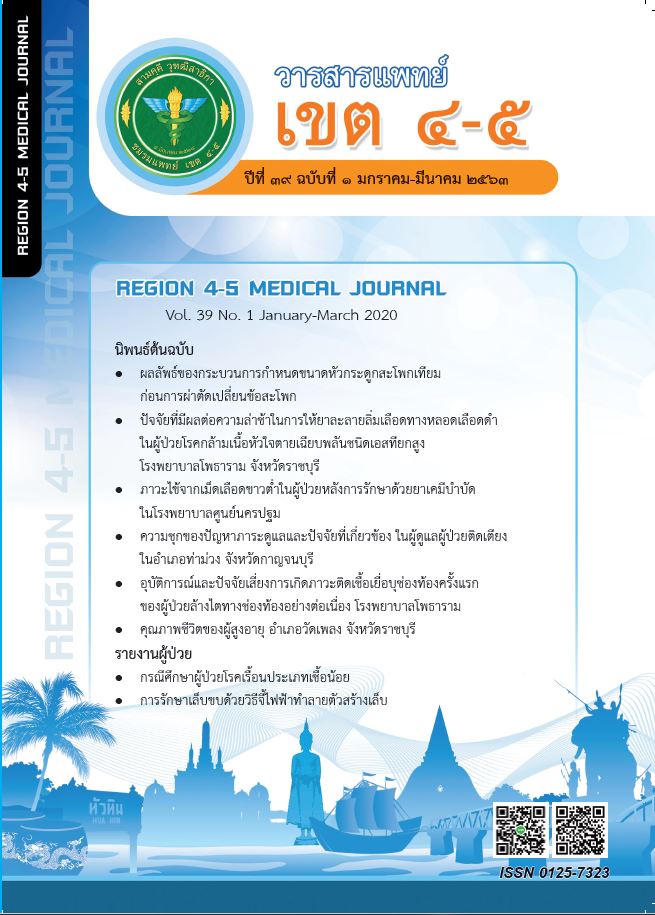
ภาวะไข้จากเม็ดเลือดขาวต่ำในผู้ป่วยหลังการรักษาด้วยยาเคมีบำบัด ในโรงพยาบาลศูนย์นครปฐม
คำสำคัญ:
ภาวะไข้จากเม็ดเลือดขาวต่ำ, มะเร็ง, ยาเคมีบำบัด, มะเร็งโลหิตวิทยาบทคัดย่อ
วัตถุประสงค์: เพื่อศึกษาอุบัติการณ์การเกิดภาวะไข้จากเม็ดเลือดขาวต่ำภายหลังการได้รับยาเคมีบำบัด อัตราการเสียชีวิตและปัจจัยที่เกี่ยวข้องกับการเสียชีวิตจากภาวะไข้จากเม็ดเลือดขาวต่ำภายหลังได้รับยาเคมีบำบัด
วิธีการศึกษา: เป็นการศึกษาวิจัยย้อนหลัง ในผู้ป่วยที่มีภาวะไข้จากเม็ดเลือดขาวต่ำภายหลังได้รับยาเคมีบำบัดที่มีอายุเท่ากับหรือมากกว่า 15 ปี ตั้งแต่ 1 มกราคม 2557 ถึง 31 ธันวาคม 2561 โดยศึกษาอุบัติการณ์ อัตราการเสียชีวิตและปัจจัยที่สัมพันธ์กับการเสียชีวิต
ผลการศึกษา: ผู้ป่วยทั้งสิ้น 188 ราย เป็นหญิงร้อยละ 60 มีอุบัติการณ์เกิดภาวะไข้จากเม็ดเลือดขาวต่ำภายหลังการได้รับยาเคมีบำบัด ร้อยละ 3.5 มีอัตราการเสียชีวิต ร้อยละ 18 จากการวิเคราะห์ข้อมูลแบบ multivariate analysis พบว่าปัจจัยที่สัมพันธ์กับการเสียชีวิต ได้แก่ ระดับneutrophils ตั้งต้นที่ต่ำกว่า 100 เซลล์/ลบ.มม. (OR 3.76, 95%CI 1.26-11.22 p= .018) ECOG scoreตั้งแต่ 3 ขึ้นไป (OR 3.59, 95%CI 1.22-10.58 p = .02) และระยะเวลาตั้งแต่ผู้ป่วยเริ่มมีไข้จนกระทั่งได้รับยาต้านจุลชีพเกิน 4 ชั่วโมง (OR 16.16, 95%CI 3.48-74.99,p < .001) อย่างไรก็ตามชนิดของมะเร็งไม่มีผลต่ออัตราการเสียชีวิต
สรุป: การศึกษานี้พบอุบัติการณ์เกิดภาวะไข้จากเม็ดเลือดขาวต่ำภายหลังได้รับยาเคมีบำบัดในอัตราส่วนที่ต่ำ แต่กลับพบว่ามีอัตราการเสียชีวิตที่สูง ดังนั้น การรักษาจึงต้องคำนึงถึงลักษณะทางกายภาพของผู้ป่วย ระดับ neutrophil และช่วงเวลาของการได้รับยาต้านจุลชีพตั้งแต่ผู้ป่วยเริ่มมีไข้
เอกสารอ้างอิง
2. Ozer H, Armitage JO, Bennett CL, et al. 2000 Update of Recommendations for the use of Hematopoietic Colony-Stimulating Factors: Evidence-Based, Clinical Practice Guidelines. J ClinOncol 2000;18:3558-85.
3. Klastersky J, Paesmans M, et al. The Multinational Association for Supportive Care in Cancer risk index: a multinational scoring system for identifying low-risk febrile neutropenic cancer patients. J Clin Oncol 2000;18:3038-51.
4. DE Castro Carpeño J, Gascón-Vilaplana P, Tejerina AM, et al. Epidemiology and characteristics of febrile neutropenia in oncology patients from Spanish tertiary care hospitals: PINNACLE study. Mol Clin Oncol 2015;3(3):725–9.
5. Weycker D, Barron R, Kartashov A, et al. Incidence, treatment, and consequences of chemotherapy-induced febrile neutropenia in the inpatient and outpatient settings.J Oncol Pharm Pract 2014;20(3):190-8. doi: 10.1177/1078155213492450.
6. Chindaprasirt J, Wanitpongpun C, Limpawattana P, et al. Mortality, Length of Stay, and Cost Associated with Hospitalized Adult Cancer Patients with Febrile Neutropenia. Asian Pacific J Cancer Prev 2013;14(2),1115-9.
7. Kuderer NM, Dale DC, Crawford J, et al. Mortality, Morbidity, and Cost Associated with Febrile Neutropenia in Adult Cancer Patients. Cancer 2006;106(10):2258-66.
8. de Naurois J, Novitzky-Basso I, Gill MJ, et al. Management of febrile neutropenia: ESMO Clinical Practice Guidelines. Ann Oncol. 2010;21 Suppl 5:v252-6. doi: 10.1093/annonc/mdq196.
9. Kawatkar AA, Farias AJ, Chao C, et al. Hospitalizations, outcomes, and management costs of febrile neutropenia in patients from a managed care population. Support Care Cancer. 2017;25(9):2787–95.
10. Hosiriluck N, Klomjit S, Rassameehiran S, et al. Prognostic factors for mortality with febrile neutropenia in hospitalized patients.SWRCCC 2015;3(9):3-13.
11. Marín M, Gudiol C, Ardanuy C, et al. Factors influencing mortality in neutropenic patients with haematologic malignancies or solid tumours with bloodstream infection. ClinMicrobiol Infect 2015; 21: 583–90
12. Lyman GH, Michels SL, Reynolds MW, et al. Risk of Mortality in Patients With Cancer Who Experience Febrile Neutropenia. Cancer 2010;116(1):5555–63. doi: 10.1002/cncr.25332
13. Rasmy A. Amal A, Fotih S, et al. Febrile Neutropenia in Cancer Patient: Epidemiology, Microbiology, Pathophysiology and Management. J Cancer PrevCurr Res 2016, 5(3): 00165
ดาวน์โหลด
เผยแพร่แล้ว
รูปแบบการอ้างอิง
ฉบับ
ประเภทบทความ
สัญญาอนุญาต
ลิขสิทธิ์บทความเป็นของผู้เขียนบทความ แต่หากผลงานของท่านได้รับการพิจารณาตีพิมพ์ลงวารสารแพทย์เขต 4-5 จะคงไว้ซึ่งสิทธิ์ในการตีพิมพ์ครั้งแรกด้วยเหตุที่บทความจะปรากฎในวารสารที่เข้าถึงได้ จึงอนุญาตให้นำบทความในวารสารไปใช้ประโยชน์ได้ในเชิงวิชาการโดยจำเป็นต้องมีการอ้างอิงถึงชื่อวารสารอย่างถูกต้อง แต่ไม่อนุญาตให้นำไปใช้ในเชิงพาณิชย์