
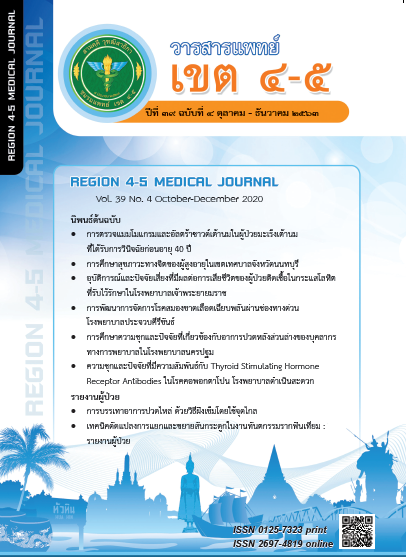
Prevalence and Factors Associated with Positive Thyrotropin Receptor Antibody in Graves’ Disease Patients at Damnoen Saduak Hospital: A Prospective Study
Keywords:
thyrotropin receptor antibody (TRAb), thyrotropin receptor antibody (TRAb),, anti-thyroid hormoneAbstract
Abstract
Objective: The aim was to investigated the prevalence of thyrotropin receptor antibody (TRAb) positivity and clinically relevant in the patients with Graves' disease (GD).
Methods: This study, conducted between July 2014-2020. All 162 patients with GD treated with anti-thyroid drugs were included in the study. The median observation period was 48 months. The TRAb positive comparison between each modality was made by Chi-square and t-test independent.
Results: Patients with GD were seropositive for TRAb at 45.7 %. The TRAb positive, had statistically significant relations to remission and recurrence (p=.005 and p=.019 respectively); furthermore, it was affected by FT3 (p=.016). However, the TRAb positive was not affected by sex, age, duration of symptoms, heart rate, thyroxine (FT4), anti-thyroid peroxidase, and anti-thyroglobulin levels.
Conclusions: Patients with GD show positive TRAb before medical treatment, which points to a relationship with the remission and recurrence. Our results suggest that it is beneficial to determine TRAb in GD.
References
1. Bahn RS. Autoimmunity and graves disease. Clin Pharmacol Ther. 2012; 91(4): 577–9. doi: 10.1038/clpt.2012.10.
2. Bartalena L. Diagnosis and management of Graves disease: a global overview. Nat Rev Endocrinol. 2013; 9(12): 724–34. doi: 10.1038/nrendo.2013.193.
3. Roti E, Braverman LE, DeGroot LJ. TSH Receptor Antibody Measurement in the Diagnosis and Management of Graves’ Disease Is Rarely Necessary. J Clin Endocrinol Metab. 1998; 83(11): 3781–4.
4. Feldt-Rasmussen U, Schleusener H, Carayon P. Meta-analysis evaluation of the impact of thyrotropin receptor antibodies on long term remission after medical therapy of Graves’ disease. J Clin Endocrinol Metab. 1994; 78(1): 98–102. doi: 10.1210/jcem.78.1.8288723.
5. Vitti P, Rago T, Chiovato L, et al. Clinical features of patients with graves’ disease undergoing remission after antithyroid drug treatment. Thyroid. 1997;7(3):369–75. doi: 10.1089/thy.1997.7.369.
6. Bluszcz GA, Bednarczuk T, Bartoszewicz Z, et al. Clinical utility of TSH receptor antibody levels in Graves’ orbitopathy: A comparison of two TSH receptor antibody immunoassays. Cent Eur J Immunol. 2018; 43(4): 405–12. doi: 10.5114/ceji.2018.80224.
7. Meena MQ. Diagnosing Graves’ Disease and Non-Graves Hyperthyroidism Using TSH Receptor Antibody Test versus Non-TSH Receptor Antibody Test Methods of Diagnosis. Open J Endocr Metab Dis. 2020; 10(02): 7–17. doi: 10.4236/ojemd.2020.102002.
8. Bell L, Hunter AL, Kyriacou A, et al. Clinical diagnosis of Graves’ or non-Graves’ hyperthyroidism compared to TSH receptor antibody test. Endocr Connect. 2018; 7(4): 504–10. doi: 10.1530/EC-18-0082.
9. American Thyroid Association. Some patients with apparent Graves’ disease do not have an autoimmune thyroid disorder. Clinical Thyroidology for the Public. 2014; 7(2): 4-5.
10. Laurberg P, Nygaard B, Andersen S, et al. Association between TSH-receptor autoimmunity, hyperthyroidism, goitre, and orbitopathy in 208 patients included in the remission induction and sustenance in graves’ disease study. J Thyroid Res. 2014; 2014: 165487. doi: 10.1155/2014/165487.
11. Shyamasunder AH, Abraham P. Measuring TSH receptor antibody to influence treatment choices in Graves’ disease. Clin Endocrinol (Oxf). 2017; 86(5): 652-7. doi: 10.1111/cen.13327.
12. Barbesino G, Tomer Y. Clinical utility of TSH receptor antibodies. J Clin Endocrinol Metab. 2013; 98(6): 2247–55.
13. Thyroid antibody levels may not predict thyroid hormone levels and risk of recurrence in older patients with Graves’ disease. Clinical Thyroidology for the Public. 2019; 12(7): 12-3.
14. Bano A, Gan E, Addison C, et al. Age May Influence the Impact of TRAbs on Thyroid Function and Relapse-Risk in Patients With Graves Disease. J Clin Endocrinol Metab. 2019; 104(5): 1378–85. doi: 10.1210/jc.2018-01738.
Downloads
Published
How to Cite
Issue
Section
License
ลิขสิทธิ์บทความเป็นของผู้เขียนบทความ แต่หากผลงานของท่านได้รับการพิจารณาตีพิมพ์ลงวารสารแพทย์เขต 4-5 จะคงไว้ซึ่งสิทธิ์ในการตีพิมพ์ครั้งแรกด้วยเหตุที่บทความจะปรากฎในวารสารที่เข้าถึงได้ จึงอนุญาตให้นำบทความในวารสารไปใช้ประโยชน์ได้ในเชิงวิชาการโดยจำเป็นต้องมีการอ้างอิงถึงชื่อวารสารอย่างถูกต้อง แต่ไม่อนุญาตให้นำไปใช้ในเชิงพาณิชย์