
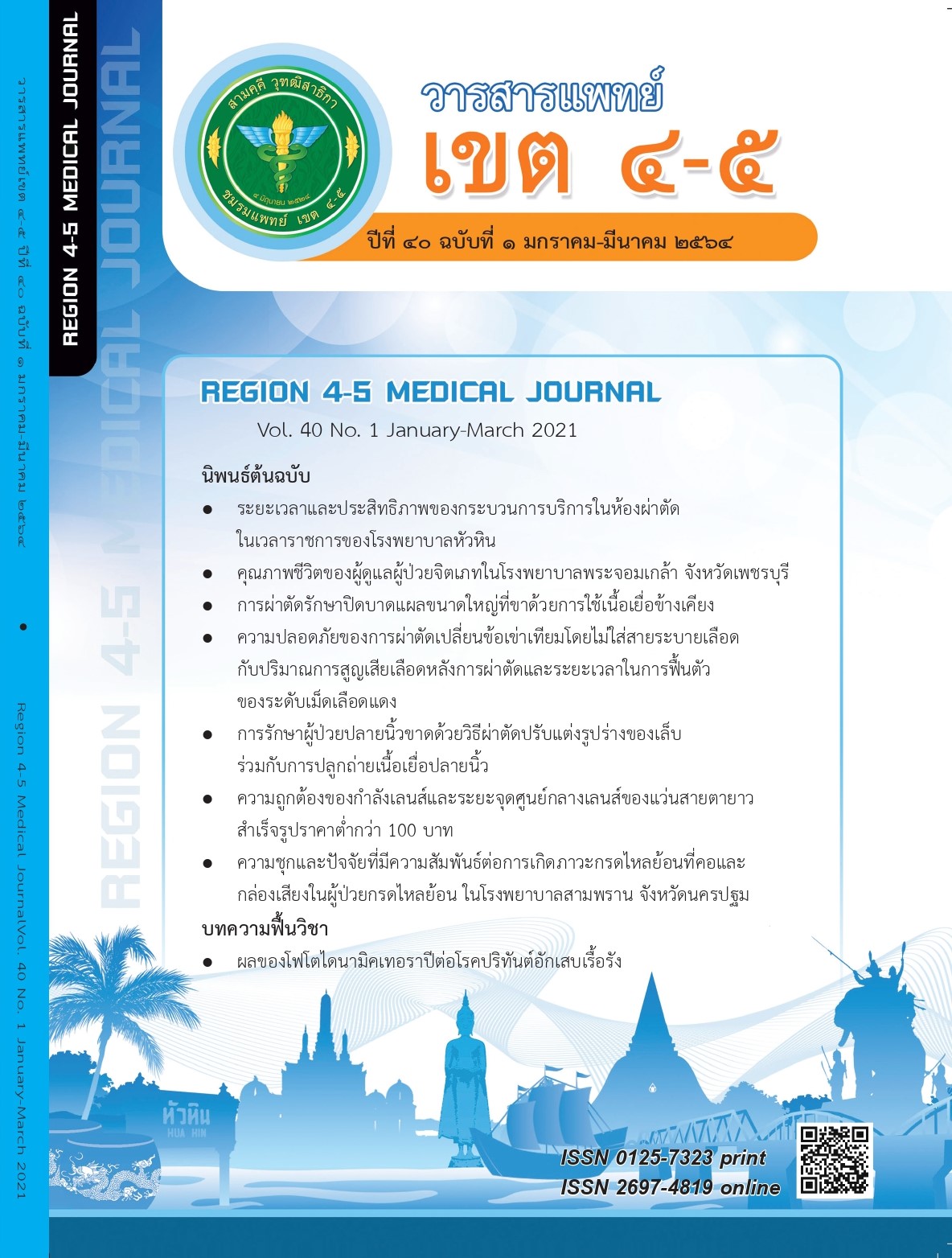
Safety of Total Knee Arthroplasty Without Drain Placement in Primary Osteoarthritis Patients, with Postoperative Blood Loss and the Duration for Recovery of Hemoglobin Level
Keywords:
total knee arthroplasty, total blood loss, hemoglobin level, hematocrit levelAbstract
Objective: The objectives of this study were determining the safety of total knee arthroplasty without drain, and study for the average total blood loss and the duration for hemoglobin and hematocrit to return to pre-operative level.
Methods: This study was conducted at Samutsakhon Hospital from January 2018 to March 2020. The studied group consisted of 100 patients undergoing total knee arthroplasty without drain (100 knees). The hemoglobin and hematocrit were collected preoperatively and postoperatively at day 5, 2 weeks, 1 month, 2 months and 3 months to determine the calculated blood loss and the duration for hemoglobin and hematocrit level to return to preoperative level. Complications of the surgical wounds were as well recorded.
Results: The mean blood loss was 758.93 ml and the duration for hemoglobin and hematocrit level returned to preoperative level at an average of 51.30 days. Only 1 patient received blood transfusion. There were no any complications of the surgical wounds such as infection and hematoma.
Conclusion: The total knee arthroplasty without drain is safe and the duration for hemoglobin and hematocrit level to return to preoperative level is within 3 months (mean 51.30 days).
References
2. Alshryda S, Mason J, Sarda P, et al. Topical (intra-articular) tranexamic acid reduces blood loss and transfusion rates following total hip replacement: a randomized controlled trial (TRANX-H). J Bone Joint Surg Am. 2013; 95(21): 1969-74. doi: 10.2106/JBJS.L.00908.
3. Friedman R, Homering M, Holberg G, et al. Allogeneic blood transfusions and postoperative infections after total hip or knee arthroplasty. J Bone Joint Surg Am. 2014; 96(4): 272-8. doi: 10.2106/JBJS.L.01268.
4. Silliman CC, Fung YL, Ball JB, et al. Transfusion-related acute lung injury (TRALI): current concepts and misconceptions. Blood Rev. 2009; 23(6): 245-55.doi: 10.1016/j.blre.2009.07.005.
5. Martin A, Prenn M, Spiegel T, et al. Relevance of wound drainage in total knee arthroplasty--a prospective comparative study. Z Orthop Ihre Grenzgeb. 2004; 142(1): 46-50. doi: 10.1055/s-2004-817656.
6. Kim YH, Cho SH, Kim RS. Drainage versus nondrainage in simultaneous bilateral total knee arthroplasties. Clin Orthop Relat Res. 1998; (347): 188-93.
7. Berman AT, Fabiano D, Bosacco SJ, et al. Comparison between intermittent (spring-loaded) and continuous closed suction drainage of orthopedic wounds: a controlled clinical trial. Orthopedics. 1990; 13(3): 309-14.
8. Jones AP, Harrison M, Hui A. Comparison of autologous transfusion drains versus no drain in total knee arthroplasty. Acta Orthop Belg. 2007; 73(3): 377-85.
9. Parker MJ, Roberts CP, Hay D. Closed suction drainage for hip and knee arthroplasty. A meta-analysis. J Bone Joint Surg Am. 2004; 86(6): 1146-52. doi: 10.2106/00004623-200406000-00005.
10. Cao L, Ablimit N, Mamtimin A, et al. Comparison of no drain or with a drain after unilateral total knee arthroplasty: a prospective randomized controlled trial. Zhonghua Wai Ke Za Zhi. 2009; 47(18): 1390-3.
11. Munoz M, bLeal-Noval SR, Restrictive transfusion triggers in major orthopaedic surgery: effective and safe?. Blood transfusion.2013; 11(2): 169.
12. So-Osman C, Nelissen R, Brand R, et al. The impact of a restrictive transfusion trigger on post-operative complication rate and well-being following elective orthopaedic surgery: a post-hoc analysis of a randomized study. Blood Transfusion. 2013; 11(2): 289.
13. Lacher DA, Barletta J, Hughes JP. Biological variation of hematology tests based on the 1999-2002 national health and nutrition examination survey. Natl Health Stat Report. 2012: 12(54): 1-10.
14. Gross JB. Estimating allowable blood loss: corrected for dilution. Anaesthesiology 1983; 58(3): 277-80. doi: : 10.1097/00000542-198303000-00016
15. Evans S, O’Loughlin E, Bruce J. Retrospective audit of blood transfusion and comparison with haemoglobin concentration in patients undergoing elective primary and revisionlower limb arthroplasty. Anaesth Intensive Care. 2011; 39: 480-5.
16. Erskine JG, Fraser C, Simpson R, et al. Blood loss with knee joint replacement. J R Coll Surg Edinb.1981; 26(5): 295-7.
17. Sehat KR, Evans RL, Newman JH. Hidden blood loss following hip and knee arthroplasty. Correct management of blood loss should take hidden loss into account. J Bone Joint Surg Br. 2004; 86: 561-5.
18. Gibon E, Courpied JP, Hamadouche M. Total joint replacement and blood loss: what is the best equation?. Int Orthop. 2013; 37(4): 735-9
19. Stucinskas J, Tarasevicius S, Cebatorius A, et al. Conventional drainage versus four hour clamping drainage after total knee arthroplasty in severe osteoarthritis: a prospective, randomised trial. Int Orthop. 2009; 33(5): 1275–8. doi: 10.1007/s00264-008-0662-4
20. Chotanaphuti T, Wangwittayakul V, Khuangsirikul S. The accuracy of component alignment in custom cutting blocks compared with conventional total knee arthroplasty instrumentation: prospective control trial. The Knee. 2014;21(1):185-8
21. Billett HH. Hemoglobin and Hematocrit. In: Walker HK, Hall WD, Hurst JW, editors. Clinical methods: The history, physical, and laboratory examinations. 3rd ed. Boston: Butterworths; 1990: 151..
22. Quinn M, Bowe A, Galvin R, et al. The use of postoperative suction drainage in total knee arthroplasty: a systematic review. IntOrthop.2015; 39(4): 653-8. doi: 10.1007/s00264-014-2455-2.
Downloads
Published
How to Cite
Issue
Section
License
ลิขสิทธิ์บทความเป็นของผู้เขียนบทความ แต่หากผลงานของท่านได้รับการพิจารณาตีพิมพ์ลงวารสารแพทย์เขต 4-5 จะคงไว้ซึ่งสิทธิ์ในการตีพิมพ์ครั้งแรกด้วยเหตุที่บทความจะปรากฎในวารสารที่เข้าถึงได้ จึงอนุญาตให้นำบทความในวารสารไปใช้ประโยชน์ได้ในเชิงวิชาการโดยจำเป็นต้องมีการอ้างอิงถึงชื่อวารสารอย่างถูกต้อง แต่ไม่อนุญาตให้นำไปใช้ในเชิงพาณิชย์