
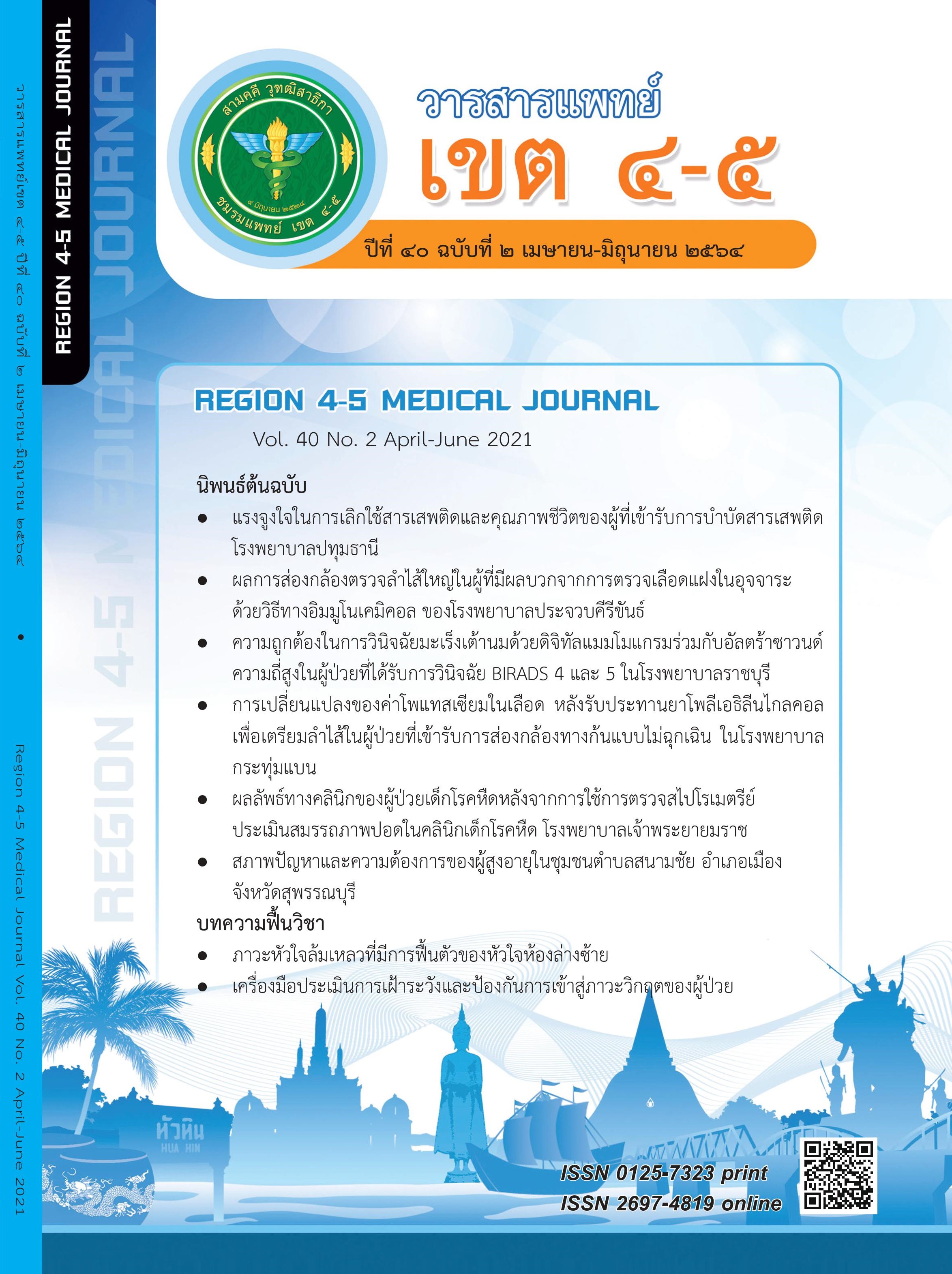
Motivation to Change in Substance Use and Quality of Life in Addicted Persons Who Received Matrix Program at Pathumthani Hospital
Keywords:
Matrix program, motivation to change, quality of life, addiction treatmentAbstract
Objective: This was to study and compare motivation to change and quality of life of addicted persons before and after completed treatment with Matrix Program at Pathumthani Hospital.
Methods: This comparative research was done by collecting data from 60 addicted persons treated with Matrix Program from January to December 2020. Motivation to change was compared by using a SOCRATES questionnaire and the quality of life by using WHOQOL-BREF-THAI. Identification data were analyzed by using percentage, mean, and SD. Comparative analysis was done by using t test.
Result: The result showed improvement of all domains in motivation of change in addicted persons. Recognition and ambivalence domains were not statistically significant. Taking- step domain was statistically significant at p<.05 level. All domains of the quality of life of addicted persons were better than before treatment. Physical and social domains were statistically significant at p<.05 level, whereas psychological and environment domains were not statistically significant.
Conclusion: The Matrix Program is useful for treatment of addicted persons at Pathumthani Hospital and improves motivation to change and quality of life.
References
2. สำนักงานคณะกรรมการป้องกันและปราบปรามยาเสพติด กระทรวงยุติธรรม. แผนประชารัฐร่วมใจสร้างหมู่บ้าน/ชุมชนมั่นคง ปลอดภัยยาเสพติด พ.ศ. 2559-2560 [อินเทอร์เน็ต]. 2559 [เข้าถึงเมื่อ 4 พฤศจิกายน 2563]; เข้าถึงได้จาก: https://www.oncb.go.th/Home/PublishingImages/Pages/ProgramsandActivities/Pracharat_plan%202559-2560.pdf
3. สำนักงานสาธารณสุขจังหวัดปทุมธานี. โครงการพัฒนาการบำบัดรักษาและฟื้นฟูสมรรถภาพและผู้ติดยาเสพติดให้มีประสิทธิภาพ โรงพยาบาลคลองหลวง จังหวัดปทุมธานี ปีงบประมาณ 2563 [อินเทอร์เน็ต]. ม.ป.ป. [เข้าถึงเมื่อ 4 พฤศจิกายน 2563]; เข้าถึงได้จาก: http://164.115.23.235:8080/sms2020/report/v_actionplan_budget_budgetcenter.php?budget_center=2100200081&budget_code=2100205782000000&budget_id=O3095
4. กัณณิกา สิทธิพงษ์. แรงจูงใจในการเลิกยาเสพติดของผู้ป่วยในโรงพยาบาลธัญญารักษ์ขอนแก่น. วารสารการพัฒนาสุขภาพชุมชน มหาวิทยาลัยขอนแก่น. 2560; 5(2): 217-38.
5. อมาวสี กลั่นสุวรรณ, นิตยา ตากวิริยะนันท์, ตะวันชัย จิรประมุขพิทักษ์. ผลของโปรแกรมเสริมสร้างแรงจูงใจร่วมกับการบำบัดความคิดและพฤติกรรมต่อพฤติกรรมร่วมมือในการเปลี่ยนแปลงตนเองของผู้ป่วยเสพติดแอมเฟตามีน ในสถานบำบัดรักษาแห่งหนึ่ง จังหวัดปทุมธานี. วารสารกรมการแพทย์. 2561; 43(1): 90-5.
6. จิรฉัตร ถิ่นไพโรจน์, นวพร หิรัญวิวัฒน์กุล. ผลของการเข้ารับการบำบัดด้วยโปรแกรมเมทริกซ์ต่อคุณภาพชีวิตของ ผู้ป่วยยาเสพติดโรงพยาบาลพระมงกุฎเกล้า. เวชสารแพทยทหารบก. 2561; 71(1): 3-10.
7. Miller WR, Tonigan JS. Assessing drinkers’ motivation for change: The Stages of Change Readiness and Treatment Eagerness Scale (SOCRATES). Psychology of Addictive Behaviors. 1996; 10(2): 81-9.
8. อรรถพงษ์ ฉัตรดอน, รัศมน กัลยาศิริ. ความชุกของการใช้และการติดสารเสพติด คุณภาพชีวิต และแรงจูงใจการเปลี่ยนแปลงการใช้สารเสพติดของผู้ป่วยนอก แผนกจิตเวชศาสตร์ โรงพยาบาลจุฬาลงกรณ์ [วิทยานิพนธ์ปริญญาวุฒิบัตรจิตเวชศาสตร์]. ภาควิชาจิตเวชศาสตร์ , บัณฑิตวิทยาลัย. กรุงเทพฯ: จุฬาลงกรณ์มหาวิทยาลัย; 2558.
9. สุวัฒน์ มหัตนิรันดร์กุล, วิระวรรณ ตันติพิวัฒนสกุล, วนิดา พุ่มไพศาลชัย, และคณะ. เปรียบเทียบแบบวัดคุณภาพชีวิตขององค์การอนามัยโลกทุก 100 ตัวชี้วัด และ 26 ตัวชี้วัด, ประชุมวิชาการกรมสุขภาพจิต ครั้งที่ 4; 7-9 กันยายน 2541; โรงพยาบาลสวนปรุง จังหวัดเชียงใหม่; 2540.
10. Prochaska JO, DiClemente CC, Norcross JC. In search of how people change. Applications to addictive behaviours. Am Psychol. 1992; 47(9): 1102-14. doi: 10.1037//0003-066x.47.9.1102.
11. Diclemente CC, Prochaska JO. Self change and therapy change of smoking behavior: A comparison of processes of change in cessation and maintenance. Addict Behav. 1982; 7(2): 133-42. doi: 10.1016/0306-4603(82)90038-7
Downloads
Published
How to Cite
Issue
Section
License
ลิขสิทธิ์บทความเป็นของผู้เขียนบทความ แต่หากผลงานของท่านได้รับการพิจารณาตีพิมพ์ลงวารสารแพทย์เขต 4-5 จะคงไว้ซึ่งสิทธิ์ในการตีพิมพ์ครั้งแรกด้วยเหตุที่บทความจะปรากฎในวารสารที่เข้าถึงได้ จึงอนุญาตให้นำบทความในวารสารไปใช้ประโยชน์ได้ในเชิงวิชาการโดยจำเป็นต้องมีการอ้างอิงถึงชื่อวารสารอย่างถูกต้อง แต่ไม่อนุญาตให้นำไปใช้ในเชิงพาณิชย์