
Effects of Stepwise Carbetocin Administration on Postpartum Hemorrhage after Prelabor Cesarean Delivery
DOI:
https://doi.org/10.33192/smj.v77i7.273108Keywords:
Carbetocin, stepwise administration, cesarean delivery, postpartum hemorrhageAbstract
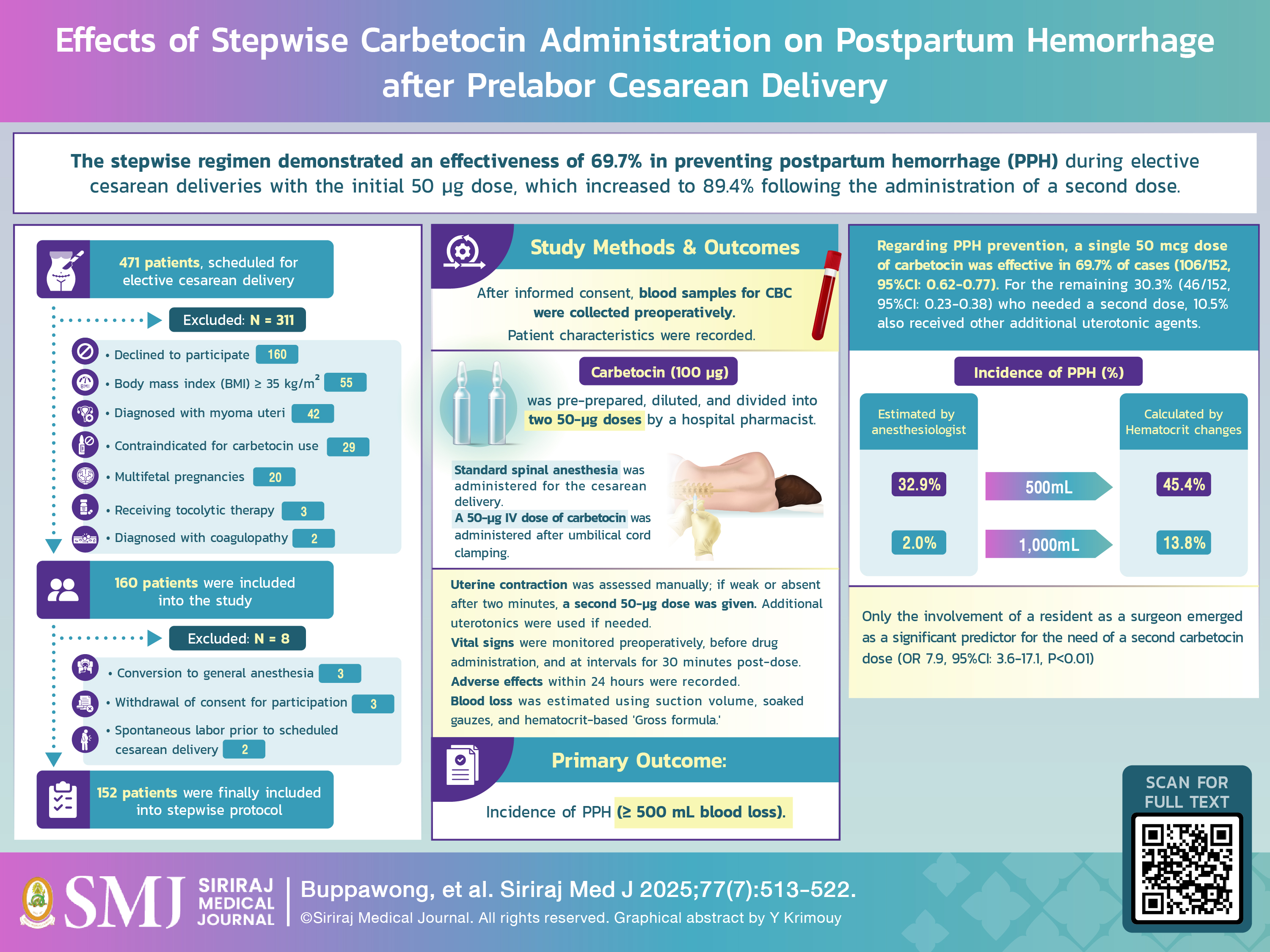
Objective: To evaluate the effectiveness of stepwise administration of carbetocin in reducing postpartum hemorrhage (PPH) in term pregnancies undergoing elective cesarean delivery.
Materials and Methods: This study included term pregnancies scheduled for cesarean delivery. Exclusion criteria were a BMI ≥ 35 kg/m2, any underlying disease contraindicated carbetocin use, and conditions affecting uterine contraction. Following newborn delivery, an initial dose of 50 µg of carbetocin was administered, with a subsequent 50 µg given if uterine contraction was inadequate. The primary outcome was the incidence of PPH exceeding 500 mL, while secondary outcomes included total blood loss ≥ 1,000 mL, administration of additional uterotonic agents, adverse effects, other pregnancy-related and surgical outcomes.
Results: Out of 152 pregnant women analyzed, adequate uterine contraction was observed in 69.7% of cases after the first carbetocin dose, with an additional 19.7% achieving adequate contraction after the second dose. Estimated blood loss exceeded 500 mL was 32.9% and exceeded 1,000 mL was 2.0% of cases, respectively. Recalculations based on pre- and post-hematocrit levels indicated higher rates of blood loss: more than 500 mL in 45.4% and over 1,000 mL in 13.8%. No serious side effects or complications were reported.
Conclusion: The stepwise regimen demonstrated an effectiveness of 69.7% in preventing postpartum hemorrhage (PPH) during elective cesarean deliveries with the initial 50 µg dose, which increased to 89.4% following the administration of a second dose.
References
Vogel JP, Williams M, Gallos I, Althabe F, Oladapo OT. WHO recommendations on uterotonics for postpartum haemorrhage prevention: what works, and which one? BMJ Glob Health. 2019;4(2):e001466.
Lertbunnaphong T LJ, Thitadilok W. Risk Factors of Primary Postpartum Hemorrhage in Siriraj Hospital. Siriraj Med J. 2020;62(5):195-8.
Group FPTW, Begum F, Beyeza J, Burke T, Evans C, Hanson C, et al. FIGO and the International Confederation of Midwives endorse WHO guidelines on prevention and treatment of postpartum hemorrhage. Int J Gynaecol Obstet. 2022;158 Suppl 1(Suppl 1):6-10.
Hunter DJ, Schulz P, Wassenaar W. Effect of carbetocin, a long-acting oxytocin analog on the postpartum uterus. Clin Pharmacol Ther. 1992;52(1):60-7.
Onwochei DN, Van Ross J, Singh PM, Salter A, Monks DT. Carbetocin reduces the need for additional uterotonics in elective caesarean delivery: a systematic review, meta-analysis and trial sequential analysis of randomised controlled trials. Int J Obstet Anesth. 2019;40:14-23.
Gallos I, Williams H, Price M, Pickering K, Merriel A, Tobias A, et al. Uterotonic drugs to prevent postpartum haemorrhage: a network meta-analysis. Health Technol Assess. 2019;23(9):1-356.
Leduc D, Senikas V, Lalonde AB, Clinical Practice Obstetrics C. Active management of the third stage of labor: prevention and treatment of postpartum hemorrhage. J Obstet Gynaecol Can. 2009;31(10):980-93.
Heesen M, Carvalho B, Carvalho JCA, Duvekot JJ, Dyer RA, Lucas DN, et al. International consensus statement on the use of uterotonic agents during caesarean section. Anaesthesia. 2019;74(10):1305-19.
Khan M, Balki M, Ahmed I, Farine D, Seaward G, Carvalho JC. Carbetocin at elective Cesarean delivery: a sequential allocation trial to determine the minimum effective dose. Can J Anaesth. 2014;61(3):242-8.
Drew T, Balki M, Farine D, Ye XY, Downey K, Carvalho JCA. Carbetocin at elective caesarean section: a sequential allocation trial to determine the minimum effective dose in obese women. Anaesthesia. 2020;75(3):331-7.
Nguyen-Lu N, Carvalho JC, Farine D, Seaward G, Ye XY, Balki M. Carbetocin at Cesarean delivery for labor arrest: a sequential allocation trial to determine the effective dose. Can J Anaesth. 2015;62(8):866-74.
Cordovani D, Balki M, Farine D, Seaward G, Carvalho JC. Carbetocin at elective Cesarean delivery: a randomized controlled trial to determine the effective dose. Can J Anaesth. 2012;59(8):751-7.
Anandakrishnan S, Balki M, Farine D, Seaward G, Carvalho JC. Carbetocin at elective Cesarean delivery: a randomized controlled trial to determine the effective dose, part 2. Can J Anaesth. 2013;60(11):1054-60.
Lin YM, Yu C, Xian GZ. Calculation methods for intraoperative blood loss: a literature review. BMC Surg. 2024;24(1):394.
Matthijsse S, Andersson FL, Gargano M, Yip Sonderegger YL. Cost-effectiveness analysis of carbetocin versus oxytocin for the prevention of postpartum hemorrhage following vaginal birth in the United Kingdom. J Med Econ. 2022;25(1):129-37.
You JHS, Leung TY. Cost-effectiveness analysis of carbetocin for prevention of postpartum hemorrhage in a low-burden high-resource city of China. PLoS One. 2022;17(12):e0279130.
Briones JR, Talungchit P, Thavorncharoensap M, Chaikledkaew U. Economic evaluation of carbetocin as prophylaxis for postpartum hemorrhage in the Philippines. BMC Health Serv Res. 2020;20(1):975.
Amornpetchakul P, Lertbunnaphong T, Boriboonhiransarn D, Leetheeragul J, Sirisomboon R, Jiraprasertwong R. Intravenous carbetocin versus intravenous oxytocin for preventing atonic postpartum hemorrhage after normal vaginal delivery in high-risk singleton pregnancies: a triple-blind randomized controlled trial. Arch Gynecol Obstet. 2018;298(2):319-27.
Kalafat E, Gokce A, O'Brien P, Benlioglu C, Koc A, Karaaslan O, et al. Efficacy of carbetocin in the prevention of postpartum hemorrhage: a systematic review and Bayesian meta-analysis of randomized trials. J Matern Fetal Neonatal Med. 2021;34(14):2303-16.
Bell SF, Watkins A, John M, Macgillivray E, Kitchen TL, James D, et al. Incidence of postpartum haemorrhage defined by quantitative blood loss measurement: a national cohort. BMC Pregnancy Childbirth. 2020;20(1):271.
Quantitative Blood Loss in Obstetric Hemorrhage: ACOG COMMITTEE OPINION, Number 794. Obstet Gynecol. 2019;134(6):e150-e6.
Widmer M, Piaggio G, Nguyen TMH, Osoti A, Owa OO, Misra S, et al. Heat-Stable Carbetocin versus Oxytocin to Prevent Hemorrhage after Vaginal Birth. N Engl J Med. 2018;379(8):743-52.
van der Nelson H, O'Brien S, Burnard S, Mayer M, Alvarez M, Knowlden J, et al. Intramuscular oxytocin versus Syntometrine((R)) versus carbetocin for prevention of primary postpartum haemorrhage after vaginal birth: a randomised double-blinded clinical trial of effectiveness, side effects and quality of life. BJOG. 2021;128(7):1236-46.
Published
How to Cite
License
Copyright (c) 2025 Siriraj Medical Journal

This work is licensed under a Creative Commons Attribution-NonCommercial-NoDerivatives 4.0 International License.
Authors who publish with this journal agree to the following conditions:
Copyright Transfer
In submitting a manuscript, the authors acknowledge that the work will become the copyrighted property of Siriraj Medical Journal upon publication.
License
Articles are licensed under a Creative Commons Attribution-NonCommercial-NoDerivatives 4.0 International License (CC BY-NC-ND 4.0). This license allows for the sharing of the work for non-commercial purposes with proper attribution to the authors and the journal. However, it does not permit modifications or the creation of derivative works.
Sharing and Access
Authors are encouraged to share their article on their personal or institutional websites and through other non-commercial platforms. Doing so can increase readership and citations.