Efficacy of Topical Andrographis Paniculata Extract for Pruritus in Chronic Liver Disease: A Randomized, Placebo-Controlled Trial
DOI:
https://doi.org/10.33192/smj.v77i7.273826Keywords:
Andrographis paniculata, pruritus, quality of life, chronic liver disease, topical treatmentAbstract
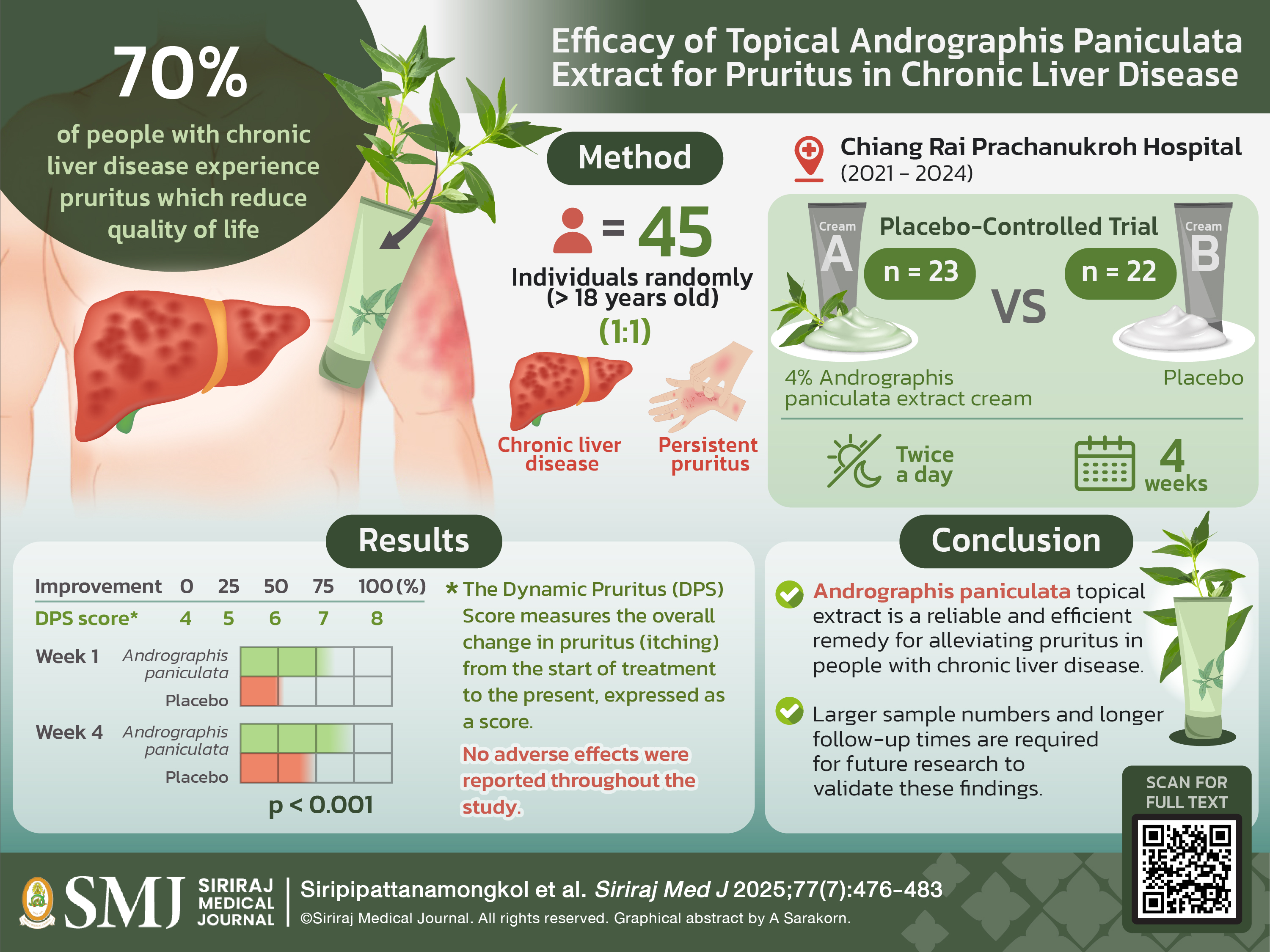
Objective: Assessing the effectiveness of topical extract from Andrographis paniculata, which has anti-inflammatory properties, in reducing pruritus in individuals with chronic liver disease.
Materials and Methods: At Chiang Rai Prachanukroh Hospital, a randomized, placebo-controlled trial was carried out from 2021 to 2024. Forty-five individuals with chronic liver disease and persistent pruritus who were at least eighteen years old were randomly assigned (1:1) to receive 4% extract cream from Andrographis paniculata or a placebo, which was applied twice a day for four weeks. The dynamic pruritus score (DPS), which was used to measure pruritus severity at baseline, week 1, and week 4, was the main outcome. The dermatology life quality index (DLQI) was used to measure the quality of life as the secondary outcome.
Results: The Andrographis paniculata extract significantly improved the pruritus severity compared to placebo, with DPS scores of 6.31±0.41 at week 1 and 6.82±0.40 at week 4 versus 5.01±0.24 and 5.59±0.35, respectively (p<0.001). However, there was no significant difference in DLQI scores between treatments. There were no adverse effects reported, and one participant in the treatment arm withdrew due to logistical issues.
Conclusion: Andrographis paniculata topical extract is a reliable and efficient remedy for alleviating pruritus in individuals with chronic liver disease. However, larger sample numbers and longer follow-up times are required for future research to validate these findings and evaluate the impact on quality of life.
References
Mela M, Mancuso A, Burroughs AK. Review article: pruritus in cholestatic and other liver diseases. Aliment Pharmacol Ther. 2003;17(7):857–70.
Rishe E, Azarm A, Bergasa NV. Itch in primary biliary cirrhosis: a patient ‘perspective. Acta Derm Venereol. 2008;88(1):34–37.
Bergasa NV. The pruritus of cholestasis. J Hepatol. 2005;43(6):1078–88.
Ghent CN, Bloomer JR, Klatskin G. Elevations in skin tissue levels of bile acids in human cholestasis: relation to serum levels and pruritus. Gastroenterology. 1977;73(5):1125–30.
Kremer AE, Martens JJ, Kulik W, Rueff F, Kuiper EMM, van Buuren HR, et al. Lysophosphatidic acid is a potential mediator of cholestatic pruritus. Gastroenterology. 2010;139(3):1008−18.
Hagermark O. Peripheral and central mediators of itch. Skin Pharmacol. 1992;5(1):1–8.
van Meeteren LA, Moolenaar WH. Regulation and biological activities of the autotaxin-LPA axis. Prog Lipid Res. 2007;46(2):145–60.
Hashimoto T, Ohata H, Momose K. Itch-scratch responses induced by lysophosphatidic acid in mice. Pharmacology. 2004;72(1):51–56.
Bunchorntavakul C, Reddy KR. Pruritus in chronic cholestatic liver disease. Clin Liver Dis. 2012;16:331–46.
Kremer AE, Oude Elferink RP, Beuers U. Pathophysiology, and current management of pruritus in liver disease. Clin Res Hepatol Gastroenterol. 2011;35(2):89–97.
Ikoma A, Steinhoff M, Ständer S, Yosipovitch G, Schmelz M. The neurobiology of itch. Nat Rev Neurosci. 2006;7(7):535–47.
Kremer AE, Beuers U, Oude-Elferink RP, Pusl T. Pathogenesis and treatment of pruritus in cholestasis. Drugs. 2008;68:2163–82.
Vinod S Hegade, Stuart FW Kendrick, David EJ Jones. Drug treatment of pruritus in liver diseases. Clin Med. 2015;15(4):351–7.
Javitt NB. Letter: timing of cholestyramine doses in cholestatic liver disease. N Engl J Med. 1974;290(23):1328–9.
George RB, Allen TK, Habib AS. Serotonin receptor antagonists for the prevention and treatment of pruritus, nausea, and vomiting in women undergoing cesarean delivery with intrathecal morphine: a systematic review and meta-analysis. Anesth Analg. 2009;109(1):174–82.
Thisoda P, Rangkadilok N, Pholphana N, Worasuttayangkurn L, Ruchirawat S, Satayavivad J. Inhibitory effect of Andrographis paniculata extract and its active diterpenoids on platelet aggregation. Eur J Pharmacol. 2006;553:39-45.
Sheeja K, Shihab PK, Kuttan G. Antioxidant and anti-inflammatory activities of the plant Andrographis Paniculata Nees. Immunopharmacol Immunotoxicol. 2006;28(1):129-40.
Song CH, Lee MH, No KO, Kang SJ. Andrographolide or Andrographis paniculata extract containing composition having an anti-itching effect (Patent No. KR20030098988). Republic of Korea. Issued December 29, 2003.
Kumar, RA, Sridevi K, Kumar NV, Nanduri S, Rajagopal S. Anticancer and immunostimulatory compounds from Andrographis paniculata. J Ethnopharmacol. 2004;92(2−3):291−5.
Zou W, Xiao Z, Wen X, Luo J, Chen S, Cheng Z, et al. The anti-inflammatory effect of Andrographis paniculata (Burm. f.) Nees on pelvic inflammatory disease in rats through down-regulation of the NF-κB pathway. BMC Complement Altern Med. 2016;16(1):483.
Li Z, Tan J, Wang L, Li Q. Andrographolide benefits rheumatoid arthritis via inhibiting MAPK pathways. Inflammation. 2017;40(5):1599−605.
Cáceres DD, Hancke JL, Burgos RA, Sandberg F, Wikman GK. Use of visual analogue scale measurements (VAS) to assess the effectiveness of standardized Andrographis paniculata extract SHA-10 in reducing the symptoms of the common cold. A randomized double-blind placebo study. Phytomedicine. 1999;6(4):217−23.
Burgos RA, Hancke JL, Bertoglio JC, Aguirre V, Arriagada S, Calvo M, et al. Efficacy of an Andrographis paniculata composition for the relief of rheumatoid arthritis symptoms: A prospective randomized placebo-controlled trial. Clin Rheumatol. 2009;28(8):931–46.
Che D, Hou Y, Zeng Y, Li C, Zhang Y, Wei D, et al. Dehydroandrographolide inhibits IgE-mediated anaphylactic reactions via the calcium signaling pathway. Toxicol Appl Pharmacol. 2019;366:46–53.
Ständer S, Blome C, Anastasiadou Z, Zeidler C, Jung KA, Tsianakas A, et al. Dynamic pruritus score: evaluation of the validity and reliability of a new instrument to assess the course of pruritus. Acta Derm Venereol. 2017;97(2):230–4.
Zou Q, Luo Y, Hao D, Li M, Jihui C. Validation and application of the Dermatology Life Quality Index score, a modification of the DLQI score, in psoriasis patients. J Health Popul Nutr. 2024;43(1):92.
Kulthana K, Jiamton S, Wanitphakdeedecha R, Chantharujikaphong S. The validity and reliability of the dermatology life quality index (DLQI) in Thais. Thai J Dermatol. 2004; 20:113−23.
Kulthanan K, Jiamton S, Kittisarapong R. Dermatology life quality index in Thai Patients with Acne. Siriraj Med J. 2007;59:3−7.
Noppakun N, Rajatanavin N, Suthipinittharm P, Puvabanditsin P, Akaraphanth R, Tuchinda C, et al. Clinical Practice Guideline for Psoriasis. Dermatological Society of Thailand 2011. Retrieved May 30, 2020, Available from: http://www.dst.or.th/files_news/007-Guideline_Psoriasis_2011.pdf.
Kobpungton P, Thampanya V, Sirijanchune P, Chueamuangphan N. Effect of topical Andrographis paniculata extract on end-stage renal disease pruritus: A randomized controlled trial. The Clinical Academia. 2021;45(2):53–59.
Rangkadilok N, Pholphana N, Suriyo T, Satayavivad J. ฟ้าทะลายโจร (Andrographis paniculata) – ข้อมูลวิชาการที่น่ารู้ [Andrographis paniculata – Academic information worth knowing]. Chulabhorn Research Institute 2016. Retrieved May 30, 2020, from http://www.eht.sc.mahidol.ac.th/-article/1818.
Published
How to Cite
License
Copyright (c) 2025 Siriraj Medical Journal

This work is licensed under a Creative Commons Attribution-NonCommercial-NoDerivatives 4.0 International License.
Authors who publish with this journal agree to the following conditions:
Copyright Transfer
In submitting a manuscript, the authors acknowledge that the work will become the copyrighted property of Siriraj Medical Journal upon publication.
License
Articles are licensed under a Creative Commons Attribution-NonCommercial-NoDerivatives 4.0 International License (CC BY-NC-ND 4.0). This license allows for the sharing of the work for non-commercial purposes with proper attribution to the authors and the journal. However, it does not permit modifications or the creation of derivative works.
Sharing and Access
Authors are encouraged to share their article on their personal or institutional websites and through other non-commercial platforms. Doing so can increase readership and citations.