
Osteitis in Chronic Rhinosinusitis: A State-of-the-Art Review
DOI:
https://doi.org/10.33192/smj.v77i7.274010Keywords:
Bone remodeling, chronic rhinosinusitis, hyperostosis, neo-osteogenesis, osteitisAbstract
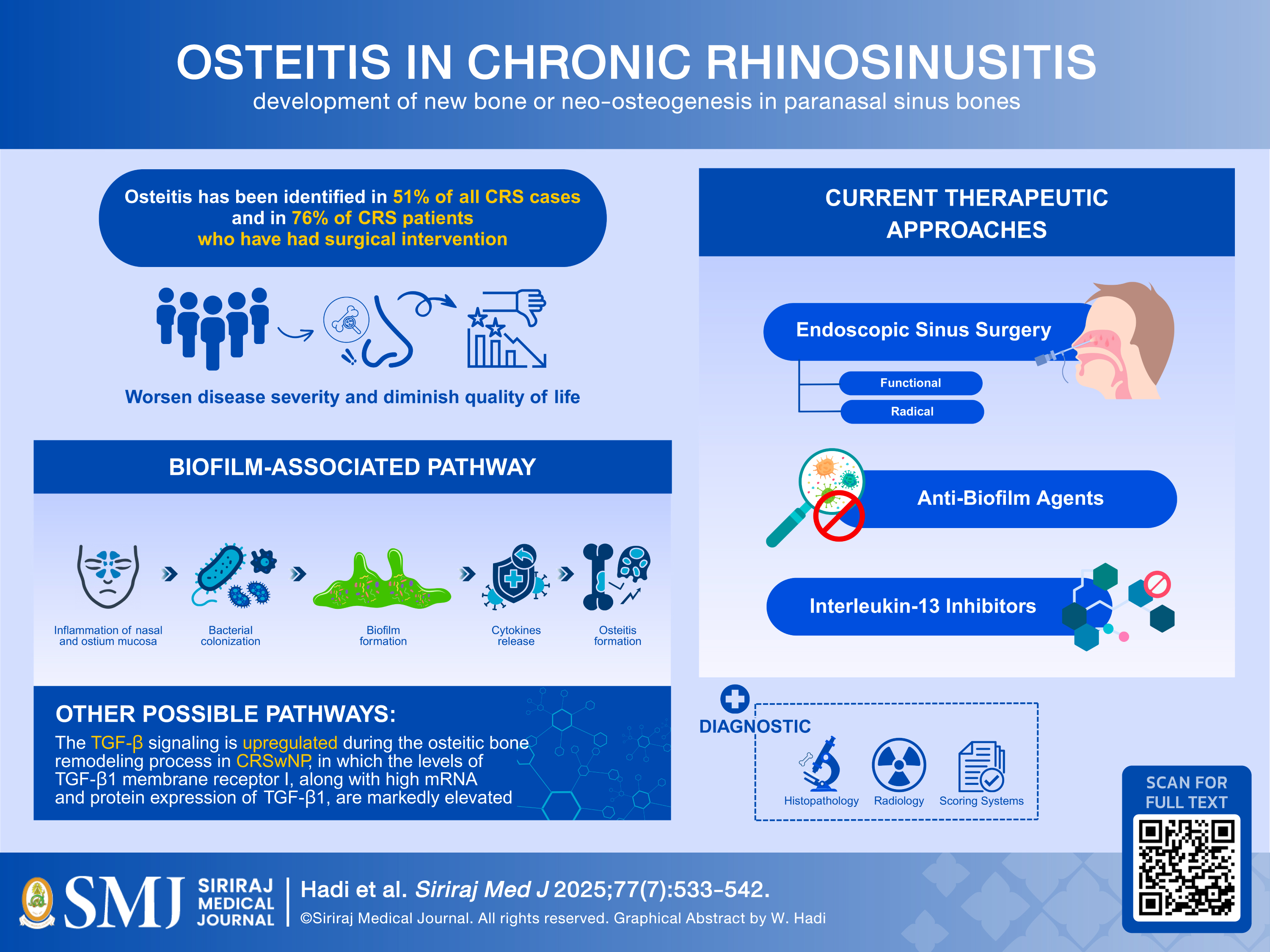
Chronic rhinosinusitis (CRS) is characterized by inflammation of the nasal mucosa and paranasal sinuses. Mucosal inflammation can induce bone remodeling leading to osteitis. Paranasal sinus osteitis is a relatively new clinical finding, describing changes in the bone due to inflammation that will damage the lamellar bone structure and new bone formation. As many as 36-53% of CRS patients have osteitis, which makes CRS difficult to cure despite adequate management and is related to a substantial number of revision surgeries. Understanding all the evidence regarding osteitis in CRS is critical in discovering effective treatments for this incurable disease. Hence, we summarize the essential yet well-established features of osteitis in CRS, including the updated definition, the role of biofilm formation along with cytokines and runt-related transcription factor 2 axis as its possible underlying pathogenesis, the transforming growth factor beta signaling pathway of the disease, histopathological bone changes, radiographic staging and scoring systems, disease impacts on the CRS severity and quality of life, as well as the most up-to-date treatment strategies for osteitis in CRS. These include functional or radical endoscopic sinus surgery, interleukin-13 inhibitors, anti-biofilm agents, high-dose intranasal corticosteroids, and other potential therapies.
References
Fokkens WJ, Lund VJ, Hopkins C, Hellings PW, Kern R, Reitsma S, et al. European Position Paper on Rhinosinusitis and Nasal Polyps 2020. Rhinology. 2020;58(Suppl S29):1-464.
Kato A, Peters AT, Stevens WW, Schleimer RP, Tan BK, Kern RC. Endotypes of chronic rhinosinusitis: Relationships to disease phenotypes, pathogenesis, clinical findings, and treatment approaches. Allergy. 2022;77(3):812-26.
Kato A, Schleimer RP, Bleier BS. Mechanisms and pathogenesis of chronic rhinosinusitis. J Allergy Clin Immunol. 2022;149(5):1491-1503.
Dietz de Loos D, Lourijsen ES, Wildeman MAM, Freling NJM, Wolvers MDJ, Reitsma S, et al. Prevalence of chronic rhinosinusitis in the general population based on sinus radiology and symptomatology. J Allergy Clin Immunol. 2019;143(3):1207-14.
Min HK, Lee S, Kim S, Son Y, Park J, Kim HJ, et al. Global incidence and prevalence of chronic rhinosinusitis: A systematic review. Clin Exp Allergy. 2025;55(1):52-66.
van der Veen J, Seys SF, Timmermans M, Levie P, Levie P, Jorissen M, Fokkens WJ, et al. Real-life study showing uncontrolled rhinosinusitis after sinus surgery in a tertiary referral centre. Allergy. 2017;72(2):282-90.
Georgalas C, Videler W, Freling N, Fokkens W. Global Osteitis Scoring Scale and chronic rhinosinusitis: A marker of revision surgery. Clin Otolaryngol. 2010;35(6):455-61.
Kong IG, Kim DW. Pathogenesis of recalcitrant chronic rhinosinusitis: The emerging role of innate immune cells. Immune Netw. 2018;18(2):e6.
Lee JT, Kennedy DW, Palmer JN, Feldman M, Chiu AG. The incidence of concurrent osteitis in patients with chronic rhinosinusitis: A clinicopathological study. Am J Rhinol. 2006;20(3):278-82.
Israchmadi A, Ningrum FH, Baskoro N, Mailasari A. Correlation between the severity of chronic rhinosinusitis and the degree of osteitis based on computerized tomography evaluation. Medica Hospitalia J Clin Med. 2024;11(2):209-13.
Snidvongs K, McLachlan R, Chin D, Pratt E, Sacks R, Earls P, et al. Osteitic bone: A surrogate marker of eosinophilia in chronic rhinosinusitis. Rhinology. 2012;50(3):299-305.
Saladin KS. Anatomy & physiology: The unity of form and function. New York, NY: McGraw-Hill Companies; 2007.
Kennedy DW, Senior BA, Gannon FH, Montone KT, Hwang P, Lanza DC. Histology and histomorphometry of ethmoid bone in chronic rhinosinusitis. Laryngoscope. 1998;108(4 Pt 1):502-7.
Westrin KM, Norlander T, Stierna P, Carlsöö B, Nord CE. Experimental maxillary sinusitis induced by Bacteroides fragilis: A bacteriological and histological study in rabbits. Acta Otolaryngol. 1992;112(1):107-14.
Perloff JR, Gannon FH, Bolger WE, Montone KT, Orlandi R, Kennedy DW. Bone involvement in sinusitis: An apparent pathway for the spread of disease. Laryngoscope. 2000;110(12):2095-9.
Antunes MB, Feldman MD, Cohen NA, Chiu AG. Dose-dependent effects of topical tobramycin in an animal model of Pseudomonas sinusitis. Am J Rhinol. 2007;21(4):423-7.
Cho SH, Min HJ, Han HX, Paik SS, Kim KR. CT analysis and histopathology of bone remodeling in patients with chronic rhinosinusitis. Otolaryngol Head Neck Surg. 2006;135(3):404-8.
Snidvongs K, Earls P, Dalgorf D, Sacks R, Pratt E, Harvey RJ. Osteitis is a misnomer: A histopathology study in primary chronic rhinosinusitis. Int Forum Allergy Rhinol. 2014;4(5):390-6.
Wang M, Ye T, Liang N, Huang Z, Cui S, Li Y, et al. Differing roles for TGF-β/Smad signaling in osteitis in chronic rhinosinusitis with and without nasal polyps. Am J Rhinol Allergy. 2015;29(5):e152-9.
Zhang Z, Zuo Q, Du Y, Jiang H, Ma F, Zhang Y. Correlation of eosinophils and type 2 inflammatory mediators with osteitis in chronic rhinosinusitis with nasal polyps. J Inflamm Res. 2024;17:4055-64.
Jiao J, Wang C, Zhang L. Epithelial physical barrier defects in chronic rhinosinusitis. Expert Rev Clin Immunol. 2019;15(6):679-88.
Cho DY, Hunter RC, Ramakrishnan VR. The microbiome and chronic rhinosinusitis. Immunol Allergy Clin North Am. 2020;40(2):251-63.
He Y, Fu Y, Wu Y, Zhu T, Li H. Pathogenesis and treatment of chronic rhinosinusitis from the perspective of sinonasal epithelial dysfunction. Front Med (Lausanne). 2023;10:1139240.
Kim YJ, Cho HJ, Shin WC, Song HA, Yoon JH, Kim CH. Hypoxia-mediated mechanism of MUC5AC production in human nasal epithelia and its implication in rhinosinusitis. PLoS One. 2014;9(5):e98136.
Hansson GC. Mucins and the microbiome. Annu Rev Biochem. 2020;89:769-93.
Zhai Z, Shao L, Lu Z, Yang Y, Wang J, Liu Z, et al. Characteristics of mucin hypersecretion in different inflammatory patterns based on endotypes of chronic rhinosinusitis. Clin Transl Allergy. 2024;14(1):e12334.
Rice DH. Biofilm in chronic rhinosinusitis: A review. Med Res Arch. 2020;8(2).
Sauer K, Stoodley P, Goeres DM, Hall-Stoodley L, Burmølle M, Stewart PS, et al. The biofilm life cycle: Expanding the conceptual model of biofilm formation. Nat Rev Microbiol. 2022;20(10):608-20.
Maina IW, Patel NN, Cohen NA. Understanding the role of biofilms and superantigens in chronic rhinosinusitis. Curr Otorhinolaryngol Rep. 2018;6(3):253-62.
Chegini Z, Noei M, Hemmati J, Arabestani MR, Shariati A. The destruction of mucosal barriers, epithelial remodeling, and impaired mucociliary clearance: Possible pathogenic mechanisms of Pseudomonas aeruginosa and Staphylococcus aureus in chronic rhinosinusitis. Cell Commun Signal. 2023;21(1):306.
Tantilipikorn P, Bunnag C, Srifuengfung S, Dhiraputra C, Tiensasitorn C, Jaroencharsri P, et al. A surveillance study of bacteriologic profile in rhinosinusitis. Siriraj Med J. 2007;59(4):177-80.
Bedavanija A, Tantilipikorn P, Banditsing C, Kiratisin P, Bunnag C. A comparison of the bacterial culture results of maxillary sinus mucosa and pus collections for chronic maxillary rhinosinusitis. Siriraj Med J. 2019;71(2):95-101.
Xu J, Yu L, Liu F, Wan L, Deng Z. The effect of cytokines on osteoblasts and osteoclasts in bone remodeling in osteoporosis: A review. Front Immunol. 2023;14:1222129.
Khalmuratova R, Park JW, Shin HW. Immune cell responses and mucosal barrier disruptions in chronic rhinosinusitis. Immune Netw. 2017;17(1):60-67.
Onoe Y, Miyaura C, Kaminakayashiki T, Nagai Y, Noguchi K, Chen QR, et al. IL-13 and IL-4 inhibit bone resorption by suppressing cyclooxygenase-2-dependent prostaglandin synthesis in osteoblasts. J Immunol. 1996;156(2):758-64.
Silfverswärd CJ, Penno H, Frost A, Nilsson O, Ljunggren O. Expression of markers of activity in cultured human osteoblasts: effects of interleukin-4 and interleukin-13. Scand J Clin Lab Invest. 2010;70(5):338-42.
Khalmuratova R, Shin HW, Kim DW, Park JW. Interleukin (IL)-13 and IL-17A contribute to neoosteogenesis in chronic rhinosinusitis by inducing RUNX2. EBioMedicine. 2019;46:330-41.
Beringer A, Miossec P. Systemic effects of IL-17 in inflammatory arthritis. Nat Rev Rheumatol. 2019;15(8):491-501.
Vander Ark A, Cao J, Li X. TGF-β receptors: In and beyond TGF-β signaling. Cell Signal. 2018;52:112-20.
Salib RJ, Howarth PH. Transforming growth factor-beta in allergic inflammatory disease of the upper airways: Friend or foe? Clin Exp Allergy. 2009;39(8):1128-35.
Van Zele T, Claeys S, Gevaert P, Van Maele G, Holtappels G, Van Cauwenberge P, et al. Differentiation of chronic sinus diseases by measurement of inflammatory mediators. Allergy. 2006;61(11):1280-9.
Van Bruaene N, Derycke L, Perez-Novo CA, Gevaert P, Holtappels G, De Ruyck N, et al. TGF-beta signaling and collagen deposition in chronic rhinosinusitis. J Allergy Clin Immunol. 2009;124(2):253-9, 259.e1-2.
Park YG, Kang SK, Kim WJ, Lee YC, Kim CH. Effects of TGF-beta, TNF-alpha, IL-beta and IL-6 alone or in combination, and tyrosine kinase inhibitor on cyclooxygenase expression, prostaglandin E2 production and bone resorption in mouse calvarial bone cells. Int J Biochem Cell Biol. 2004;36(11):2270-80.
Takai E, Tsukimoto M, Kojima S. TGF-β1 downregulates COX-2 expression leading to decrease of PGE2 production in human lung cancer A549 cells, which is involved in fibrotic response to TGF-β1. PLoS One. 2013;8(10):e76346.
Snidvongs K, Sacks R, Harvey RJ. Osteitis in Chronic Rhinosinusitis. Curr Allergy Asthma Rep. 2019;19(5):24.
Shapiro F, Wu JY. Woven bone overview: structural classification based on its integral role in developmental, repair and pathological bone formation throughout vertebrate groups. Eur Cell Mater. 2019;38:137-67.
Pokharel M, Khadilkar MN, Sreedharan S, Pai R, Shenoy V, Bhojwani K, et al. Bone changes in chronic rhinosinusitis: Pathological or physiological? Indian J Otolaryngol Head Neck Surg. 2022;74(2):178-84.
Cho SH, Shin KS, Lee YS, Jeong JH, Lee SH, Tae K, et al. Impact of chronic rhinosinusitis and endoscopic sinus surgery on bone remodeling of the paranasal sinuses. Am J Rhinol. 2008;22(5):537-41.
Dong Y, Zhou B, Wang X, Huang Z, Wang M, Li Y, et al. Computed tomography and histopathological evaluation of osteitis in rabbit models with rhinosinusitis. Acta Otolaryngol. 2017;137(5):534-40.
Che Z, Zhang Q, Zhao P, Lv H, Ding H, Li J, et al. Computed tomography evaluation of unilateral chronic maxillary sinusitis with osteitis. Ear Nose Throat J. 2023;102(5):NP237-NP244.
Crișan G, Moldovean-Cioroianu NS, Timaru DG, Andrieș G, Căinap C, Chiș V. Radiopharmaceuticals for PET and SPECT imaging: A literature review over the last decade. Int J Mol Sci. 2022;23(9):5023.
Jang YJ, Koo TW, Chung SY, Park SG. Bone involvement in chronic rhinosinusitis assessed by 99mTc-MDP bone SPECT. Clin Otolaryngol Allied Sci. 2002;27(3):156-61.
Catalano PJ, Dolan R, Romanow J, Payne SC, Silverman M. Correlation of bone SPECT scintigraphy with histopathology of the ethmoid bulla: Preliminary investigation. Ann Otol Rhinol Laryngol. 2007;116(9):647-52.
Li YX, Lin F, Cheng L, Huang Q, Huang ZX, Zhang XQ, Zhou B. Clinical application of modified global osteitis score in chronic rhinosinusitis. Lin Chuang Er Bi Yan Hou Tou Jing Wai Ke Za Zhi. 2017;31(21):1666-70.
Bhandarkar ND, Mace JC, Smith TL. The impact of osteitis on disease severity measures and quality of life outcomes in chronic rhinosinusitis. Int Forum Allergy Rhinol. 2011;1(5):372-8.
Brooks SG, Trope M, Blasetti M, Doghramji L, Parasher A, Glicksman JT, et al. Preoperative Lund-Mackay computed tomography score is associated with preoperative symptom severity and predicts quality-of-life outcome trajectories after sinus surgery. Int Forum Allergy Rhinol. 2018;8(6):668-75.
Cheng L, Huang ZX, Zhou B, Huang Q, Wang CS, Cui SJ, et al. Clinical implication of global osteitis score system and its role in evaluation of osteitis of chronic rhinosinusitis. Zhonghua Er Bi Yan Hou Tou Jing Wai Ke Za Zhi. 2013;48(2):119-22.
Huang Z, Hajjij A, Li G, Nayak JV, Zhou B, Hwang PH. Clinical predictors of neo-osteogenesis in patients with chronic rhinosinusitis. Int Forum Allergy Rhinol. 2015;5(4):303-9.
Aparna S, George S. The impact of osteitis on quality of life in patients with chronic rhinosinusitis. Indian J Otolaryngol Head Neck Surg. 2023;75(Suppl 1):1056-61.
Gallo S, Russo F, Mozzanica F, Preti A, Bandi F, Costantino C, et al. Prognostic value of the Sinonasal Outcome Test 22 (SNOT-22) in chronic rhinosinusitis. Acta Otorhinolaryngol Ital. 2020;40(2):113-21.
Ting F, Hopkins C. Outcome measures in chronic rhinosinusitis. Curr Otorhinolaryngol Rep. 2018;6(3):271-5.
Yim MT, Smith KA, Alt JA, Orlandi RR. The value of endoscopic sinus surgery in chronic rhinosinusitis. Laryngoscope Investig Otolaryngol. 2021;6(1):58-63.
Bassiouni A, Naidoo Y, Wormald PJ. When FESS fails: The inflammatory load hypothesis in refractory chronic rhinosinusitis. Laryngoscope. 2012;122(2):460-6.
Wreesmann VB, Fokkens WJ, Knegt PP. Refractory chronic sinusitis: Evaluation of symptom improvement after Denker's procedure. Otolaryngol Head Neck Surg. 2001;125(5):495-500.
Wang M, Zhou B, Li Y, Cui S, Huang Q. Radical versus functional endoscopic sinus surgery for osteitis in chronic rhinosinusitis. ORL J Otorhinolaryngol Relat Spec. 2021;83(4):234-41.
Aldajani A, Alroqi A, Alrashidi A, Alsaif A, Almeshari S, Aldwaighri M, et al. Outcomes of endoscopic sinus surgery for chronic rhinosinusitis with nasal polyposis and risk factors of recurrence in a tertiary care teaching hospital. Ther Adv Allergy Rhinol. 2024;15:27534030241274764.
Khalmuratova R, Lee M, Park JW, Shin HW. Evaluation of neo-osteogenesis in eosinophilic chronic rhinosinusitis using a nasal polyp murine model. Allergy Asthma Immunol Res. 2020;12(2):306-21.
Hershey GK. IL-13 receptors and signaling pathways: An evolving web. J Allergy Clin Immunol. 2003;111(4):677-90; quiz 691.
Mukerji SS, Pynnonen MA, Kim HM, Singer A, Tabor M, Terrell JE. Probiotics as adjunctive treatment for chronic rhinosinusitis: A randomized controlled trial. Otolaryngol Head Neck Surg. 2009;140(2):202-8.
Chiu AG, Palmer JN, Woodworth BA, Doghramji L, Cohen MB, Prince A, et al. Baby shampoo nasal irrigations for the symptomatic post-functional endoscopic sinus surgery patient. Am J Rhinol. 2008;22(1):34-7.
Alandejani T, Marsan J, Ferris W, Slinger R, Chan F. Effectiveness of honey on Staphylococcus aureus and Pseudomonas aeruginosa biofilms. Otolaryngol Head Neck Surg. 2009;141(1):114-8.
Paramasivan S, Drilling AJ, Jardeleza C, Jervis-Bardy J, Vreugde S, Wormald PJ. Methylglyoxal-augmented manuka honey as a topical anti-Staphylococcus aureus biofilm agent: Safety and efficacy in an in vivo model. Int Forum Allergy Rhinol. 2014;4(3):187-95.
Jervis-Bardy J, Boase S, Psaltis A, Foreman A, Wormald PJ. A randomized trial of mupirocin sinonasal rinses versus saline in surgically recalcitrant staphylococcal chronic rhinosinusitis. Laryngoscope. 2012;122(10):2148-53.
Kurasirikul S, Jirapongsananurak O, Vichyanond P, Visitsunthorn N. Gentamicin nasal irrigation in children with chronic rhinosinusitis: A retrospective cohort of 38 patients. Siriraj Med J. 2014;66(2):28-32.
Al-Mutairi D, Kilty SJ. Bacterial biofilms and the pathophysiology of chronic rhinosinusitis. Curr Opin Allergy Clin Immunol. 2011;11(1):18-23.
Foreman A, Jervis-Bardy J, Wormald PJ. Do biofilms contribute to the initiation and recalcitrance of chronic rhinosinusitis? Laryngoscope. 2011;121(5):1085-91.
Foreman A, Boase S, Psaltis A, Wormald PJ. Role of bacterial and fungal biofilms in chronic rhinosinusitis. Curr Allergy Asthma Rep. 2012;12(2):127-35.
Dong D, Yulin Z, Xiao W, Hongyan Z, Jia L, Yan X, et al. Correlation between bacterial biofilms and osteitis in patients with chronic rhinosinusitis. Laryngoscope. 2014;124(5):1071-7.
Hadi W, Handoko E, Noorhamdani, Prawiro SR. Effect of ethanolic extract propolis Trigona spp. Malang Indonesia on isolate Staphylococcus aureus biofilm architecture from chronic rhinosinusitis: A confocal laser scanning microscopic study. Int J Pharm Sci Res. 2019;10(6):2711-7.
Goggin R, Jardeleza C, Wormald PJ, Vreugde S. Corticosteroids directly reduce Staphylococcus aureus biofilm growth: An in vitro study. Laryngoscope. 2014;124(3):602-7.
Published
How to Cite
License
Copyright (c) 2025 Siriraj Medical Journal

This work is licensed under a Creative Commons Attribution-NonCommercial-NoDerivatives 4.0 International License.
Authors who publish with this journal agree to the following conditions:
Copyright Transfer
In submitting a manuscript, the authors acknowledge that the work will become the copyrighted property of Siriraj Medical Journal upon publication.
License
Articles are licensed under a Creative Commons Attribution-NonCommercial-NoDerivatives 4.0 International License (CC BY-NC-ND 4.0). This license allows for the sharing of the work for non-commercial purposes with proper attribution to the authors and the journal. However, it does not permit modifications or the creation of derivative works.
Sharing and Access
Authors are encouraged to share their article on their personal or institutional websites and through other non-commercial platforms. Doing so can increase readership and citations.