
Integrating Artificial Intelligence into Chronic Kidney Disease Care: Enhancing Hemodialysis Scheduling, Comorbidity Management, and Diagnostic Capabilities
DOI:
https://doi.org/10.33192/smj.v77i7.274440Keywords:
Chronic kidney disease, Hemodialysis, Artificial intelligenceAbstract
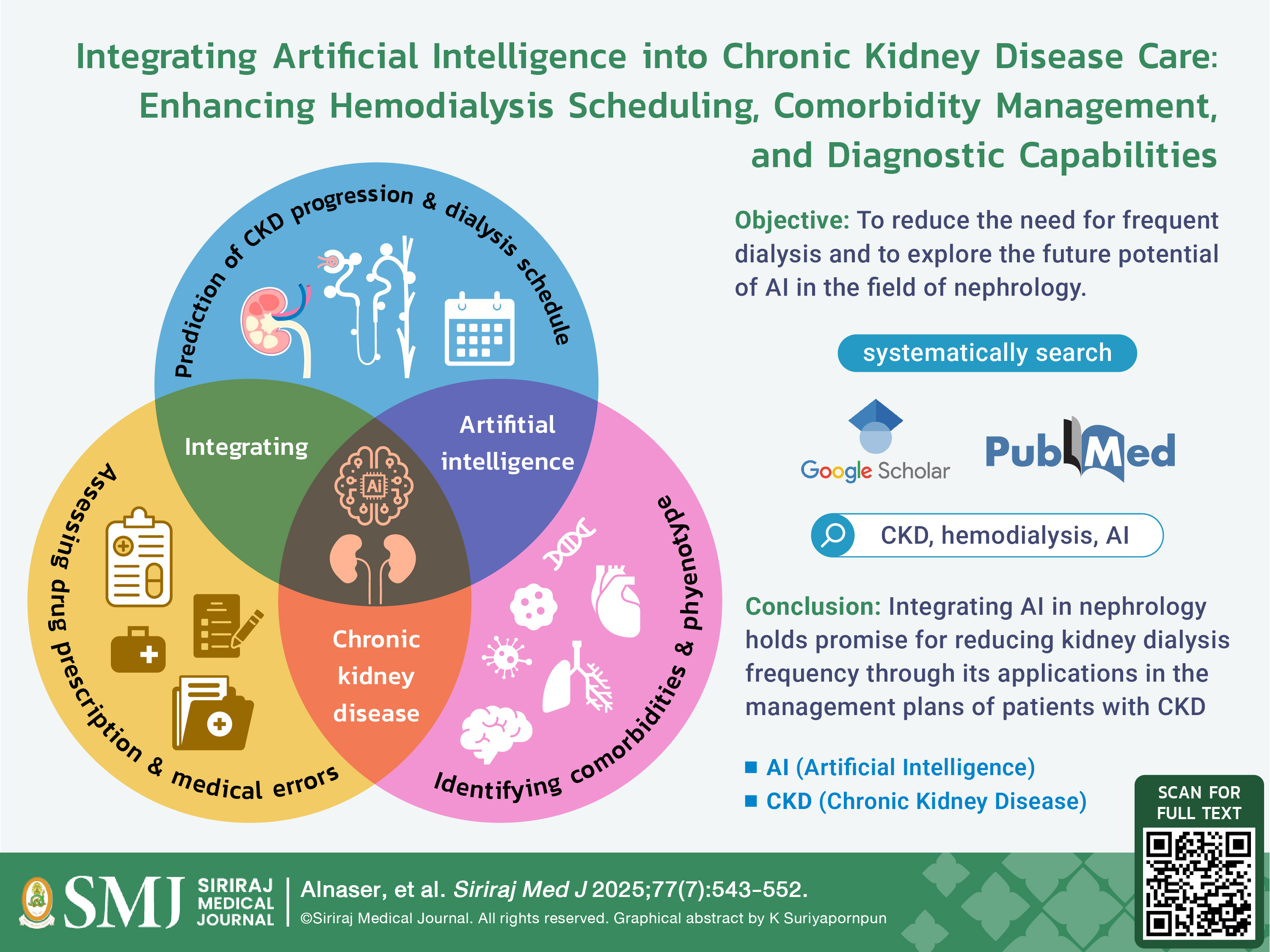
Chronic kidney disease (CKD) is one of the most common and serious illnesses affecting individuals worldwide, potentially leading to kidney failure. Various strategies exist to manage CKD, with hemodialysis being the most effective. However, this treatment comes with numerous limitations that can significantly affect patients’ quality of life. Therefore, it is crucial to explore new approaches to address these challenges. Recently, artificial intelligence (AI) has emerged as a promising tool in nephrology. This review aims to reduce the need for frequent dialysis and to explore the future potential of AI in the field of nephrology. The frequency of hemodialysis refers to the regular, scheduled dialysis sessions mainly prescribed for patients with CKD, in addition to the unplanned or premature initiation of hemodialysis through predictive and preventive interventions. This narrative review systematically searched Google Scholar and PubMed using keywords related to CKD, hemodialysis, and AI. AI is used in kidney disease to predict CKD progression, evaluate drug prescriptions, detect medical errors, adjust dialysis schedules, and identify unknown comorbidities and phenotypes. Integrating AI in nephrology holds promise for reducing kidney dialysis frequency through its applications in the management plans of patients with CKD.
References
Foreman KJ, Marquez N, Dolgert A, Fukutaki K, Fullman N, McGaughey M, et al. Forecasting life expectancy, years of life lost, and all-cause and cause-specific mortality for 250 causes of death: reference and alternative scenarios for 2016–40 for 195 countries and territories. Lancet. 2018;392(10159):2052–90.
Romagnani P, Remuzzi G, Glassock R, Levin A, Jager KJ, Tonelli M, et al. Chronic kidney disease. Nat Rev Dis Prim. 2017;3(1):17088.
Ammirati AL. Chronic Kidney Disease. Rev Assoc Med Bras. 2020;66(suppl 1):s03–9.
Lateef A. Psychological Impact of Chronic Kidney Disease and Hemodialysis: Narrative Review. Psychosom Med Res. 2022;4(2):9.
Bello AK, Okpechi IG, Osman MA, Cho Y, Htay H, Jha V, et al. Epidemiology of haemodialysis outcomes. Nat Rev Nephrol. 2022;18(6):378–95.
Zaki MK, Abed MN, Alassaf FA. Antidiabetic Agents and Bone Quality: A Focus on Glycation End Products and Incretin Pathway Modulations. J Bone Metab. 2024;31(3):169–81.
Himmelfarb J, Vanholder R, Mehrotra R, Tonelli M. The current and future landscape of dialysis. Nat Rev Nephrol. 2020;16(10):573–85.
Niel O, Bastard P. Artificial Intelligence in Nephrology: Core Concepts, Clinical Applications, and Perspectives. Am J Kidney Dis. 2019;74(6):803–10.
Chen TK, Knicely DH, Grams ME. Chronic Kidney Disease Diagnosis and Management. JAMA. 2019;322(13):1294.
Saran R. US renal data system. 2018 USRDS annual data report: epidemiology of kidney disease in the United States. Vol. 73, Am J Kidney Dis. 2019.p.Svii‐Sxxii, S1‐S.
Anderson TJ, Grégoire J, Pearson GJ, Barry AR, Couture P, Dawes M, et al. 2016 Canadian Cardiovascular Society Guidelines for the Management of Dyslipidemia for the Prevention of Cardiovascular Disease in the Adult. Can J Cardiol. 2016;32(11):1263–82.
Sarafidis PA, Khosla N, Bakris GL. Antihypertensive Therapy in the Presence of Proteinuria. Am J Kidney Dis. 2007;49(1):12–26.
Banerjee D, Winocour P, Chowdhury TA, De P, Wahba M, Montero R, et al. Management of hypertension and renin-angiotensin-aldosterone system blockade in adults with diabetic kidney disease: Association of British Clinical Diabetologists and the Renal Association UK guideline update 2021. BMC Nephrol. 2022;23(1):9.
Whelton PK, Carey RM, Aronow WS, Casey DE, Collins KJ, Dennison Himmelfarb C, et al. 2017 ACC/AHA/AAPA/ABC/ACPM/AGS/APhA/ASH/ASPC/NMA/PCNA Guideline for the Prevention, Detection, Evaluation, and Management of High Blood Pressure in Adults. J Am Coll Cardiol. 2018;71(19):e127–248.
Burnier M, Bakris G, Williams B. Redefining diuretics use in hypertension. J Hypertens. 2019;37(8):1574–86.
Ohno S, Ishii A, Yanagita M, Yokoi H. Calcium channel blocker in patients with chronic kidney disease. Clin Exp Nephrol. 2022;26(3):207–15.
Tomiyama H, Yamashina A. Beta-Blockers in the Management of Hypertension and/or Chronic Kidney Disease. Int J Hypertens. 2014;2014:1–7.
Hocht C, Bertera FM, Del Mauro JS, Santander Plantamura Y, Taira CA, Polizio AH. What is the Real Efficacy of Beta-Blockers for the Treatment of Essential Hypertension? Curr Pharm Des. 2017;23(31):4658-77.
Guideline development group, Bilo H, Coentrao L, Couchoud C, Covic A, De Sutter J, et al. Clinical Practice Guideline on management of patients with diabetes and chronic kidney disease stage 3b or higher (eGFR <45 mL/min). Nephrol Dial Transplant. 2015;30(Suppl 2):ii1–142.
Alnaser RI, Alassaf FA, Abed MN. Melatonin as a potential treatment option in diabetes complications. Eur J Transl Clin Med. 2024;7(2):78-91.
Alassaf FA, Jasim MHM, Alfahad M, Qazzaz ME, Abed MN, Thanoon IAJ. Effects of Bee Propolis on FBG, HbA1c, and Insulin Resistance in Healthy Volunteers. Turkish J Pharm Sci. 2021;18(4):405-9.
Ahmed GM, Abed MN, Alassaf FA. An overview of the effects of sodium-glucose co-transporter-2 inhibitors on hematological parameters in diabetic patients. Iraqi J Pharm. 2023;20(1):65–71.
Alnaser RI, Alassaf FA, Abed MN. Adulteration of hypoglycemic products: the silent threat. Rom J Med Pract. 2023;18(4):202–5.
Madero M, Chertow GM, Mark PB. SGLT2 Inhibitor Use in Chronic Kidney Disease: Supporting Cardiovascular, Kidney, and Metabolic Health. Kidney Med. 2024;6(8):100851.
Alnaser RI, Alassaf FA, Abed MN. Incretin-Based Therapies: A Promising Approach for Modulating Oxidative Stress and Insulin Resistance in Sarcopenia. J Bone Metab. 2024;31(4):251-63.
Intensive blood-glucose control with sulphonylureas or insulin compared with conventional treatment and risk of complications in patients with type 2 diabetes (UKPDS 33). Lancet. 1998;352(9131):837–53.
Neal B, Perkovic V, Mahaffey KW, de Zeeuw D, Fulcher G, Erondu N, et al. Canagliflozin and Cardiovascular and Renal Events in Type 2 Diabetes. N Engl J Med. 2017;377(7):644–57.
Ahmed GM, Abed MN, Alassaf FA. Impact of calcium channel blockers and angiotensin receptor blockers on hematological parameters in type 2 diabetic patients. Naunyn Schmiedebergs Arch Pharmacol. 2023;397(3):1817-28.
Hammo AA, Althanoon ZA, Ahmad AA. The Protective Effect of Coenzyme Q10 against Doxorubicin-induced Nephrotoxicity in Albino Rats. Rev Electron Vet. 2022;23(3):314–25.
Abed MN, Qazzaz ME, Alassaf FA. Investigating the nephrotoxic effects of medroxyprogesterone in female albino rats. Ukr J Nephrol Dial. 2024;2(82):25-33.
Markowitz GS, Perazella MA. Acute phosphate nephropathy. Kidney Int. 2009;76(10):1027–34.
Hammo AA, Ahmad AA, Althanoon ZA. Role of Gender in the Protection Against Doxorubicin-Induced Oxidative Stress. Pharmacogn J. 2023;14(6):782–8.
Abed MN, Alassaf FA, Jasim MHM, Alfahad M, Qazzaz ME. Comparison of Antioxidant Effects of the Proton Pump-Inhibiting Drugs Omeprazole, Esomeprazole, Lansoprazole, Pantoprazole, and Rabeprazole. Pharmacology. 2020;105(11–12):645–51.
Alfahad M, Qazzaz ME, Abed MN, Alassaf FA, Jasim MHM. Comparison of Anti-Oxidant Activity of Different Brands of Esomeprazole Available in Iraqi Pharmacies. Syst Rev Pharm. 2020;11(5):330-4.
Palacio‐Lacambra M, Comas‐Reixach I, Blanco‐Grau A, Suñé‐Negre J, Segarra‐Medrano A, Montoro‐Ronsano J. Comparison of the Cockcroft–Gault, MDRD and CKD‐EPI equations for estimating ganciclovir clearance. Br J Clin Pharmacol. 2018;84(9):2120-8.
Inker LA, Astor BC, Fox CH, Isakova T, Lash JP, Peralta CA, et al. KDOQI US Commentary on the 2012 KDIGO Clinical Practice Guideline for the Evaluation and Management of CKD. Am J Kidney Dis. 2014;63(5):713–35.
Bahrainwala JZ, Leonberg‐Yoo AK, Rudnick MR. Use of Radiocontrast Agents in CKD and ESRD. Semin Dial. 2017;30(4):290–304.
Perazella MA. Advanced kidney disease, gadolinium and nephrogenic systemic fibrosis: the perfect storm. Curr Opin Nephrol Hypertens. 2009;18(6):519–25.
Stevens PE, Ahmed SB, Carrero JJ, Foster B, Francis A, Hall RK, et al. KDIGO 2024 Clinical Practice Guideline for the Evaluation and Management of Chronic Kidney Disease. Kidney Int. 2024;105(4):S117–314.
Mohammed AA, Abdulla AA, Karam AA. Measurement of Inflammation-Related Biomarkers in Different Chronic Kidney Diseases in Humans: Role of Aging and Gender? IIUM Med J Malaysia. 2021;20(4):37–43.
Ahmed GM, Alassaf FA, Abed MN. The Interplay of the Angiotensin Receptor Blockers and Haematological Abnormalities: Insights and Implications. J Ayub Med Coll Abbottabad. 2023;35(4 (Suppl 1)):785–92.
Inker LA, Grams ME, Levey AS, Coresh J, Cirillo M, Collins JF, et al. Relationship of Estimated GFR and Albuminuria to Concurrent Laboratory Abnormalities: An Individual Participant Data Meta-analysis in a Global Consortium. Am J Kidney Dis. 2019;73(2):206–17.
Driver TH, Shlipak MG, Katz R, Goldenstein L, Sarnak MJ, Hoofnagle AN, et al. Low Serum Bicarbonate and Kidney Function Decline: The Multi-Ethnic Study of Atherosclerosis (MESA). Am J Kidney Dis. 2014;64(4):534–41.
Abed MN, Alassaf FA, Qazzaz ME. Exploring the Interplay between Vitamin D, Insulin Resistance, Obesity and Skeletal Health. J Bone Metab [Internet]. 2024;31(2):75–89. Available from: http://e-jbm.org/journal/view.php?doi=10.11005/jbm.2024.31.2.75
Vareesangthip K, Thanapattaraborisuth B, Chanchairujira K, Wonglaksanapimon S, Chanchairujira T. Assessment of Volume Status in Chronic Hemodialysis: Comparison of Lung Ultrasound to Clinical Practice and Bioimpedance. Siriraj Med J. 2023;75(3):224–33.
Raebel MA. Hyperkalemia Associated with Use of Angiotensin‐Converting Enzyme Inhibitors and Angiotensin Receptor Blockers. Cardiovasc Ther [Internet]. 2012;30(3):e156–66. Available from: https://onlinelibrary.wiley.com/doi/10.1111/j.1755-5922.2010.00258.x
Srisuwan W, Charoensri S, Jantarakana K, Chanchairujira T. Increasing Dialysate Flow Rate over 500 ml/min for Reused High-Flux Dialyzers do not Increase Delivered Dialysis Dose: A Prospective Randomized Cross Over Study. Siriraj Med J. 2022;74(3):152–60.
Hao W, Tang Q, Huang X, Ao L, Wang J, Xie D. Analysis of the prevalence and influencing factors of depression and anxiety among maintenance dialysis patients during the COVID-19 pandemic. Int Urol Nephrol. 2021;53(7):1453–61.
Chaudhuri S, Long A, Zhang H, Monaghan C, Larkin JW, Kotanko P, et al. Artificial intelligence enabled applications in kidney disease. Semin Dial. 2021;34(1):5-16.
Simeri A, Pezzi G, Arena R, Papalia G, Szili-Torok T, Greco R, et al. Artificial intelligence in chronic kidney diseases: methodology and potential applications. Int Urol Nephrol. 2025;57(1):159-68.
Xie Y, Bowe B, Mokdad AH, Xian H, Yan Y, Li T, et al. Analysis of the Global Burden of Disease study highlights the global, regional, and national trends of chronic kidney disease epidemiology from 1990 to 2016. Kidney Int. 2018;94(3):567–81.
Tangri N, Grams ME, Levey AS, Coresh J, Appel LJ, Astor BC, et al. Multinational Assessment of Accuracy of Equations for Predicting Risk of Kidney Failure. JAMA. 2016;315(2):164-74.
Chauhan K, Nadkarni GN, Fleming F, McCullough J, He CJ, Quackenbush J, et al. Initial Validation of a Machine Learning-Derived Prognostic Test (KidneyIntelX) Integrating Biomarkers and Electronic Health Record Data To Predict Longitudinal Kidney Outcomes. Kidney360. 2020;1(8):731–9.
Chan L, Nadkarni GN, Fleming F, McCullough JR, Connolly P, Mosoyan G, et al. Derivation and validation of a machine learning risk score using biomarker and electronic patient data to predict progression of diabetic kidney disease. Diabetologia. 2021;64(7):1504–15.
Mahesh B. Machine Learning Algorithms - A Review. Int J Sci Res. 2020;9(1):381–6.
MacEachern SJ, Forkert ND. Machine learning for precision medicine. Genome. 2021;64(4):416–25.
Goldstein BA, Chang TI, Mitani AA, Assimes TL, Winkelmayer WC. Near-Term Prediction of Sudden Cardiac Death in Older Hemodialysis Patients Using Electronic Health Records. Clin J Am Soc Nephrol. 2014;9(1):82–91.
Mezzatesta S, Torino C, Meo P De, Fiumara G, Vilasi A. A machine learning-based approach for predicting the outbreak of cardiovascular diseases in patients on dialysis. Comput Methods Programs Biomed. 2019;177:9–15.
Ramspek C, Voskamp P, van Ittersum F, Krediet R, Dekker F, van Diepen M. Prediction models for the mortality risk in chronic dialysis patients: a systematic review and independent external validation study. Clin Epidemiol. 2017;9:451–64.
Xiao J, Ding R, Xu X, Guan H, Feng X, Sun T, et al. Comparison and development of machine learning tools in the prediction of chronic kidney disease progression. J Transl Med. 2019;17(1):119.
Norouzi J, Yadollahpour A, Mirbagheri SA, Mazdeh MM, Hosseini SA. Predicting Renal Failure Progression in Chronic Kidney Disease Using Integrated Intelligent Fuzzy Expert System. Comput Math Methods Med. 2016;2016:6080814.
Jiao Y, Kopyt N, Bollu P. Use of kidney disease progression model care planning report associates with lower dialysis catheter rates at the initiation of hemodialysis [abstract SA‐PO840]. J Am Soc Nephrol. 2019;30:980.
Brier ME, Gaweda AE, Aronoff GR. Personalized Anemia Management and Precision Medicine in ESA and Iron Pharmacology in End-Stage Kidney Disease. Semin Nephrol. 2018;38(4):410–7.
Barbieri C, Molina M, Ponce P, Tothova M, Cattinelli I, Ion Titapiccolo J, et al. An international observational study suggests that artificial intelligence for clinical decision support optimizes anemia management in hemodialysis patients. Kidney Int. 2016;90(2):422–9.
Gudrun Schappacher-Tilp, Doris H. Fuertinge PK. A Multi-Compartment Model Capturing the Pharmacokinetics of the Calcimimetic Cinacalce. Cell Physiol Biochem. 2019;52(2):429–38.
Schappacher‐Tilp G, Cherif A, Fuertinger DH, Bushinsky D, Kotanko P. A mathematical model of parathyroid gland biology. Physiol Rep. 2019;7(7):e14045.
Akizawa T, Kurita N, Mizobuchi M, Fukagawa M, Onishi Y, Yamaguchi T, et al. PTH-dependence of the effectiveness of cinacalcet in hemodialysis patients with secondary hyperparathyroidism. Sci Rep. 2016;6(1):19612.
Makary MA, Daniel M. Medical error—the third leading cause of death in the US. BMJ. 2016;353:i2139.
Kopec D, Kabir MH, Reinharth D, Rothschild O, Castiglione JA. Human Errors in Medical Practice: Systematic Classification and Reduction with Automated Information Systems. J Med Syst. 2003;27(4):297-313.
Paredes M. Can Artificial Intelligence help reduce human medical errors? Two examples from ICUs in the US and Peru. Techpolicy Inst. 2021. Available from: https://techpolicyinstitute.org/wp-content/uploads/2018/02/Paredes-Can-Artificial-Intelligence-help-reduce-human-medical-errors-DRAFT.pdf
Stafie CS, Sufaru IG, Ghiciuc CM, Stafie II, Sufaru EC, Solomon SM, et al. Exploring the Intersection of Artificial Intelligence and Clinical Healthcare: A Multidisciplinary Review. Diagnostics (Basel). 2023;13(12):1995.
Chaudhuri S, Long A, Zhang H, Monaghan C, Larkin JW, Kotanko P, et al. Applications of Artificial Intelligence (AI) in Kidney Disease. Appl Digit Technol Artif Intell Nephrol. 2021;34(1):21.
Khan K, Zameer F, Jain P, KR R, Niranjan V, Manoj S, et al. Artificial Intelligence in Revolutionizing Kidney Care and Beyond: Kid-AI Revolution. J Bio-X Res. 2024;7. Available from: https://spj.science.org/doi/10.34133/jbioxresearch.0022
Rattanasompattikul M, Feroze U, Molnar MZ, Dukkipati R, Kovesdy CP, Nissenson AR, et al. Charlson comorbidity score is a strong predictor of mortality in hemodialysis patients. Int Urol Nephrol. 2012;44(6):1813–23.
Taesilapasathit C, Spanuchart I, Suppadungsuk S, Sutharattanapong N, Vipattawat K, Sethakarun S, et al. Accumulation of Advanced Glycation End Products Independently Increases the Risk of Hospitalization Among Hemodialysis Patients. Siriraj Med J. 2022;74(5):305-13.
Brown R, Thorsteinsson E. Comorbidity: What Is It and Why Is It Important? In: Comorbidity. Cham: Springer International Publishing; 2020.p.1–22.
Fayos De Arizón L, Viera ER, Pilco M, Perera A, De Maeztu G, Nicolau A, et al. Artificial intelligence: a new field of knowledge for nephrologists? Clin Kidney J. 2023;16(12):2314–26.
Dekker MJE, Konings C, Canaud B, van der Sande FM, Stuard S, Raimann JG, et al. Interactions Between Malnutrition, Inflammation, and Fluid Overload and Their Associations With Survival in Prevalent Hemodialysis Patients. J Ren Nutr. 2018;28(6):435–44.
Hung SC, Kuo KL, Peng CH, Wu CH, Lien YC, Wang YC, et al. Volume overload correlates with cardiovascular risk factors in patients with chronic kidney disease. Kidney Int. 2014;85(3):703–9.
Shah SJ, Katz DH, Selvaraj S, Burke MA, Yancy CW, Gheorghiade M, et al. Phenomapping for Novel Classification of Heart Failure With Preserved Ejection Fraction. Circulation. 2015;131(3):269–79.
Seymour CW, Kennedy JN, Wang S, Chang CCH, Elliott CF, Xu Z, et al. Derivation, Validation, and Potential Treatment Implications of Novel Clinical Phenotypes for Sepsis. JAMA. 2019;321(20):2003.
Akl AI, Sobh MA, Enab YM, Tattersall J. Artificial intelligence: A new approach for prescription and monitoring of hemodialysis therapy. Am J Kidney Dis. 2001;38(6):1277–83.
Gabutti L, Burnier M, Mombelli G, Malé F, Pellegrini L, Marone C. Usefulness of artificial neural networks to predict follow-up dietary protein intake in hemodialysis patients. Kidney Int. 2004;66(1):399–407.
Niel O, Bastard P. Artificial intelligence improves estimation of tacrolimus area under the concentration over time curve in renal transplant recipients. Transpl Int. 2018;31(8):940–1.
Zhang K, Liu X, Xu J, Yuan J, Cai W, Chen T, et al. Deep-learning models for the detection and incidence prediction of chronic kidney disease and type 2 diabetes from retinal fundus images. Nat Biomed Eng. 2021;5(6):533–45.
Babenko B, Mitani A, Traynis I, Kitade N, Singh P, Maa AY, et al. Detection of signs of disease in external photographs of the eyes via deep learning. Nat Biomed Eng. 2022;6(12):1370–83.
Delrue C, De Bruyne S, Speeckaert MM. Application of Machine Learning in Chronic Kidney Disease: Current Status and Future Prospects. Biomedicines. 2024;12(3):568.
Hagemann V, Rieth M, Suresh A, Kirchner F. Human-AI teams—Challenges for a team-centered AI at work. Front Artif Intell. 2023;6:1252897.
Barredo Arrieta A, Díaz-Rodríguez N, Del Ser J, Bennetot A, Tabik S, Barbado A, et al. Explainable Artificial Intelligence (XAI): Concepts, taxonomies, opportunities and challenges toward responsible AI. Inf Fusion. 2020;58:82-115.
Published
How to Cite
License
Copyright (c) 2025 Siriraj Medical Journal

This work is licensed under a Creative Commons Attribution-NonCommercial-NoDerivatives 4.0 International License.
Authors who publish with this journal agree to the following conditions:
Copyright Transfer
In submitting a manuscript, the authors acknowledge that the work will become the copyrighted property of Siriraj Medical Journal upon publication.
License
Articles are licensed under a Creative Commons Attribution-NonCommercial-NoDerivatives 4.0 International License (CC BY-NC-ND 4.0). This license allows for the sharing of the work for non-commercial purposes with proper attribution to the authors and the journal. However, it does not permit modifications or the creation of derivative works.
Sharing and Access
Authors are encouraged to share their article on their personal or institutional websites and through other non-commercial platforms. Doing so can increase readership and citations.