
Factors Associated with Pain Scores in Late Preterm and Term Infants Undergoing Routine Procedures
DOI:
https://doi.org/10.33192/smj.v77i7.274583Keywords:
Heelstick, intramuscular, late-preterm, PIPP-R scores, venipunctureAbstract
Objective: To identify factors associated with Premature Infant Pain Profile-Revised (PIPP-R) scores in late preterm and term infants undergoing routine skin-puncture procedures.
Materials and Methods: A secondary analysis of a prospective cohort study was conducted in hemodynamically stable late preterm and term infants (gestational age [GA] 34–41 weeks) undergoing routine procedures. PIPP-R scores were evaluated through video recordings by a blinded assessor.
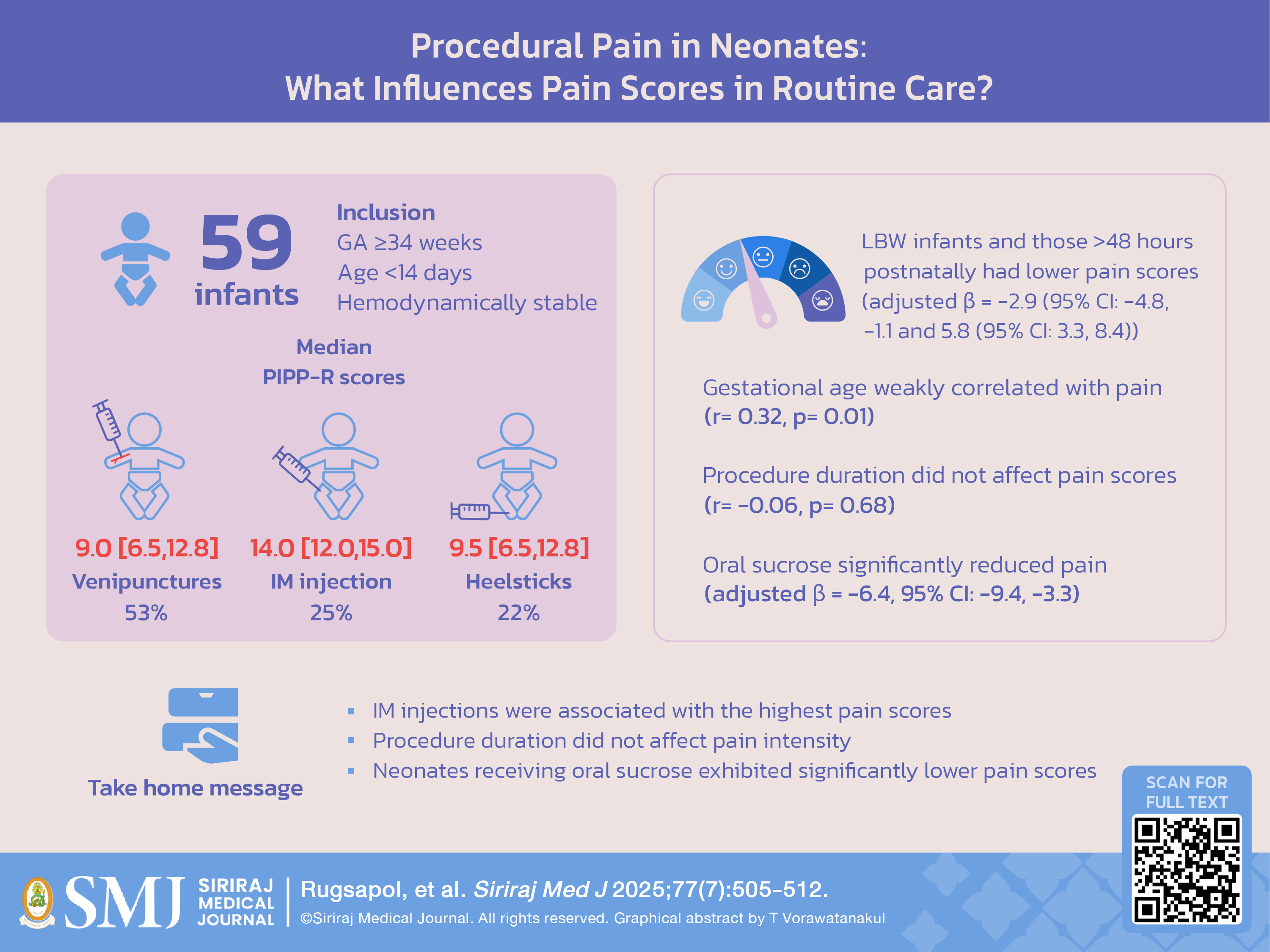
Results: Among 59 infants, 31 (52.5%) underwent venipuncture, 15 (25.4%) received intramuscular (IM) injections, and 13 (22%) underwent heelsticks. The median PIPP-R score was 11.0 [7.0, 14.0]. IM injections and heelsticks resulted in significantly higher pain scores compared to venipunctures (regression coefficient: 4.6, 95% CI: 2.3–6.8, and 2.8, 95% CI: 0.6–5.0, respectively). No correlation was observed between procedure duration and pain scores (r = -0.06, p = 0.68), but GA showed a weak positive correlation (r = 0.32, p = 0.01). After adjustment, low birthweight (<2500 g) was independently associated with lower PIPP-R scores (-2.9, 95% CI: -4.8, -1.1), while postnatal age <48 hours was linked to higher scores (5.8, 95% CI: 3.3–8.4). Oral sucrose solution significantly reduced pain scores (-6.4, 95% CI: -9.4, -3.3).
Conclusion: IM injections were associated with the highest pain scores, while procedure duration did not affect pain intensity. LBW infants and those >48 hours old exhibited lower pain scores, suggesting developmental factors. The demonstrated efficacy of oral sucrose underscores its importance in neonatal pain management, emphasizing the need for routine implementation of analgesic strategies.
References
McPherson C, Miller SP, El-Dib M, Massaro AN, Inder TE. The influence of pain, agitation, and their management on the immature brain. Pediatr Res. 2020;88(2):168-75.
Buser JR, Maire J, Riddle A, Gong X, Nguyen T, Nelson K, et al. Arrested preoligodendrocyte maturation contributes to myelination failure in premature infants. Ann Neurol. 2012;71(1):93-109.
Brummelte S, Grunau RE, Chau V, Poskitt KJ, Brant R, Vinall J, et al. Procedural pain and brain development in premature newborns. Ann Neurol. 2012;71(3):385-96.
Vinall J, Miller SP, Bjornson BH, Fitzpatrick KP, Poskitt KJ, Brant R, et al. Invasive procedures in preterm children: brain and cognitive development at school age. Pediatrics. 2014;133(3):412-21.
Johnston CC, Fernandes AM, Campbell-Yeo M. Pain in neonates is different. Pain. 2011;152(3 Suppl):S65-s73.
Walker SM, Melbourne A, O'Reilly H, Beckmann J, Eaton-Rosen Z, Ourselin S, et al. Somatosensory function and pain in extremely preterm young adults from the UK EPICure cohort: sex-dependent differences and impact of neonatal surgery. Br J Anaesth. 2018;121(3):623-35.
Hermann C, Hohmeister J, Demirakça S, Zohsel K, Flor H. Long-term alteration of pain sensitivity in school-aged children with early pain experiences. Pain. 2006;125(3):278-85.
Williams MD, Lascelles BDX. Early neonatal pain—a review of clinical and experimental implication on painful conditions later in life. Front Pediatr. 2020;8:30.
Slater R, Fabrizi L, Worley A, Meek J, Boyd S, Fitzgerald M. Premature infants display increased noxious-evoked neuronal activity in the brain compared to healthy age-matched term-born infants. Neuroimage. 2010;52(2):583-9.
Craig KD, Hadjistavropoulos HD, Grunau RV, Whitfield MF. A comparison of two measures of facial activity during pain in the newborn child. J Pediatr Psychol. 1994;19(3):305-18.
Gibbins S, Stevens B, McGrath PJ, Yamada J, Beyene J, Breau L, et al. Comparison of pain responses in infants of different gestational ages. Neonatology. 2008;93(1):10-8.
Maxwell LG, Fraga MV, Malavolta CP. Assessment of pain in the newborn: an update. Clin Perinatol. 2019;46(4):693-707.
Olsson E, Ahl H, Bengtsson K, Vejayaram DN, Norman E, Bruschettini M, et al. The use and reporting of neonatal pain scales: a systematic review of randomized trials. Pain. 2021;162(2):353-60.
Amornjiraporn I, Rugsapol S, Thanasarnpaiboon P, Paes B, Kitsommart R. A comparison of the effect of procedural pain on cerebral oxygen saturation between late preterm and term infants. J Perinatol. 2024; doi: 10.1038/s41372-024-01978-4.
Wilson-Smith EM. Procedural pain management in neonates, infants and children. Rev Pain. 2011;5(3):4-12.
Gibbins S, Stevens BJ, Yamada J, Dionne K, Campbell-Yeo M, Lee G, et al. Validation of the Premature Infant Pain Profile-Revised (PIPP-R). Early Hum Dev. 2014;90(4):189-93.
Good practice in postoperative and procedural pain management, 2nd edition. Paediatr Anaesth. 2012;22 Suppl 1:1-79.
Yoon SH, Rah UW, Sheen SS, Cho KH. Comparison of 3 needle sizes for trigger point injection in myofascial pain syndrome of upper- and middle-trapezius muscle: a randomized controlled trial. Arch Phys Med Rehabil. 2009;90(8):1332-9.
Tucker MH, Tiwari P, Carter BS. The physiology, assessment, and treatment of neonatal pain. Semin Fetal Neonatal Med. 2023;28(4):101465.
Shah VS, Ohlsson A. Venepuncture versus heel lance for blood sampling in term neonates. Cochrane Database Syst Rev. 2011; doi: 10.1002/14651858.CD001452.pub4(10).
Stevens B, Yamada J, Ohlsson A, Haliburton S, Shorkey A. Sucrose for analgesia in newborn infants undergoing painful procedures. Cochrane Database Syst Rev. 2016;7(7):Cd001069.
Witt N, Coynor S, Edwards C, Bradshaw H. A guide to pain assessment and management in the neonate. Curr Emerg Hosp Med Rep. 2016;4(1):1-10.
Moolmai P, Rattanachamnongk P, Yangthara B, Wutthigate P. Factors influencing bronchopulmonary dysplasia: an eight-year study in a single tertiary care unit in Thailand. Siriraj Med J. 2025;77(2):158-67.
Published
How to Cite
License
Copyright (c) 2025 Siriraj Medical Journal

This work is licensed under a Creative Commons Attribution-NonCommercial-NoDerivatives 4.0 International License.
Authors who publish with this journal agree to the following conditions:
Copyright Transfer
In submitting a manuscript, the authors acknowledge that the work will become the copyrighted property of Siriraj Medical Journal upon publication.
License
Articles are licensed under a Creative Commons Attribution-NonCommercial-NoDerivatives 4.0 International License (CC BY-NC-ND 4.0). This license allows for the sharing of the work for non-commercial purposes with proper attribution to the authors and the journal. However, it does not permit modifications or the creation of derivative works.
Sharing and Access
Authors are encouraged to share their article on their personal or institutional websites and through other non-commercial platforms. Doing so can increase readership and citations.