
Development and Evaluation of a Patient Education Booklet on Fall Prevention Exercises for Older Lower Limb Prosthesis Users
DOI:
https://doi.org/10.33192/smj.v78i2.277785Keywords:
fall prevention education, fall prevention exercise, older adult, amputee, prosthesisAbstract
Objective: To assess the suitability and usability of a patient education booklet on fall prevention exercises for older lower limb prosthesis (LLP) users.
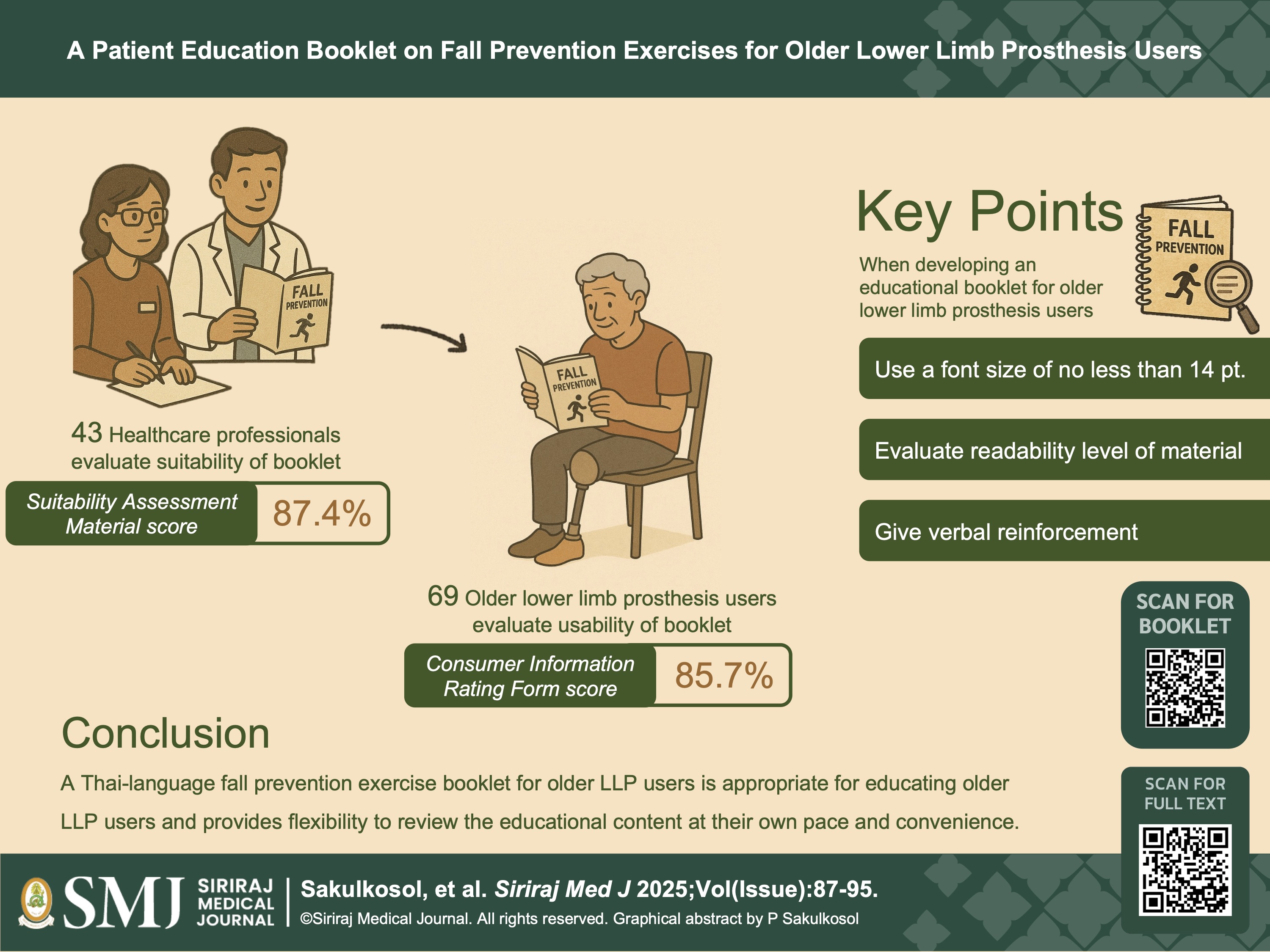
Materials and Methods: A descriptive study was conducted from February 2024 to March 2025. A fall prevention exercise booklet was developed based on literature and clinical guidelines. The booklet covered the following domains: falls and fall prevention in older adults, benefits of exercises, exercise principles and precautions, and exercise descriptions. Healthcare professionals who care for LLP users assessed the educational booklet’s suitability using the Suitability Assessment of Material (SAM) tool. Based on their feedback, the font size was increased from 12 to 14 points. Thereafter, older LLP users (over 60) assessed the educational booklet’s usability using the Consumer Information Rating Form (CIRF).
Results: Suitability was assessed by 43 evaluators (30 prosthetists, six physical therapists, four nurses and three rehabilitation physicians). The median (IQR) SAM score was 88.1 (81.0; 95.2). Usability was assessed by 69 participants. The median (IQR) CIRF score was 86.9 (80.8; 90.9).
Conclusion: The results of the suitability and usability assessments indicate that the developed fall prevention exercise booklet is appropriate for educating older LLP users. The booklet provides a practical tool that enables LLP users to perform exercises safely at home and review educational content at their own pace.
References
Rubenstein LZ. Falls in older people: epidemiology, risk factors and strategies for prevention. Age Ageing. 2006;35(Suppl_2):ii37–ii41.
Assantachai P, Praditsuwan R, Chatthanawaree W, Pisalsarakij D, Thamlikitkul V. Risk factors for falls in the Thai elderly in an urban community. J Med Assoc Thai. 2003;86(2):124–30.
World Health Organization. Ageing And Life Course Unit, Université De Genève. Centre Interfacultaire De Gérontologie. A global response to elder abuse and neglect: building primary health care capacity to deal with the problem worldwide. Geneva: World Health Organization; 2008.
Zalewski CK. Aging of the human vestibular system. Semin Hear 2015;36(3):175–196.
Hunter SW, Batchelor F, Hill KD, Hill A-M, Mackintosh S, Payne M. Risk factors for falls in people with a lower limb amputation: a systematic review. PM R. 2017;9(2):170–80. e1.
Miller WC, Speechley M, Deathe B. The prevalence and risk factors of falling and fear of falling among lower extremity amputees. Arch Phys Med Rehabil. 2001;82(8):1031–7.
Lewallen R, Johnson Jr E. Fractures in amputation stumps: review of treatment of 16 fractures. Mayo Clin Proc. 1981;56(1):22-6.
Kulkarni J, Wright S, Toole C, Morris J, Hirons R. Falls in patients with lower limb amputations: prevalence and contributing factors. Physiotherapy. 1996;82(2):130–6.
Behar T, Burnham S, Johnson Jr G. Major stump trauma following below-knee amputation. Outcome and recommendations for therapy. J Cardiovasc Surg (Torino). 1991;32(6):753–6.
Mundell B, Maradit Kremers H, Visscher S, Hoppe K, Kaufman K. Direct medical costs of accidental falls for adults with transfemoral amputations. Prosthet Orthot Int. 2017;41(6):564–70.
Kaufman KR, Miller EJ, Deml CM, Sheehan RC, Grabiner MD, Wyatt M, et al. Fall prevention training for service members with an amputation or limb salvage following lower extremity trauma. Mil Med. 2024;189(5-6):980–7.
Clemens S, Doerger C, Lee S-P. Current and emerging trends in the management of fall risk in people with lower limb amputation. Curr Geriatr Rep. 2020;9(3):134–41.
Smith JA, Kindo CC, Kurian S, Whitaker LM, Burke C, Wachel B, et al. Evaluation of patient chemotherapy education in a gynecology oncology center. Support Care Cancer. 2004;12(8):577–83.
Goodman C, Lambert K. Scoping review of the preferences of older adults for patient education materials. Patient Educ Couns. 2023;108:107591.
Dajpratham P, Thitisakulchai P, Pongratanakul R, Prapavanond R, Haridravedh S, Muangpaisan W. Effectiveness of personalized multifactorial fall risk assessment and intervention in reducing fall rates among older adults: a retrospective study. Siriraj Med J. 2025;77(1):64–72.
Pantera E, Pourtier-Piotte C, Bensoussan L, Coudeyre E. Patient education after amputation: systematic review and experts' opinions. Ann Phys Rehabil Med. 2014;57(3):143–58.
World Health Organization. WHO global report on falls prevention in older age. Geneva: World Health Organization; 2007.
Division of noncommunicable diseases [Internet]. Nonthaburi: The division; 2021. Fall prevention for the elderly; [cited 2025 July 1]; [about 2 screens]. Available from: http://ftp.thaincd.com/2016/media.php?gid=1-015-009
Thomas S, Mackintosh S, Halbert J. Does the ‘Otago exercise programme’reduce mortality and falls in older adults? a systematic review and meta-analysis. Age Ageing. 2010;39(6):681–7.
Parker C, Scott S, Geddes A. Snowball sampling. SAGE research methods foundations. 2019.
Ximenes MAM, Fontenele NÂO, Bastos IB, Macêdo TS, Galindo NM, Caetano JÁ, et al. Construction and validation of educational booklet content for fall prevention in hospitals. Acta Paul Enferm. 2019;32:433–41.
Doak C, Doak L, Root J. Assessing suitability of materials. Teaching patients with low literacy skills. 1996:41–60.
Klute GK, Berge JS, Orendurff MS, Williams RM, Czerniecki JM. Prosthetic intervention effects on activity of lower-extremity amputees. Arch Phys Med Rehabil. 2006;87(5):717–22.
Nasreddine ZS, Phillips NA, Bédirian V, Charbonneau S, Whitehead V, Collin I, et al. The Montreal Cognitive Assessment, MoCA: a brief screening tool for mild cognitive impairment. J Am Geriatr Soc. 2005;53(4):695–9.
Krass I, Svarstad BL, Bultman D. Using alternative methodologies for evaluating patient medication leaflets. Patient Educ Couns. 2002;47(1):29–35.
Wongtaweepkij K, Krska J, Pongwecharak J, Pongpunna S, Jarernsiripornkul N. Development and psychometric validation for evaluating written medicine information in Thailand: the consumer information rating form. BMJ Open. 2021;11(10):e053740.
Reeves PT, Kenny TM, Mulreany LT, McCown MY, Jacknewitz-Woolard JE, Rogers PL, et al. Development and assessment of a low literacy, pictographic asthma action plan with clinical automation to enhance guideline-concordant care for children with asthma. J Asthma. 2023;60(4):655–72.
Espigares-Tribo G, Ensenyat A. Assessing an educational booklet for promotion of healthy lifestyles in sedentary adults with cardiometabolic risk factors. Patient Educ Couns. 2021;104(1):201–6.
Tongtep N, Coenen F, Theeramunkong T. Content-based readability assessment: a study using a syllabic alphabetic language (Thai). In: Pham DN, Park SB, editors. Artificial Intelligence. PRICAI 2014: Proceeding of the 13th Pacific Rim International Conference on Artificial Intelligence; 2014 Dec 1-5; Gold Coast, Australia. Switzerland: Springer; 2014. p. 863–70.
Chen Y-H, Daowadung P. Assessing readability of Thai text using support vector machines. Maejo Int J Sci Technol. 2015;9(3):355–69.
Corey MR, Julien JS, Miller C, Fisher B, Cederstrand SL, Nylander WA, et al. Patient education level affects functionality and long term mortality after major lower extremity amputation. Am J Surg. 2012;204(5):626–30.
Sudore RL, Schillinger D. Interventions to improve care for patients with limited health literacy. J Clin Outcomes Manag. 2009;16(1):20–9.
Jahan S, Al-Saigul AM, Alharbi AM, Abdelgadir MH. Suitability assessment of health education brochures in Qassim province, Kingdom of Saudi Arabia. J Family Community Med. 2014;21(3):186–92.
Dreeben-Irimia O. Patient education in rehabilitation: Jones & Bartlett Learning; 2010.
Reeves PT, Packett AC, Burklow CS, Echelmeyer S, Larson NS. Development and assessment of a low-health-literacy, pictographic adrenal insufficiency action plan. J Pediatr Endocrinol Metab. 2022;35(2):205–15.
Vinkers DJ, Gussekloo J, Stek ML, Westendorp RG, Van Der Mast RC. Temporal relation between depression and cognitive impairment in old age: prospective population based study. BMJ. 2004;329(7471):881.
Rastall M, Brooks B, Klarneta M, Moylan N, McCloud W, Tracey S. An investigation into younger and older adults' memory for physiotherapy exercises. Physiotherapy. 1999;85(3):122–8.
Peterson DJ, Gargya S, Kopeikin KS, Naveh-Benjamin M. The impact of level of education on age-related deficits in associative memory: Behavioral and neuropsychological perspectives. Cortex. 2017;91:9–24.
Nanasilp P. Gerontological nursing’s core knowledge: Who are the older persons, determinant by age or other factors. J Nurs. 2015;42:156–62.
Sabharwal S, Wilson H, Reilly P, Gupte CM. Heterogeneity of the definition of elderly age in current orthopaedic research. Springerplus. 2015;4:1–7.
Thirapatarapong W, Dajpratham P. Prosthetic usage among the Thai lower limb amputees. Siriraj Med J. 2017;61(4):185–8.
Godlwana L, Nadasan T, Puckree T. Global trends in incidence of lower limb amputation: a review of the literature. S Afr J Physiother. 2008;64(1):8–12.
Published
How to Cite
Issue
Section
Categories
License
Copyright (c) 2025 Siriraj Medical Journal

This work is licensed under a Creative Commons Attribution-NonCommercial-NoDerivatives 4.0 International License.
Authors who publish with this journal agree to the following conditions:
Copyright Transfer
In submitting a manuscript, the authors acknowledge that the work will become the copyrighted property of Siriraj Medical Journal upon publication.
License
Articles are licensed under a Creative Commons Attribution-NonCommercial-NoDerivatives 4.0 International License (CC BY-NC-ND 4.0). This license allows for the sharing of the work for non-commercial purposes with proper attribution to the authors and the journal. However, it does not permit modifications or the creation of derivative works.
Sharing and Access
Authors are encouraged to share their article on their personal or institutional websites and through other non-commercial platforms. Doing so can increase readership and citations.