
Integrative Transcriptomic Analysis Reveals Synaptic Pathway-Enriched Prognostic Gene Signature in Glioblastoma
DOI:
https://doi.org/10.33192/smj.v78i2.277969Keywords:
Glioblastoma, Transcriptomics, Prognostic model, Synaptic pathways, differentially expressed genesAbstract
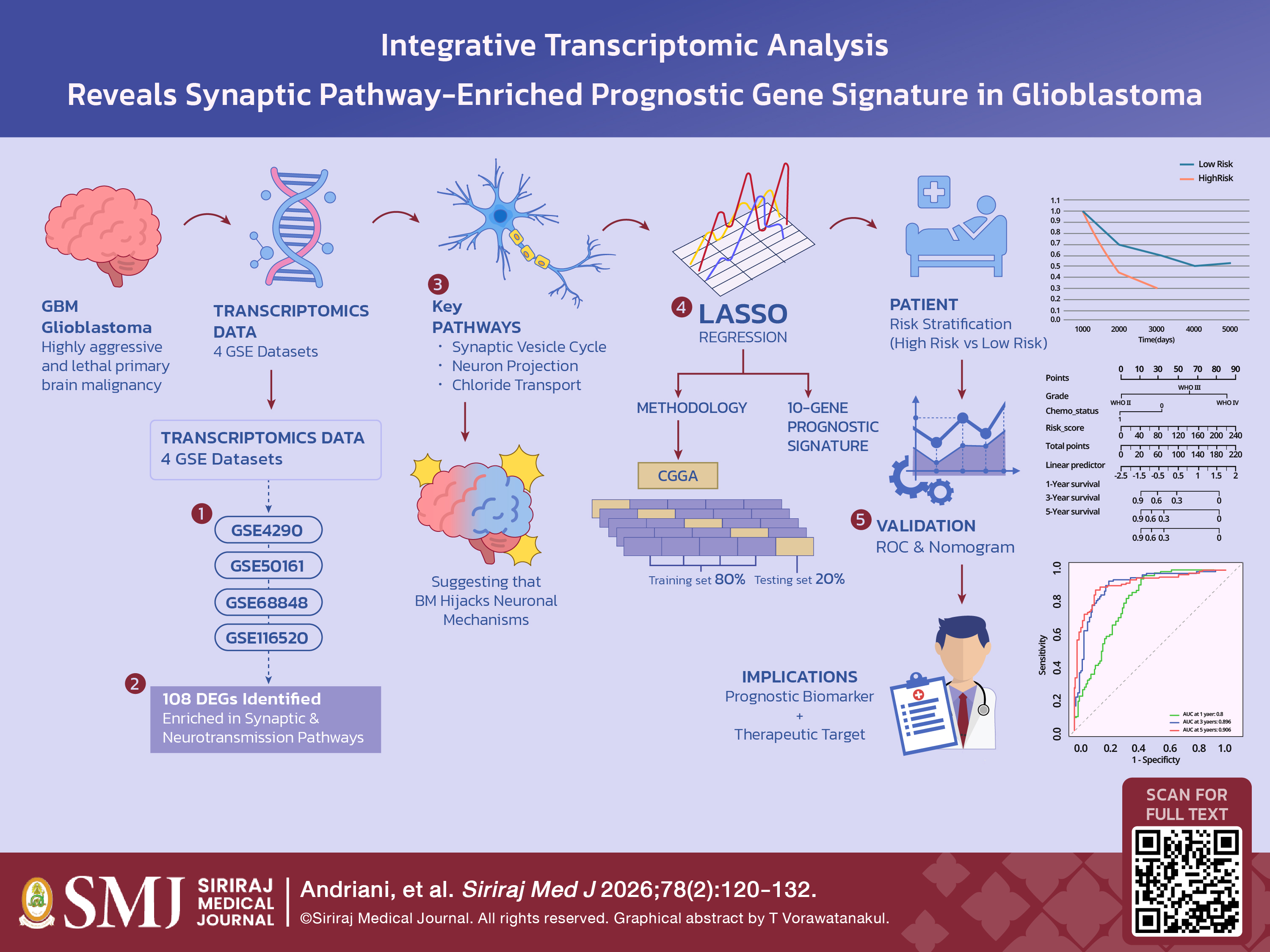
Objective: This study aimed to elucidate the transcriptomic landscape of glioblastoma (GBM) by integrating multiple datasets to identify prognostically significant gene signatures and investigate the involvement of synaptic pathways.
Materials and Methods: Four transcriptomic datasets were analyzed using the limma pipeline for differential gene expression analysis with empirical Bayes moderation to identify differentially expressed genes (DEGs). Functional enrichment analyses were conducted via Gene Ontology and KEGG. A prognostic model was constructed using LASSO-Cox regression on the CGGA mRNAseq_693 cohort (n=693) and validated on the CGGA_325 cohort (n=325). Multivariate Cox proportional hazards regression assessed the model’s independent prognostic value. External validation of gene expression was performed using TCGA (n=163) and GTEx (n=207) datasets.
Results: A total of 108 consistently dysregulated DEGs were identified, enriched in synaptic vesicle cycling, neuronal projection, and chloride transport pathways. A robust ten-gene prognostic signature (SPRY1, CD58, RCC1, E2F7, BUB1, FAM46A, TYMS, NEDD9, CHST14, REPS2) effectively stratified patients, with time-dependent ROC AUCs of 0.718, 0.755, and 0.757 at 1-, 3-, and 5-year survival points. Multivariate Cox analysis confirmed the model’s independent prognostic value, further refined by a nomogram with AUCs of 0.8, 0.898, and 0.906. Differential expression of all ten genes was validated externally.
Conclusion: This study reveals a previously underexplored synaptic pathway-related gene signature with strong prognostic relevance for GBM. The ten-gene model offers a clinically applicable tool for risk stratification and highlights neuron-tumor synaptic interactions as critical drivers of tumor progression, providing a foundation for future therapeutic strategies.
References
Sipos D, Raposa BL, Freihat O, Simon M, Mekis N, Cornacchione P, et al. Glioblastoma: Clinical Presentation, Multidisciplinary Management, and Long-Term Outcomes. Cancers (Basel). 2025;17(1):146.
Pouyan A, Ghorbanlo M, Eslami M, Jahanshahi M, Ziaei E, Salami A, et al. Glioblastoma multiforme: insights into pathogenesis, key signaling pathways, and therapeutic strategies. Mol Cancer. 2025;24(1):58.
Lim-Fat MJ, Wen PY. Glioma progression through synaptic activity. Nat Rev Neurol. 2020;16(1):6-7.
Venkataramani V, Yang Y, Schubert MC, Reyhan E, Tetzlaff SK, Wißmann N, et al. Glioblastoma hijacks neuronal mechanisms for brain invasion. Cell. 2022;185(16):2899-917. e31.
Dresselhaus EC, Meffert MK. Cellular specificity of NF-κB function in the nervous system. Front Immunol. 2019;10:1043.
Zhang GL, Wang CF, Qian C, Ji YX, Wang YZ. Role and mechanism of neural stem cells of the subventricular zone in glioblastoma. World J Stem Cells. 2021;13(7):877-93.
Feng J, Yang J. Glioma-neuron interactions: insights from neural plasticity. Front Oncol. 2025;15:1661897.
Hua T, Shi H, Zhu M, Chen C, Su Y, Wen S, et al. Glioma‑neuronal interactions in tumor progression: Mechanism, therapeutic strategies and perspectives (Review). Int J Oncol. 2022;61(3).
Williams JB, Cao Q, Yan Z. Transcriptomic analysis of human brains with Alzheimer’s disease reveals the altered expression of synaptic genes linked to cognitive deficits. Brain Commun. 2021;3(3):fcab123.
Nguyen DPQ, Pham S, Jallow AW, Ho N-T, Le B, Quang HT, et al. Multiple Transcriptomic Analyses Explore Potential Synaptic Biomarker Rabphilin-3A for Alzheimer's Disease. Sci Rep. 2024;14(1):18717.
Bhattacharya A, Stutvoet TS, Perla M, Loipfinger S, Jalving M, Reyners AKL, et al. Transcriptional pattern enriched for synaptic signaling is associated with shorter survival of patients with high-grade serous ovarian cancer. eLife. 2025;13:RP101369.
Yoshino Y, Roy B, Kumar N, Shahid Mukhtar M, Dwivedi Y. Molecular pathology associated with altered synaptic transcriptome in the dorsolateral prefrontal cortex of depressed subjects. Transl Psychiatry. 2021;11(1):73.
Sun L, Hui AM, Su Q, Vortmeyer A, Kotliarov Y, Pastorino S, et al. Neuronal and glioma-derived stem cell factor induces angiogenesis within the brain. Cancer Cell. 2006;9(4):287-300.
Griesinger AM, Birks DK, Donson AM, Amani V, Hoffman LM, Waziri A, et al. Characterization of distinct immunophenotypes across pediatric brain tumor types. J Immunol. 2013;191(9):4880-8.
Madhavan S, Zenklusen JC, Kotliarov Y, Sahni H, Fine HA, Buetow K. Rembrandt: helping personalized medicine become a reality through integrative translational research. Mol Cancer Res. 2009;7(2):157-67.
Kruthika BS, Jain R, Arivazhagan A, Bharath RD, Yasha TC, Kondaiah P, et al. Transcriptome profiling reveals PDZ binding kinase as a novel biomarker in peritumoral brain zone of glioblastoma. J Neurooncol. 2019;141(2):315-25.
Alnaser RI, Abed MN, Alassaf FA, Alsaaty MH. Integrating Artificial Intelligence into Chronic Kidney Disease Care: Enhancing Hemodialysis Scheduling, Comorbidity Management, and Diagnostic Capabilities. Siriraj Med J. 2025;77(7):543-52.
Saenmanot N, Ruangchainikom M, Ariyawatkul T, Korwutthikulrangsri E, Saenmanot S, Luksanapruksa P, et al. Survival Analysis of and Prognostic Factors for Metastatic Epidural Spinal Cord Compression Compared between Preoperative Known and Unknown Primary Tumors. Siriraj Med J. 2022;74(10):684-92.
Chen EY, Tan CM, Kou Y, Duan Q, Wang Z, Meirelles GV, et al. Enrichr: interactive and collaborative HTML5 gene list enrichment analysis tool. BMC Bioinformatics. 2013;14:128.
Kuleshov MV, Jones MR, Rouillard AD, Fernandez NF, Duan Q, Wang Z, et al. Enrichr: a comprehensive gene set enrichment analysis web server 2016 update. Nucleic Acids Res. 2016;44(W1):W90-W97.
Xie Z, Bailey A, Kuleshov MV, Clarke DJB, Evangelista JE, Jenkins SL, et al. Gene Set Knowledge Discovery with Enrichr. Curr Protoc. 2021;1(3):e90.
Ashburner M, Ball CA, Blake JA, Botstein D, Butler H, Cherry JM, et al. Gene ontology: tool for the unification of biology. Nat Genet. 2000;25(1):25-9.
Kanehisa M, Goto S. KEGG: kyoto encyclopedia of genes and genomes. Nucleic acids research. 2000;28(1):27-30.
Tian Y, Chen Le, Jiang Y. LASSO-based screening for potential prognostic biomarkers associated with glioblastoma. Front Oncol. 2023;12:1057383.
Yu SH, Cai JH, Chen DL, Liao SH, Lin YZ, Chung YT, et al. LASSO and Bioinformatics Analysis in the Identification of Key Genes for Prognostic Genes of Gynecologic Cancer. J Pers Med. 2021;11(11).
Kamarudin AN, Cox T, Kolamunnage-Dona R. Time-dependent ROC curve analysis in medical research: current methods and applications. BMC Medical Research Methodology. 2017;17(1):53.
Geanphun S, Rerkpichaisuth V, Ruangchira-urai R, Thongcharoen P. Survival of Non-Small Cell Lung Cancer Patients with Unexpected N2 after Complete Resection: Role of Aggressive Invasive Mediastinal Staging Should be Considered. Siriraj Med J. 2022;74(3):161-8.
Jia Z, Wu H, Xu J, Sun G. Development and validation of a nomogram to predict overall survival in young non-metastatic rectal cancer patients after curative resection: a population-based analysis. Int J Colorectal Dis. 2022;37(11):2365-74.
Tang Z, Li C, Kang B, Gao G, Li C, Zhang Z. GEPIA: a web server for cancer and normal gene expression profiling and interactive analyses. Nucleic Acids Res. 2017;45(W1):W98-W102.
Sudhof TC. The synaptic vesicle cycle. Annu Rev Neurosci. 2004;27:509-47.
Venkataramani V, Tanev DI, Strahle C, Studier-Fischer A, Fankhauser L, Kessler T, et al. Glutamatergic synaptic input to glioma cells drives brain tumour progression. Nature. 2019;573(7775):532-8.
Krishna S, Choudhury A, Keough MB, Seo K, Ni L, Kakaizada S, et al. Glioblastoma remodelling of human neural circuits decreases survival. Nature. 2023;617(7961):599-607.
Venkataramani V, Tanev DI, Strahle C, Studier-Fischer A, Fankhauser L, Kessler T, et al. Glutamatergic synaptic input to glioma cells drives brain tumour progression. Nature. 2019;573(7775):532-8.
Venkatesh HS, Morishita W, Geraghty AC, Silverbush D, Gillespie SM, Arzt M, et al. Electrical and synaptic integration of glioma into neural circuits. Nature. 2019;573(7775):539-45.
Venkataramani V, Tanev DI, Kuner T, Wick W, Winkler F. Synaptic input to brain tumors: clinical implications. Neuro Oncol. 2021;23(1):23-33.
Tetzlaff SK, Reyhan E, Layer N, Bengtson CP, Heuer A, Schroers J, et al. Characterizing and targeting glioblastoma neuron-tumor networks with retrograde tracing. Cell. 2025;188(2):390-411.e36.
Taylor KR, Barron T, Hui A, Spitzer A, Yalçin B, Ivec AE, et al. Glioma synapses recruit mechanisms of adaptive plasticity. Nature. 2023;623(7986):366-74.
Hua T, Shi H, Zhu M, Chen C, Su Y, Wen S, et al. Glioma‑neuronal interactions in tumor progression: Mechanism, therapeutic strategies and perspectives (Review). Int J Oncol. 2022;61(3):104.
Sisakht AK, Malekan M, Ghobadinezhad F, Firouzabadi SNM, Jafari A, Mirazimi SMA, et al. Cellular Conversations in Glioblastoma Progression, Diagnosis and Treatment. Cell Mol Neurobiol. 2023;43(2):585-603.
Barron T, Yalçın B, Su M, Byun YG, Gavish A, Shamardani K, et al. GABAergic neuron-to-glioma synapses in diffuse midline gliomas. Nature. 2025;639(8056):1060-8.
Jovčevska I, Zottel A, Šamec N, Mlakar J, Sorokin M, Nikitin D, et al. High FREM2 Gene and Protein Expression Are Associated with Favorable Prognosis of IDH-WT Glioblastomas. Cancers (Basel). 2019;11(8):1060.
Ho P, Melms JC, Rogava M, Frangieh CJ, Poźniak J, Shah SB, et al. The CD58-CD2 axis is co-regulated with PD-L1 via CMTM6 and shapes anti-tumor immunity. Cancer Cell. 2023;41(7):1207-21.e12.
Bannoura SF, Aboukameel A, Khan HY, Uddin MH, Jang H, Beal E, et al. Regulator of Chromosome Condensation (RCC1) a novel therapeutic target in pancreatic ductal adenocarcinoma drives tumor progression via the c-Myc-RCC1-Ran axis. bioRxiv [Preprint]. 2023.12.18.572102.
Xu K, Li W, Li X, Liu C, Yi C, Tang J, et al. RNA binding motif protein 25 is a negative prognostic biomarker and promotes cell proliferation via alternative splicing in hepatocellular carcinoma. Pathol Res Pract. 2025;269:155941.
Xu K, Li W, Li X, Liu C, Yi C, Tang J, et al. RNA binding motif protein 25 is a negative prognostic biomarker and promotes cell proliferation via alternative splicing in hepatocellular carcinoma. Pathol Res Pract. 2025;269:155941.
Chen K-q, Lei H-b, Liu X, Wang S-z. The roles of E2F7 in cancer: Current knowledge and future prospects. Heliyon. 2024;10(14).
Gugnoni M, Lorenzini E, Faria do Valle I, Remondini D, Castellani G, Torricelli F, et al. Adding pieces to the puzzle of differentiated-to-anaplastic thyroid cancer evolution: the oncogene E2F7. Cell Death Dis. 2023;14(2):99.
Hao F, Wang N, Zhang Y, Xu W, Chen Y, Fei X, et al. E2F7 enhances hepatocellular carcinoma growth by preserving the SP1/SOX4/Anillin axis via repressing miRNA-383-5p transcription. Mol Carcinog. 2022;61(11):975-88.
Kim T, Gartner A. Bub1 kinase in the regulation of mitosis. Anim Cells Syst (Seoul). 2021;25(1):1-10.
Huang W, Chen Z, Tang Y, Li J, Fan L. A Pan-Cancer Analysis of the Immunological and Prognostic Role of BUB1 Mitotic Checkpoint Serine/Threonine Kinase B (BUB1B) in Human Tumors. Clin Lab. 2024;70(1).
Pokaew N, Prajumwongs P, Vaeteewoottacharn K, Wongkham S, Pairojkul C, Sawanyawisuth K. Overexpression of BubR1 Mitotic Checkpoint Protein Predicts Short Survival and Influences the Progression of Cholangiocarcinoma. Biomedicines. 2024;12(7):1611.
Liang S, Yueyang L, Jianhui H, Tian G, Lanying L, and He S. Family with sequence similarity 46 member a confers chemo-resistance to ovarian carcinoma via TGF-β/Smad2 signaling. Bioengineered. 2022;13(4):10629-39.
Guijarro MV, Nawab A, Dib P, Burkett S, Luo X, Feely M, et al. TYMS promotes genomic instability and tumor progression in Ink4a/Arf null background. Oncogene. 2023;42(23):1926-39.
Geng Y, Xie L, Wang Y, Wang Y. Unveiling the oncogenic significance of thymidylate synthase in human cancers. Am J Transl Res. 2024;16(10):5228-47.
Zhang F, Ye J, Guo W, Zhang F, Wang L, Han A. TYMS-TM4SF4 axis promotes the progression of colorectal cancer by EMT and upregulating stem cell marker. Am J Cancer Res. 2022;12(3):1009-26.
Yu HG, Bijian K, da Silva SD, Su J, Morand G, Spatz A, et al. NEDD9 links anaplastic thyroid cancer stemness to chromosomal instability through integrated centrosome asymmetry and DNA sensing regulation. Oncogene. 2022;41(21):2984-99.
Purazo ML, Ice RJ, Shimpi R, Hoenerhoff M, Pugacheva EN. NEDD9 Overexpression Causes Hyperproliferation of Luminal Cells and Cooperates with HER2 Oncogene in Tumor Initiation: A Novel Prognostic Marker in Breast Cancer. Cancers. 2023;15(4):1119.
Han D, Owiredu JN, Healy BM, Li M, Labaf M, Steinfeld JS, et al. Susceptibility-Associated Genetic Variation in NEDD9 Contributes to Prostate Cancer Initiation and Progression. Cancer Res. 2021;81(14):3766-76.
Zhan J, Zhou L, Zhang H, Zhou J, He Y, Hu T, et al. A comprehensive analysis of the expression, immune infiltration, prognosis and partial experimental validation of CHST family genes in gastric cancer. Transl Oncol. 2024;40:101843.
Zhang H, Duan CJ, Zhang H, Cheng YD, Zhang CF. Expression and clinical significance of REPS2 in human esophageal squamous cell carcinoma. Asian Pac J Cancer Prev. 2013;14(5):2851-7.
He Z, Wang C, Xue H, Zhao R, Li G. Identification of a Metabolism-Related Risk Signature Associated With Clinical Prognosis in Glioblastoma Using Integrated Bioinformatic Analysis. Front Oncol. 2020;10:1631.
Liu X, Liu X. A novel immune-related gene prognostic signature combining immune cell infiltration and immune checkpoint for glioblastoma patients. Transl Cancer Res. 2024;13(11):6136-53.
Su Y, Yang DS, Li Yq, Qin J, Liu L. Early-onset locally advanced rectal cancer characteristics, a practical nomogram and risk stratification system: a population-based study. Front Oncol. 2023;13:1190327.
Yang D, Zhu M, Xiong X, Su Y, Zhao F, Hu Y, et al. Clinical features and prognostic factors in patients with microvascular infiltration of hepatocellular carcinoma: Development and validation of a nomogram and risk stratification based on the SEER database. Front Oncol. 2022;12:987603.
Doolan P, Clynes M, Kennedy S, Mehta JP, Germano S, Ehrhardt C, et al. TMEM25, REPS2 and Meis 1: Favourable Prognostic and Predictive Biomarkers for Breast Cancer. Tumor Biology. 2009;30(4):200-9.
Published
How to Cite
License
Copyright (c) 2025 Siriraj Medical Journal

This work is licensed under a Creative Commons Attribution-NonCommercial-NoDerivatives 4.0 International License.
Authors who publish with this journal agree to the following conditions:
Copyright Transfer
In submitting a manuscript, the authors acknowledge that the work will become the copyrighted property of Siriraj Medical Journal upon publication.
License
Articles are licensed under a Creative Commons Attribution-NonCommercial-NoDerivatives 4.0 International License (CC BY-NC-ND 4.0). This license allows for the sharing of the work for non-commercial purposes with proper attribution to the authors and the journal. However, it does not permit modifications or the creation of derivative works.
Sharing and Access
Authors are encouraged to share their article on their personal or institutional websites and through other non-commercial platforms. Doing so can increase readership and citations.