
Complement in Human Serum Suppresses Antibody- Dependent Enhancement and Potentiates Neutralization of Dengue Virus
DOI:
https://doi.org/10.33192/smj.v78i2.278008Keywords:
human serum, complement, antibody-dependent enhancement, neutralization, U937 cells, K562 cellsAbstract
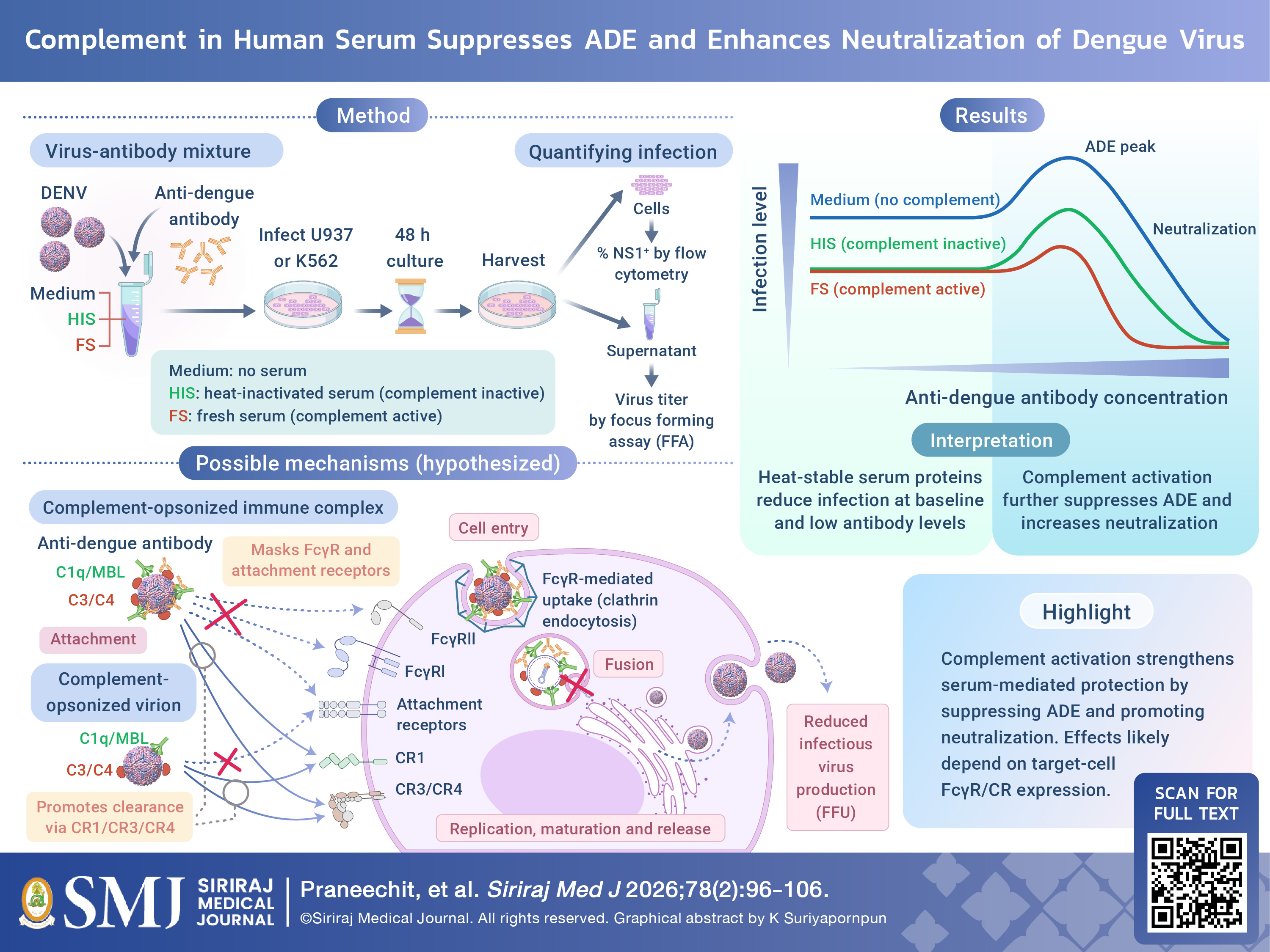
Objective: Antibody-dependent enhancement (ADE), in which pre-existing antibodies increase viral infection, is a major concern in dengue virus (DENV) pathogenesis and vaccine development. While conventional ADE models are well-established, the role of the complement system in modulating this process remains underexplored. This study investigated how complements in human serum influence DENV infection in the presence of enhancing and neutralizing antibodies.
Materials and Methods: U937 and K562 cells were infected with DENV serotype 2 (DENV-2). The virus was pre-incubated with various concentrations of dengue antibodies, purified from pooled convalescence serum, under three conditions: culture medium, heat-inactivated human serum, or fresh human serum (as a source of active complement). After 48 hours, infectious virus production was quantified by a focus-forming assay, and infection rates were measured by flow cytometry.
Results: Both fresh and heat-inactivated human serum significantly reduced DENV infection. In the presence of antibodies, complement activation in fresh serum was significantly more effective at decreasing infection than conditions with inactive complement, particularly at antibody concentrations that mediate ADE and partial neutralization.
Conclusion: Human serum limits DENV infection, and active complement amplifies this neutralizing effect under conditions that typically promote ADE. These findings support incorporating complement into in-vitro assessments and motivate validation in primary FcγR/complement receptor-expressing target cells.
References
Yang X, Quam MBM, Zhang T, Sang S. Global burden for dengue and the evolving pattern in the past 30 years. J Travel Med. 2021;28(8).
Stanaway JD, Shepard DS, Undurraga EA, Halasa YA, Coffeng LE, Brady OJ, et al. The global burden of dengue: an analysis from the Global Burden of Disease Study 2013. Lancet Infect Dis. 2016;16(6):712-23.
Bhatt S, Gething PW, Brady OJ, Messina JP, Farlow AW, Moyes CL, et al. The global distribution and burden of dengue. Nature. 2013;496(7446):504-7.
Dengue haemorrhagic fever: diagnosis, treatment, prevention and control. 2nd edition. Geneva : World Health Organization. 1997;2:12-23.
Suputtamongkol Y, Avirutnan P, Wongsawat E, Kim Y-W. Performance of Two Commercial Dengue NS1 Rapid Tests for the Diagnosis of Adult Patients with Dengue Infection. Siriraj Medical Journal. 2020;72(1):74-8.
Wongsawat E, Avirutnan P, Kim Y-W, Suputtamongkol Y. Performance of Two Commercial Dengue NS1 Rapid Tests for the Diagnosis of Adult Patients with Dengue Infection. Siriraj Medical Journal. 2019;72(1):74-8.
Hunsperger EA, Yoksan S, Buchy P, Nguyen VC, Sekaran SD, Enria DA, et al. Evaluation of commercially available diagnostic tests for the detection of dengue virus NS1 antigen and anti-dengue virus IgM antibody. PLoS Negl Trop Dis. 2014;8(10):e3171.
Blacksell Stuart D, Jarman Richard G, Bailey Mark S, Tanganuchitcharnchai A, Jenjaroen K, Gibbons Robert V, et al. Evaluation of Six Commercial Point-of-Care Tests for Diagnosis of Acute Dengue Infections: the Need for Combining NS1 Antigen and IgM/IgG Antibody Detection To Achieve Acceptable Levels of Accuracy. Clinical and Vaccine Immunology. 2011;18(12):2095-101.
Shan X, Wang X, Yuan Q, Zheng Y, Zhang H, Wu Y, et al. Evaluation of the diagnostic accuracy of nonstructural protein 1 Ag-based tests for dengue virus in Asian population: a meta-analysis. BMC Infect Dis. 2015;15:360.
Luvira V, Thawornkuno C, Lawpoolsri S, Thippornchai N, Duangdee C, Ngamprasertchai T, et al. Diagnostic Performance of Dengue NS1 and Antibodies by Serum Concentration Technique. Trop Med Infect Dis. 2023;8(2).
Halstead SB. Immune enhancement of viral infection. Prog Allergy. 1982;31:301-64.
Burke DS, Nisalak A, Johnson DE, Scott RM. A prospective study of dengue infections in Bangkok. Am J Trop Med Hyg. 1988;38(1):172-80.
Halstead SB, Nimmannitya S, Cohen SN. Observations related to pathogenesis of dengue hemorrhagic fever. IV. Relation of disease severity to antibody response and virus recovered. Yale J Biol Med. 1970;42(5):311-28.
Guzman MG, Alvarez M, Halstead SB. Secondary infection as a risk factor for dengue hemorrhagic fever/dengue shock syndrome: an historical perspective and role of antibody-dependent enhancement of infection. Arch Virol. 2013;158(7):1445-59.
Katzelnick LC, Gresh L, Halloran ME, Mercado JC, Kuan G, Gordon A, et al. Antibody-dependent enhancement of severe dengue disease in humans. Science. 2017;358(6365):929-32.
O'Driscoll M, Buddhari D, Huang AT, Waickman A, Kaewhirun S, Iamsirithaworn S, et al. Maternally derived antibody titer dynamics and risk of hospitalized infant dengue disease. Proc Natl Acad Sci U S A. 2023;120(41):e2308221120.
Rodenhuis-Zybert IA, Moesker B, da Silva Voorham JM, van der Ende-Metselaar H, Diamond MS, Wilschut J, et al. A fusion-loop antibody enhances the infectious properties of immature flavivirus particles. J Virol. 2011;85(22):11800-8.
Rodpothong P, Boonarkart C, Ruangrung K, Onsirisakul N, Kanistanon D, Auewarakul P. Relative contribution of dengue prM- and E-specific polyclonal antibodies to neutralization and enhancement. Acta Virol. 2016;60(3):249-59.
Ramadhany R, Hirai I, Sasaki T, Ono K, Ramasoota P, Ikuta K, et al. Antibody with an engineered Fc region as a therapeutic agent against dengue virus infection. Antiviral Res. 2015;124:61-8.
Littaua R, Kurane I, Ennis FA. Human IgG Fc receptor II mediates antibody-dependent enhancement of dengue virus infection. J Immunol. 1990;144(8):3183-6.
Merle NS, Noe R, Halbwachs-Mecarelli L, Fremeaux-Bacchi V, Roumenina LT. Complement System Part II: Role in Immunity. Front Immunol. 2015;6:257.
Bokisch VA, Top FH, Jr., Russell PK, Dixon FJ, Muller-Eberhard HJ. The potential pathogenic role of complement in dengue hemorrhagic shock syndrome. N Engl J Med. 1973;289(19):996-1000.
Malasit P. Complement and dengue haemorrhagic fever/shock syndrome. Southeast Asian J Trop Med Public Health. 1987;18(3):316-20.
Avirutnan P, Punyadee N, Noisakran S, Komoltri C, Thiemmeca S, Auethavornanan K, et al. Vascular leakage in severe dengue virus infections: a potential role for the nonstructural viral protein NS1 and complement. J Infect Dis. 2006;193(8):1078-88.
Mehlhop E, Diamond MS. Protective immune responses against West Nile virus are primed by distinct complement activation pathways. J Exp Med. 2006;203(5):1371-81.
Mehlhop E, Whitby K, Oliphant T, Marri A, Engle M, Diamond MS. Complement activation is required for induction of a protective antibody response against West Nile virus infection. J Virol. 2005;79(12):7466-77.
Mehlhop E, Nelson S, Jost CA, Gorlatov S, Johnson S, Fremont DH, et al. Complement protein C1q reduces the stoichiometric threshold for antibody-mediated neutralization of West Nile virus. Cell Host Microbe. 2009;6(4):381-91.
Fuchs A, Pinto AK, Schwaeble WJ, Diamond MS. The lectin pathway of complement activation contributes to protection from West Nile virus infection. Virology. 2011;412(1):101-9.
Yamanaka A, Kosugi S, Konishi E. Infection-enhancing and -neutralizing activities of mouse monoclonal antibodies against dengue type 2 and 4 viruses are controlled by complement levels. J Virol. 2008;82(2):927-37.
Mehlhop E, Ansarah-Sobrinho C, Johnson S, Engle M, Fremont DH, Pierson TC, et al. Complement protein C1q inhibits antibody-dependent enhancement of flavivirus infection in an IgG subclass-specific manner. Cell Host Microbe. 2007;2(6):417-26.
Yamanaka A, Tabuchi Y, Mulyatno KC, Susilowati H, Hendrianto E, Soegijanto S, et al. Dengue virus infection-enhancing and neutralizing antibody balance in children of the Philippines and Indonesia. Microbes Infect. 2012;14(13):1152-9.
Innis BL, Nisalak A, Nimmannitya S, Kusalerdchariya S, Chongswasdi V, Suntayakorn S, et al. An enzyme-linked immunosorbent assay to characterize dengue infections where dengue and Japanese encephalitis co-circulate. Am J Trop Med Hyg. 1989;40(4):418-27.
Durbin AP, Karron RA, Sun W, Vaughn DW, Reynolds MJ, Perreault JR, et al. Attenuation and immunogenicity in humans of a live dengue virus type-4 vaccine candidate with a 30 nucleotide deletion in its 3'-untranslated region. Am J Trop Med Hyg. 2001;65(5):405-13.
Chelluboina S, Kshirsagar D, Panzade G, Mishra AC, Arankalle V, Shrivastava S. Evaluation of methods for the measurement of antibody-dependent enhancement of dengue virus infection using different FcgammaRIIa expressing cell lines. PLoS One. 2025;20(8):e0331320.
Shukla R, Ramasamy V, Shanmugam RK, Ahuja R, Khanna N. Antibody-Dependent Enhancement: A Challenge for Developing a Safe Dengue Vaccine. Frontiers in Cellular and Infection Microbiology. 2020;10.
Narvaez F, Montenegro C, Juarez JG, Zambrana JV, Gonzalez K, Videa E, et al. Dengue severity by serotype and immune status in 19 years of pediatric clinical studies in Nicaragua. PLoS Negl Trop Dis. 2025;19(1):e0012811.
Vicente CR, Herbinger K-H, Fröschl G, Malta Romano C, de Souza Areias Cabidelle A, Cerutti Junior C. Serotype influences on dengue severity: a cross-sectional study on 485 confirmed dengue cases in Vitória, Brazil. BMC Infectious Diseases. 2016;16(1):320.
Ungchusak K, Thiparat K, Anantapreecha S, Ketkeaw J. Dengue Disease in Thailand: Donût Let the Outbreak Keep Going On and On! Siriraj Medical Journal. 2007;59(4):195-6.
Looney RJ, Abraham GN, Anderson CL. Human monocytes and U937 cells bear two distinct Fc receptors for IgG. J Immunol. 1986;136(5):1641-7.
Dai X, Jayapal M, Tay HK, Reghunathan R, Lin G, Too CT, et al. Differential signal transduction, membrane trafficking, and immune effector functions mediated by FcgammaRI versus FcgammaRIIa. Blood. 2009;114(2):318-27.
Christensen J, Leslie RG. Quantitative measurement of Fc receptor activity on human peripheral blood monocytes and the monocyte-like cell line, U937, by laser flow cytometry. J Immunol Methods. 1990;132(2):211-9.
Chawla T, Chan KR, Zhang SL, Tan HC, Lim APC, Hanson BJ, et al. Dengue Virus Neutralization in Cells Expressing Fc Gamma Receptors. PLoS ONE. 2013;8(5):e65231.
Lubow J, Levoir LM, Ralph DK, Belmont L, Contreras M, Cartwright-Acar CH, et al. Single B cell transcriptomics identifies multiple isotypes of broadly neutralizing antibodies against flaviviruses. PLOS Pathogens. 2023;19(10):e1011722.
Douradinha B, McBurney SP, Soares de Melo KM, Smith AP, Krishna NK, Barratt-Boyes SM, et al. C1q binding to dengue virus decreases levels of infection and inflammatory molecules transcription in THP-1 cells. Virus Res. 2014;179:231-4.
Fuchs A, Lin TY, Beasley DW, Stover CM, Schwaeble WJ, Pierson TC, et al. Direct complement restriction of flavivirus infection requires glycan recognition by mannose-binding lectin. Cell Host Microbe. 2010;8(2):186-95.
Avirutnan P, Hauhart RE, Marovich MA, Garred P, Atkinson JP, Diamond MS. Complement-mediated neutralization of dengue virus requires mannose-binding lectin. mBio. 2011;2(6):e00276-11-e.
Lucisano Valim YM, Lachmann PJ. The effect of antibody isotype and antigenic epitope density on the complement-fixing activity of immune complexes: a systematic study using chimaeric anti-NIP antibodies with human Fc regions. Clin Exp Immunol. 1991;84(1):1-8.
Sun J, Chen C, Pan P, Zhang K, Xu J, Chen C. The potential of bacterial anti-phagocytic proteins in suppressing the clearance of extracellular vesicles mediated by host phagocytosis. Front Immunol. 2024;15:1418061.
Avirutnan P, Mehlhop E, Diamond MS. Complement and its role in protection and pathogenesis of flavivirus infections. Vaccine. 2008;26 Suppl 8:I100-7.
Nascimento EJ, Silva AM, Cordeiro MT, Brito CA, Gil LH, Braga-Neto U, et al. Alternative complement pathway deregulation is correlated with dengue severity. PLoS One. 2009;4(8):e6782.
Delibrias CC, Fischer EM, Kazatchkine MD. The enhancing role of complement in human immunodeficiency virus infection: soluble recombinant CR1 (CD35) inhibits complement-mediated enhancement of infection of a CD4-positive T-cell line with human immunodeficiency virus-1. Scand J Immunol. 2000;51(5):526-9.
Carpentier JL, Lew DP, Paccaud JP, Gil R, Iacopetta B, Kazatchkine M, et al. Internalization pathway of C3b receptors in human neutrophils and its transmodulation by chemoattractant receptors stimulation. Cell Regul. 1991;2(1):41-55.
Stoiber H, Frank I, Spruth M, Schwendinger M, Mullauer B, Windisch JM, et al. Inhibition of HIV-1 infection in vitro by monoclonal antibodies to the complement receptor type 3 (CR3): an accessory role for CR3 during virus entry? Mol Immunol. 1997;34(12-13):855-63.
Thieblemont N, Haeffner-Cavaillon N, Ledur A, L'Age-Stehr J, Ziegler-Heitbrock HW, Kazatchkine MD. CR1 (CD35) and CR3 (CD11b/CD18) mediate infection of human monocytes and monocytic cell lines with complement-opsonized HIV independently of CD4. Clin Exp Immunol. 1993;92(1):106-13.
Schiller C, Spittler A, Willheim M, Szepfalusi Z, Agis H, Koller M, et al. Influence of suramin on the expression of Fc receptors and other markers on human monocytes and U937 cells, and on their phagocytic properties. Immunology. 1994;81(4):598-604.
Begum F, Das S, Mukherjee D, Mal S, Ray U. Insight into the Tropism of Dengue Virus in Humans. Viruses. 2019;11(12).
Kou Z, Quinn M, Chen H, Rodrigo WW, Rose RC, Schlesinger JJ, et al. Monocytes, but not T or B cells, are the principal target cells for dengue virus (DV) infection among human peripheral blood mononuclear cells. J Med Virol. 2008;80(1):134-46.
Byrne AB, Talarico LB. Role of the complement system in antibody-dependent enhancement of flavivirus infections. International Journal of Infectious Diseases. 2021;103:404-11.
Vidarsson G, Dekkers G, Rispens T. IgG Subclasses and Allotypes: From Structure to Effector Functions. Frontiers in Immunology. 2014;Volume 5 - 2014.
De Alwis R, Williams KL, Schmid MA, Lai C-Y, Patel B, Smith SA, et al. Dengue Viruses Are Enhanced by Distinct Populations of Serotype Cross-Reactive Antibodies in Human Immune Sera. PLoS Pathogens. 2014;10(10):e1004386.
Dias AG, Jr., Duarte EM, Zambrana JV, Cardona-Ospina JA, Bos S, Roy V, et al. Anti-dengue virus antibodies that elicit complement-mediated lysis of Zika virion correlate with protection from severe dengue disease. Cell Rep. 2025;44(5):115613.
Sampei Z, Koo CXE, Teo FJ, Toh YX, Fukuzawa T, Gan SW, et al. Complement Activation by an Anti-Dengue/Zika Antibody with Impaired Fcγ Receptor Binding Provides Strong Efficacy and Abrogates Risk of Antibody-Dependent Enhancement. Antibodies. 2023;12(2):36.
Nascimento EJM, Norwood B, Kpamegan E, Parker A, Fernandes J, Perez-Guzman E, et al. Antibodies Produced in Response to a Live-Attenuated Dengue Vaccine Are Functional in Activating the Complement System. J Infect Dis. 2023;227(11):1282-92.
Vidarsson G, Dekkers G, Rispens T. IgG subclasses and allotypes: from structure to effector functions. Front Immunol. 2014;5:520.
Byrne AB, Talarico LB. Role of the complement system in antibody-dependent enhancement of flavivirus infections. Int J Infect Dis. 2021;103:404-11.
Published
How to Cite
License
Copyright (c) 2025 Siriraj Medical Journal

This work is licensed under a Creative Commons Attribution-NonCommercial-NoDerivatives 4.0 International License.
Authors who publish with this journal agree to the following conditions:
Copyright Transfer
In submitting a manuscript, the authors acknowledge that the work will become the copyrighted property of Siriraj Medical Journal upon publication.
License
Articles are licensed under a Creative Commons Attribution-NonCommercial-NoDerivatives 4.0 International License (CC BY-NC-ND 4.0). This license allows for the sharing of the work for non-commercial purposes with proper attribution to the authors and the journal. However, it does not permit modifications or the creation of derivative works.
Sharing and Access
Authors are encouraged to share their article on their personal or institutional websites and through other non-commercial platforms. Doing so can increase readership and citations.