
Combining Histopathologic and Gene-Expression Profiling for Risk Stratification of Nodal Metastasis in Colorectal Cancer
DOI:
https://doi.org/10.33192/smj.v78i2.279649Keywords:
Colorectal neoplasm, Lymphatic metastasis, RNA sequencing, Gene expression regulation, Logistic ModelsAbstract
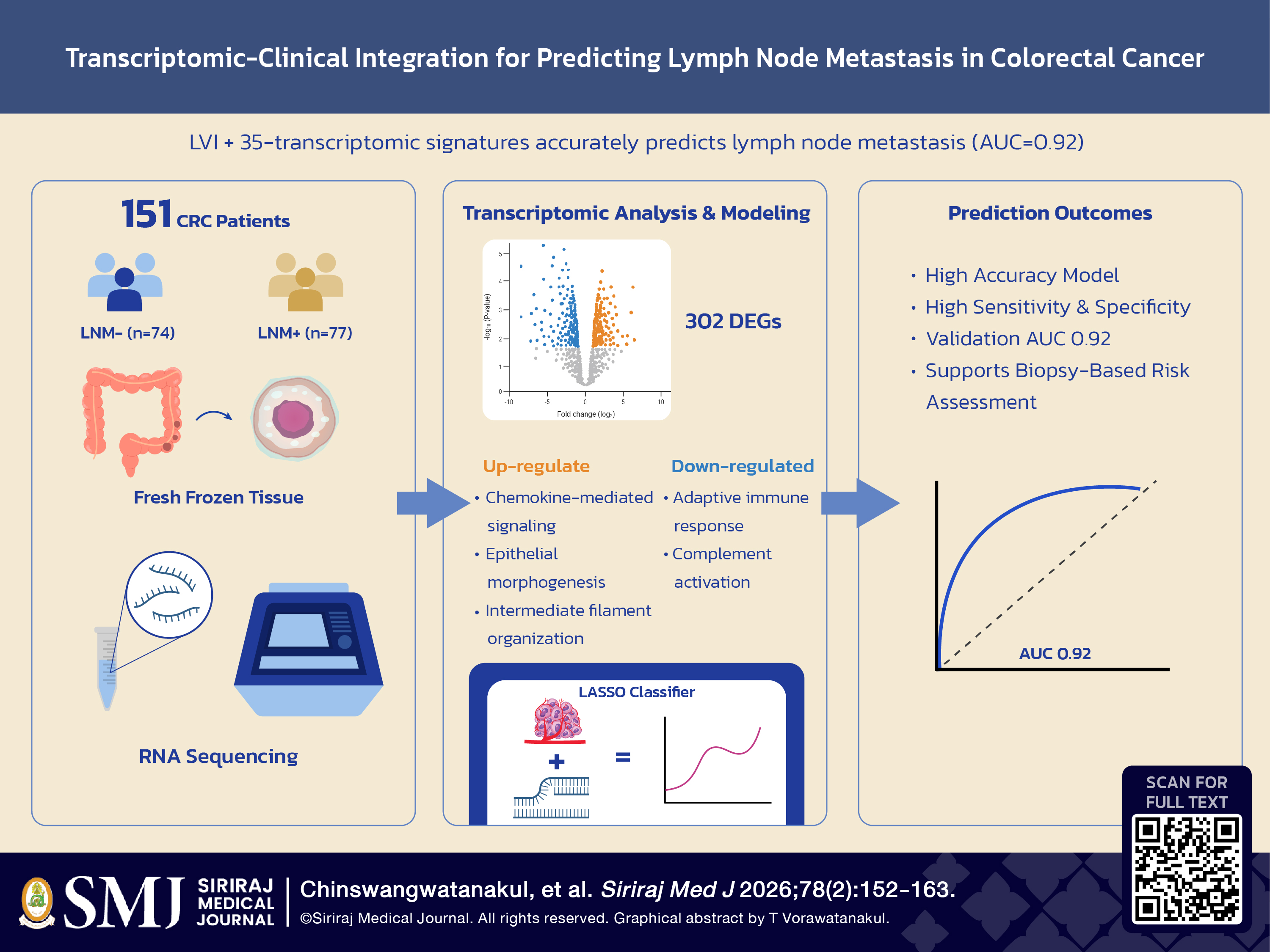
Objective: To identify gene-expression features associated with lymph node metastasis (LNM) in colorectal cancer (CRC) and to develop a transcriptomic-clinical predictive model for preoperative nodal assessment.
Materials and Methods: A total of 151 CRC tissue samples (74 LNM– and 77 LNM+) were analyzed using RNA sequencing. Differentially expressed genes (DEGs) were identified with DESeq2, and functional enrichment analyses were performed using the Database for Annotation, Visualization, and Integrated Discovery (DAVID). A Least Absolute Shrinkage and Selection Operator (LASSO) logistic regression model integrating gene-expression features with clinical variables was developed to predict LNM status. Model performance was evaluated using the area under the receiver operating characteristic curve (AUC), sensitivity, and specificity.
Results: A total of 302 DEGs were identified in LNM+ CRC, including 178 upregulated and 124 downregulated genes. Upregulated genes were enriched in chemokine-mediated signaling, epithelial morphogenesis, and intermediate filament organization, whereas downregulated genes were associated with adaptive immune response and complement activation. In multivariate analysis, lymphovascular invasion (LVI) was the only clinical variable independently associated with LNM. The optimized LASSO model, combining LVI with selected transcriptomic features demonstrated excellent discriminatory performance (AUC ≈ 0.92). Key upregulated genes included CCL21, CCL26, DEFB1, LST1, KANK4, TNNC1, PFDN6, TENM1, CST6, and PADI3, while IGHV2-26 was downregulated.
Conclusion: Integration of LVI with transcriptomic signatures enables accurate prediction of lymph node metastasis in CRC and supports biopsy-based risk assessment to guide clinical decision-making.
References
Sung H, Ferlay J, Siegel RL, Laversanne M, Soerjomataram I, Jemal A, et al. Global Cancer Statistics 2020: GLOBOCAN Estimates of Incidence and Mortality Worldwide for 36 Cancers in 185 Countries. CA Cancer J Clin. 2021;71(3):209-49.
Cardoso R, Guo F, Heisser T, De Schutter H, Van Damme N, Nilbert MC, et al. Overall and stage-specific survival of patients with screen-detected colorectal cancer in European countries: A population-based study in 9 countries. Lancet Reg Health Eur. 2022;21:100458.
Weiser MR. AJCC 8th Edition: Colorectal Cancer. Ann Surg Oncol. 2018;25(6):1454-5.
Mongkhonsupphawan A, Sethalao N, Riansuwan W. Long-term Oncologic Outcomes After Curative Surgery in Stage I–III Thai Colorectal Cancer Patients. Siriraj Med J. 2022;74(11):739-46.
Lohsiriwat V, Rungteeranont C, Saigosoom N. Incidence and Pattern of Nodal Metastasis in Colon and Rectal Cancer: a Study of 1,012 Cases from Thailand. Siriraj Med J. 2020;72(5):386-90.
Hong EK, Landolfi F, Castagnoli F, Park SJ, Boot J, Van den Berg J, et al. CT for lymph node staging of Colon cancer: not only size but also location and number of lymph node count. Abdom Radiol (NY). 2021;46(9):4096-105.
Wang X, Cao Y, Ding M, Liu J, Zuo X, Li H, Fan R. Oncological and prognostic impact of lymphovascular invasion in Colorectal Cancer patients. Int J Med Sci. 2021;18(7):1721-9.
Zhang L, Deng Y, Liu S, Zhang W, Hong Z, Lu Z, et al. Lymphovascular invasion represents a superior prognostic and predictive pathological factor of the duration of adjuvant chemotherapy for stage III colon cancer patients. BMC Cancer. 2023;23(1):3.
Weiser MR. AJCC 8th Edition: Colorectal Cancer. Ann Surg Oncol. 2018;25(6):1454-5.
Acharayothin O, Thiengtrong B, Juengwiwattanakitti P, Anekwiang P, Riansuwan W, Chinswangwatanakul V, et al. Impact of Washing Processes on RNA Quantity and Quality in Patient-Derived Colorectal Cancer Tissues. Biopreserv Biobank. 2023;21(1):31-7.
Bioinformatics B. FastQC: a quality control tool for high throughput sequence data. 2011.
Ewels P, Magnusson M, Lundin S, Käller M. MultiQC: summarize analysis results for multiple tools and samples in a single report. Bioinformatics. 2016;32(19):3047-8.
Patro R, Duggal G, Love MI, Irizarry RA, Kingsford C. Salmon provides fast and bias-aware quantification of transcript expression. Nat Methods. 2017;14(4):417-9.
Chen S, Zhou Y, Chen Y, Gu J. fastp: an ultra-fast all-in-one FASTQ preprocessor. Bioinformatics. 2018;34(17):i884-i90.
Chen S. Ultrafast one-pass FASTQ data preprocessing, quality control, and deduplication using fastp. iMeta. 2023;2(2):e107.
Sherman BT, Hao M, Qiu J, Jiao X, Baseler MW, Lane HC, et al. DAVID: a web server for functional enrichment analysis and functional annotation of gene lists (2021 update). Nucleic Acids Res. 2022;50(W1):W216-w21.
Peixoto L, Risso D, Poplawski SG, Wimmer ME, Speed TP, Wood MA, Abel T. How data analysis affects power, reproducibility and biological insight of RNA-seq studies in complex datasets. Nucleic Acids Res. 2015;43(16):7664-74.
Gandolfo LC, Speed TP. RLE plots: Visualizing unwanted variation in high dimensional data. PLoS One. 2018;13(2):e0191629.
Molania R, Gagnon-Bartsch JA, Dobrovic A, Speed TP. A new normalization for Nanostring nCounter gene expression data. Nucleic Acids Res. 2019;47(12):6073-83.
Chou CK, Fan CC, Lin PS, Liao PY, Tung JC, Hsieh CH, et al. Sciellin mediates mesenchymal-to-epithelial transition in colorectal cancer hepatic metastasis. Oncotarget. 2016;7(18):25742-54.
Mashino K, Sadanaga N, Yamaguchi H, Tanaka F, Ohta M, Shibuta K, et al. Expression of Chemokine Receptor CCR7 Is Associated with Lymph Node Metastasis of Gastric Carcinoma1. Cancer Res. 2002;62(10):2937-41.
Li J, Sun R, Tao K, Wang G. The CCL21/CCR7 pathway plays a key role in human colon cancer metastasis through regulation of matrix metalloproteinase-9. Dig Liver Dis. 2011;43(1):40-7.
Zou Y, Chen Y, Wu X, Yuan R, Cai Z, He X, et al. CCL21 as an independent favorable prognostic factor for stage III/IV colorectal cancer. Oncol Rep. 2013;30(2):659-66.
Pezeshkian Z, Nobili S, Peyravian N, Shojaee B, Nazari H, Soleimani H, et al. Insights into the Role of Matrix Metalloproteinases in Precancerous Conditions and in Colorectal Cancer. Cancers. 2021;13(24):6226.
Hosseinalizadeh H, Hussain QM, Poshtchaman Z, Ahsan M, Amin AH, Naghavi S, et al. Emerging insights into keratin 7 roles in tumor progression and metastasis of cancers. Front Oncol. 2023;13:1243871.
Li C, Cheng B, Yang X, Tong G, Wang F, Li M, et al. SOX8 promotes tumor growth and metastasis through FZD6-dependent Wnt/β-catenin signaling in colorectal carcinoma. Heliyon. 2023;9(12):e22586.
Fagarasan G, Fagarasan V, Bintintan VV, Dindelegan GC. The Role of Tumor-Infiltrating B Lymphocytes in Colorectal Cancer Patients: A Systematic Review of Immune Landscape Evolution. Cancers (Basel). 2025;17(18).
Afshar-Kharghan V. The role of the complement system in cancer. J Clin Invest. 2017;127(3):780-9.
Agoston EI, Acs B, Herold Z, Fekete K, Kulka J, Nagy A, et al. Deconstructing Immune Cell Infiltration in Human Colorectal Cancer: A Systematic Spatiotemporal Evaluation. Genes (Basel). 2022;13(4).
Lo JH, Battaglin F, Baca Y, Xiu J, Brodskiy P, Algaze S, et al. DEFB1 gene expression and the molecular landscape of colorectal cancer (CRC). J Clin Oncol. 2022;40(16 Suppl):3523.
Weidle UH, Rohwedder I, Birzele F, Weiss EH, Schiller C. LST1: A multifunctional gene encoded in the MHC class III region. Immunobiology. 2018;223(11):699-708.
Islam MS, Gopalan V, Lam AK, Shiddiky MJA. Current advances in detecting genetic and epigenetic biomarkers of colorectal cancer. Biosens Bioelectron. 2023;239:115611.
Bjorling E, Oksvold P, Forsberg M, Lund J, Ponten F, Uhlén M. Human protein atlas, version 2. Molecular & Cellular Proteomics. 2006;5(10):S328-S.
Tadijan A, Samarzija I, Humphries JD, Humphries MJ, Ambriovic-Ristov A. KANK family proteins in cancer. Int J Biochem Cell Biol. 2021;131:105903.
Yin JH, Elumalai P, Kim SY, Zhang SZ, Shin S, Lee M, et al. TNNC1 knockout reverses metastatic potential of ovarian cancer cells by inactivating epithelial-mesenchymal transition and suppressing F-actin polymerization. Biochem Biophys Res Commun. 2021;547:44-51.
Fang C, Zhang X, Li C, Liu F, Liu H. Troponin C-1 Activated by E2F1 Accelerates Gastric Cancer Progression via Regulating TGF-beta/Smad Signaling. Dig Dis Sci. 2022;67(9):4444-57.
Shang B, Qiao H, Wang L, Wang J. In-depth study of pyroptosis-related genes and immune infiltration in colon cancer. PeerJ. 2024;12:e18374.
Xu F, Kong L, Sun X, Hui W, Jiang L, Han W, et al. PFDN6 contributes to colorectal cancer progression via transcriptional regulation. eGastroenterology. 2024;2(2):e100001.
Peppino G, Ruiu R, Arigoni M, Riccardo F, Iacoviello A, Barutello G, et al. Teneurins: Role in Cancer and Potential Role as Diagnostic Biomarkers and Targets for Therapy. Int J Mol Sci. 2021;22(5):2321.
De Smedt L, Palmans S, Andel D, Govaere O, Boeckx B, Smeets D, et al. Expression profiling of budding cells in colorectal cancer reveals an EMT-like phenotype and molecular subtype switching. Br J Cancer. 2017;116(1):58-65.
Chang X, Chai Z, Zou J, Wang H, Wang Y, Zheng Y, et al. PADI3 induces cell cycle arrest via the Sirt2/AKT/p21 pathway and acts as a tumor suppressor gene in colon cancer. Cancer Biol Med. 2019;16(4):729-42.
Xu D, Ding S, Cao M, Yu X, Wang H, Qiu D, et al. A Pan-Cancer Analysis of Cystatin E/M Reveals Its Dual Functional Effects and Positive Regulation of Epithelial Cell in Human Tumors. Front Genet. 2021;12:733211.
Zhu X, Zhao L, Hu P. Predictive Values of Homeobox Gene A-Antisense Transcript 3 (HOXA-AS3), Cystatin 6 (CST6), and Chromobox Homolog 4 (CBX4) Expressions in Cancer Tissues for Recurrence of Early Colon Cancer After Surgery. Int J Gen Med. 2024;17:1-8.
Peng X, Chen X, Zhu X, Chen L. GALNT6 Knockdown Inhibits the Proliferation and Migration of Colorectal Cancer Cells and Increases the Sensitivity of Cancer Cells to 5-FU. J Cancer. 2021;12(24):7413-21.
Nunes L, Li F, Wu M, Luo T, Hammarström K, Torell E, et al. Prognostic genome and transcriptome signatures in colorectal cancers. Nature. 2024;633(8028):137-46.
Faleti OD, Gong Y, Long J, Luo Q, Tan H, Deng S, et al. TRIM72 inhibits cell migration and epithelial-mesenchymal transition by attenuating FAK/akt signaling in colorectal cancer. Heliyon. 2024;10(18):e37714.
Chung JH, Larsen AR, Chen E, Bunz F. A PTCH1 homolog transcriptionally activated by p53 suppresses Hedgehog signaling. J Biol Chem. 2014;289(47):33020-31.
Rossi M, Banskota N, Shin CH, Anerillas C, Tsitsipatis D, Yang JH, et al. Increased PTCHD4 expression via m6A modification of PTCHD4 mRNA promotes senescent cell survival. Nucleic Acids Res. 2024;52(12):7261-78.
Vite A, Li J, Radice GL. New functions for alpha-catenins in health and disease: from cancer to heart regeneration. Cell Tissue Res. 2015;360(3):773-83.
Additional Files
Published
How to Cite
License
Copyright (c) 2026 Siriraj Medical Journal

This work is licensed under a Creative Commons Attribution-NonCommercial-NoDerivatives 4.0 International License.
Authors who publish with this journal agree to the following conditions:
Copyright Transfer
In submitting a manuscript, the authors acknowledge that the work will become the copyrighted property of Siriraj Medical Journal upon publication.
License
Articles are licensed under a Creative Commons Attribution-NonCommercial-NoDerivatives 4.0 International License (CC BY-NC-ND 4.0). This license allows for the sharing of the work for non-commercial purposes with proper attribution to the authors and the journal. However, it does not permit modifications or the creation of derivative works.
Sharing and Access
Authors are encouraged to share their article on their personal or institutional websites and through other non-commercial platforms. Doing so can increase readership and citations.