
Development of a Nomogram That Predicts Outcomes After Radical Cystectomy for Bladder Cancer Using Data from Siriraj Hospital, Thailand
DOI:
https://doi.org/10.33192/smj.v78i3.279910Keywords:
Nomogram, Cystectomy, Bladder cancer, Prognostic, SurvivalAbstract
Objective: This study aimed to develop and validate a prognostic nomogram to estimate individualized overall survival (OS) for bladder cancer patients in Thailand undergoing radical cystectomy (RC), using data from Siriraj Hospital.
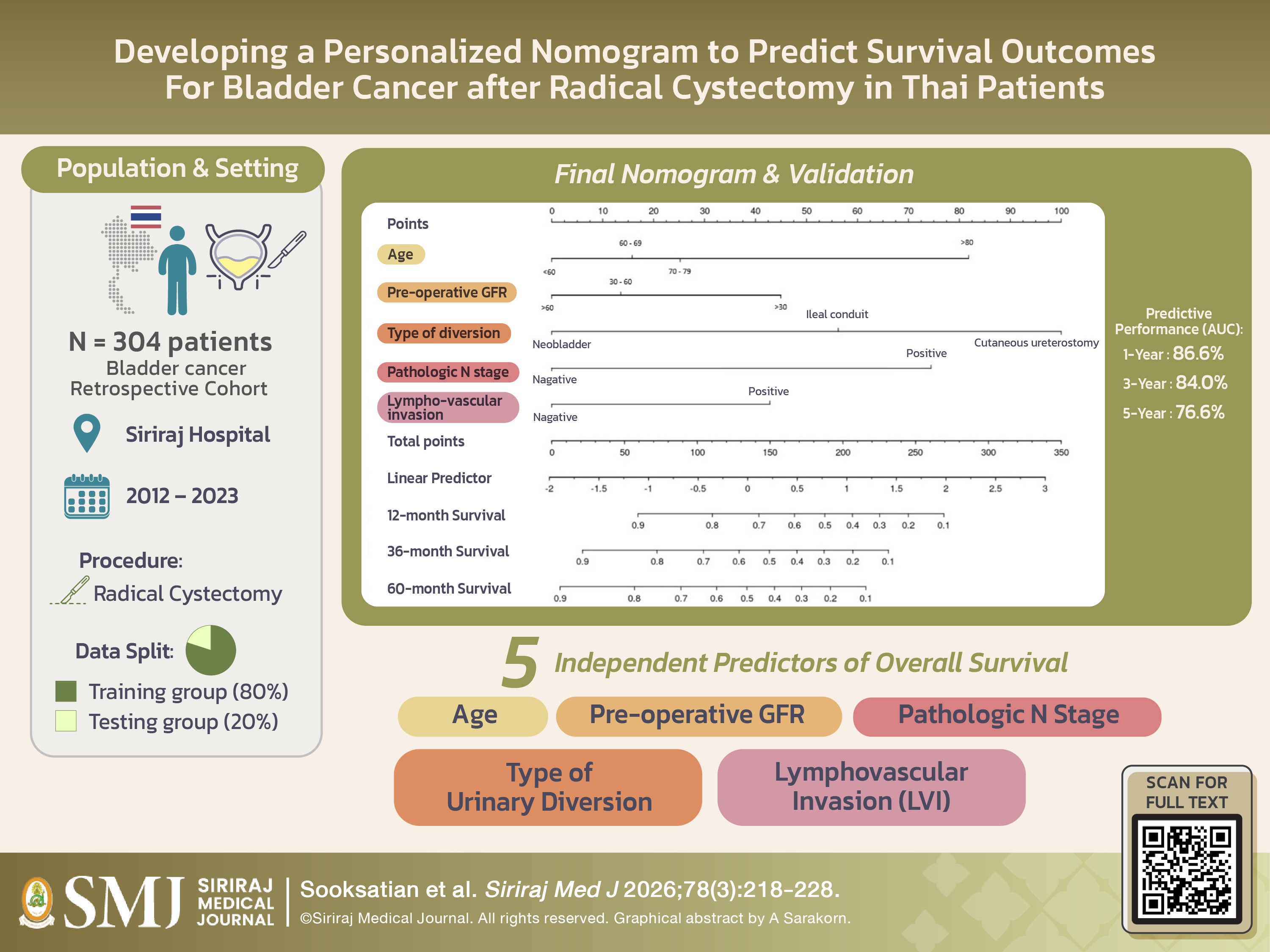
Materials and Methods: We retrospectively analyzed a cohort of 304 bladder cancer patients who underwent RC at Siriraj Hospital between 2012 and 2023. The patients were randomly allocated to the training (80%) and testing (20%) cohorts. Cox regression analyses were employed to identify predictors of OS from a range of clinical, pathological, and treatment-related variables. A prognostic nomogram was subsequently constructed and its performance was validated using the concordance index and the area under the receiver operating characteristic curve (AUC).
Results: The median patient age was 68 years and the majority of patients presented with muscle invasive disease. The median duration of follow-up was 61 months, with a median overall survival of 51 months. Multivariate analysis identified five independent predictors of OS: age, preoperative glomerular filtration rate, type of urinary diversion, pathological N stage, and presence of lymphovascular invasion. The nomogram demonstrated strong predictive performance, with AUC values of 86.6% at 12 months, 84.0% at 36 months, and 76.6% at 60 months.
Conclusion: We have developed and validated a prognostic nomogram tailored for Thai bladder cancer patients undergoing RC. This tool provides individualized survival estimates and may be a valuable aid in patient counseling, risk stratification, and formulation of postoperative management strategies. Future multicenter validation and integration of molecular markers will enhance the clinical utility of the prognostic nomogram.
References
Sung H, Ferlay J, Siegel RL, Laversanne M, Soerjomataram I, Jemal A, et al. Global Cancer Statistics 2020: GLOBOCAN Estimates of Incidence and Mortality Worldwide for 36 Cancers in 185 Countries. CA Cancer J Clin. 2021;71(3):209-49.
Cancer. IAfRo. Thailand fact sheet: GLOBOCAN 2020. . Lyon, France: International Agency for Research on Cancer; 2020.
Aboumarzouk OM, Drewa T, Olejniczak P, Chlosta PL. Laparoscopic versus open radical cystectomy for muscle-invasive bladder cancer: a single institute comparative analysis. Urol Int. 2013;91(1):109-12.
Zhang ZL, Dong P, Li YH, Liu ZW, Yao K, Han H, et al. Radical cystectomy for bladder cancer: oncologic outcome in 271 Chinese patients. Chin J Cancer. 2014;33(3):165-71.
Ramart P, Chaiyaprasithi B, Pradniwat K, Ratanarapee S, Amornvesukit T, Taweemongkongsap T, et al. Outcome of open radical cystectomy with pelvic lymph node dissection for bladder urothelial cancer in Siriraj hospital between 1998-2003. Insight Urology. 2010;31(1):27-39.
Siriboonpipattana N, Nualyong C, Taweemonkongsap T, Leewansangtong S, Ramart P, Amornvesukit T. The Oncologic Outcome of Laparoscopic Radical Cystectomy for Invasive Bladder Cancer in Siriraj Hospital Between 2005-2013. Siriraj Medical Journal. 2017;69(6):377-83.
Shariat SF, Karakiewicz PI, Palapattu GS, Amiel GE, Lotan Y, Rogers CG, et al. Nomograms provide improved accuracy for predicting survival after radical cystectomy. Clin Cancer Res. 2006;12(22):6663-76.
Yang Z, Bai Y, Liu M, Hu X, Han P. Development and validation of a prognostic nomogram for predicting cancer-specific survival after radical cystectomy in patients with bladder cancer:A population-based study. Cancer Med. 2020;9(24):9303-14.
Osawa T, Abe T, Takada N, Ito YM, Murai S, Shinohara N. Validation of the nomogram for predicting 90-day mortality after radical cystectomy in a Japanese cohort. Int J Urol. 2018;25(7):699-700.
Liu P, Xu L, Chen G, Shi B, Zhang Q, Chen S. Nomograms for predicting survival in patients with micropapillary bladder cancer: a real-world analysis based on the surveillance, epidemiology, and end results database and external validation in a tertiary center. BMC Urol. 2023;23(1):16.
Wang J, Wu Y, He W, Yang B, Gou X. Nomogram for predicting overall survival of patients with bladder cancer: A population-based study. Int J Biol Markers. 2020;35(2):29-39.
Veerakulwatana S, Suk-Ouichai C, Taweemonkongsap T, Chotikawanich E, Jitpraphai S, Woranisarakul V, et al. Perioperative factors and 30-day major complications following radical cystectomy: A single-center study in Thailand. Heliyon. 2024;10(13):e33476.
Mahalelakul A, Assavavirojekul P, Leewansangtong S, Woranisarakul V, Hansomwong T, Srinualnad S. Outcomes of Robot-assisted Radical Prostatectomy in Men Aged 75 Years Old or Older: A Single-center Study in Thailand. Siriraj Medical Journal. 2025;77(1):22-8.
Sornthai W, Teyateeti A, Taweemonkongsap T, Jitpraphai S, Woranisarakul V, Jongjitaree K, et al. Preoperative myosteatosis and perioperative serum chloride levels predict 180 day major complications after radical cystectomy. Sci Rep. 2025;15(1):3184.
Lee CT, Dunn RL, Chen BT, Joshi DP, Sheffield J, Montie JE. Impact of body mass index on radical cystectomy. J Urol. 2004;172(4 Pt 1):1281-5.
Mayr R, May M, Martini T, Lodde M, Pycha A, Comploj E, et al. Predictive capacity of four comorbidity indices estimating perioperative mortality after radical cystectomy for urothelial carcinoma of the bladder. BJU Int. 2012;110(6 Pt B):E222-7.
Kim D, Nam W, Kyung YS, You D, Jeong IG, Hong B, et al. Effect of decreased renal function on poor oncological outcome after radical cystectomy. Investig Clin Urol. 2023;64(4):346-52.
Cheng L, Neumann RM, Scherer BG, Weaver AL, Leibovich BC, Nehra A, et al. Tumor size predicts the survival of patients with pathologic stage T2 bladder carcinoma: a critical evaluation of the depth of muscle invasion. Cancer. 1999;85(12):2638-47.
Chen H, Hong Y, Yu B, Ruiqian L, Jun L, Hongyi W, et al. Retrospective analysis of bladder cancer morphology and depth of invasion under cystoscopy. BMC Urol. 2022;22(1):12.
Kimura S, Mari A, Foerster B, Abufaraj M, Vartolomei MD, Stangl-Kremser J, et al. Prognostic Value of Concomitant Carcinoma In Situ in the Radical Cystectomy Specimen: A Systematic Review and Meta-Analysis. J Urol. 2019;201(1):46-53.
Kikuchi E, Margulis V, Karakiewicz PI, Roscigno M, Mikami S, Lotan Y, et al. Lymphovascular invasion predicts clinical outcomes in patients with node-negative upper tract urothelial carcinoma. J Clin Oncol. 2009;27(4):612-8.
Chang SS, Hassan JM, Cookson MS, Wells N, Smith JA, Jr. Delaying radical cystectomy for muscle invasive bladder cancer results in worse pathological stage. J Urol. 2003;170(4 Pt 1):1085-7.
Fallara G, Di Maida F, Bravi CA, De Groote R, Piramide F, Turri F, et al. A systematic review and meta-analysis of robot-assisted vs. open radical cystectomy: where do we stand and future perspective. Minerva Urol Nephrol. 2023;75(2):134-43.
Grossman HB, Natale RB, Tangen CM, Speights VO, Vogelzang NJ, Trump DL, et al. Neoadjuvant chemotherapy plus cystectomy compared with cystectomy alone for locally advanced bladder cancer. N Engl J Med. 2003;349(9):859-66.
Published
How to Cite
License
Copyright (c) 2026 Siriraj Medical Journal

This work is licensed under a Creative Commons Attribution-NonCommercial-NoDerivatives 4.0 International License.
Authors who publish with this journal agree to the following conditions:
Copyright Transfer
In submitting a manuscript, the authors acknowledge that the work will become the copyrighted property of Siriraj Medical Journal upon publication.
License
Articles are licensed under a Creative Commons Attribution-NonCommercial-NoDerivatives 4.0 International License (CC BY-NC-ND 4.0). This license allows for the sharing of the work for non-commercial purposes with proper attribution to the authors and the journal. However, it does not permit modifications or the creation of derivative works.
Sharing and Access
Authors are encouraged to share their article on their personal or institutional websites and through other non-commercial platforms. Doing so can increase readership and citations.