
Antimicrobial Susceptibility and Multidrug Resistance among Streptococcus pneumoniae Isolates from Predominantly Non-Sterile Respiratory Specimens in Children Hospitalized with Pneumonia or Suspected Bacteremia in the Mekong Delta, Vietnam, 2022–2024
A Hospital-Based Cross-Sectional Study
DOI:
https://doi.org/10.33192/smj.v78i10.284093Keywords:
Streptococcus pneumoniae, Drug resistance, multiple, bacterial, Child, hospitalized, Pneumococcal vaccines, VietnamAbstract
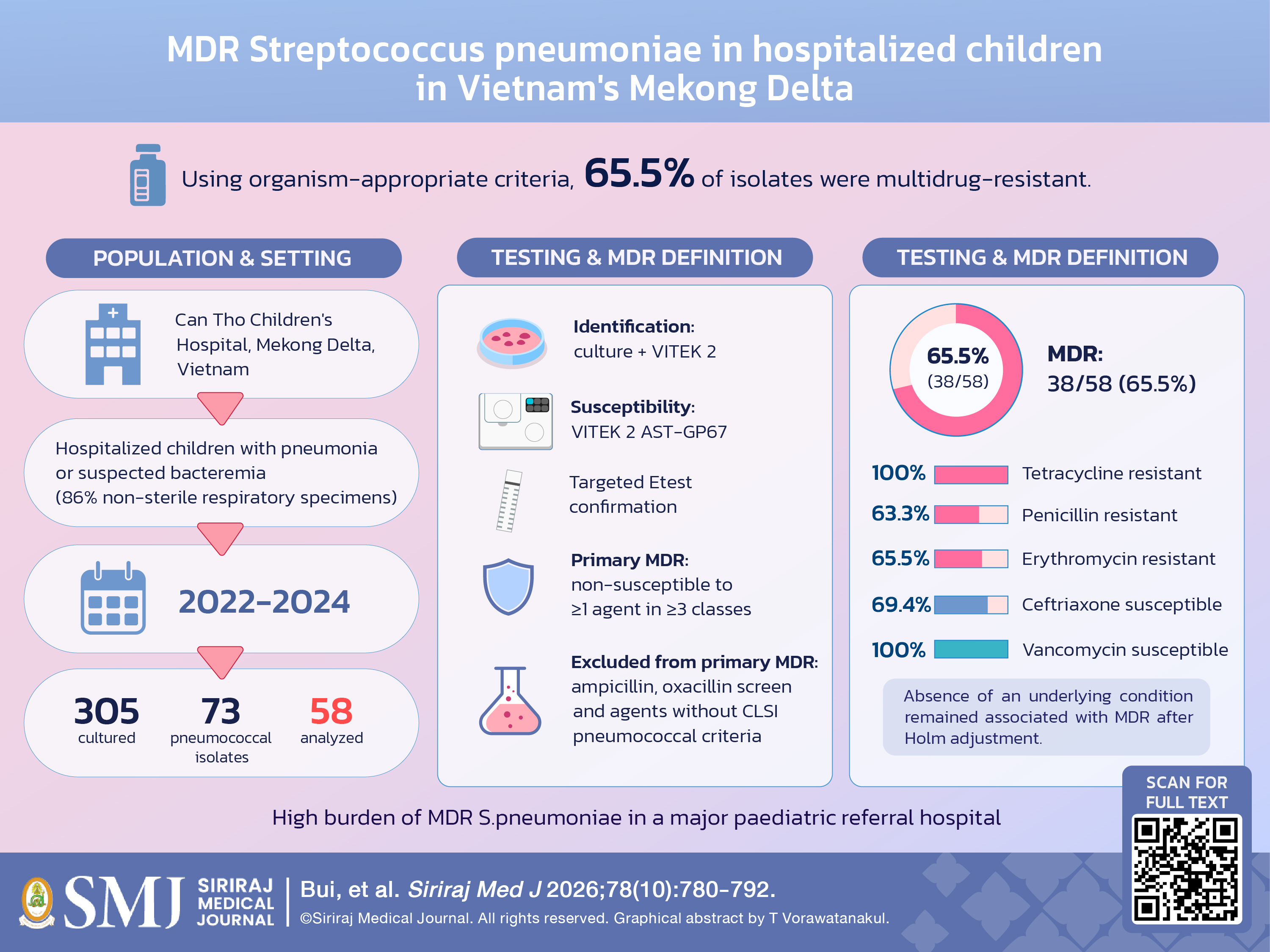
Objective: To characterize antimicrobial susceptibility and multidrug resistance (MDR) among Streptococcus pneumoniae isolates from children hospitalized with pneumonia or suspected bacteremia in Vietnam’s Mekong Delta and explore factors associated with MDR.
Materials and Methods: This cross-sectional study included children aged 2 months–15 years with culture-confirmed S. pneumoniae and susceptibility results at a tertiary pediatric hospital during 2022–2024. Identification used conventional methods and VITEK 2 Compact; susceptibility testing used VITEK 2 AST-GP67 and Etest when indicated, and contemporaneous CLSI M100 criteria. MDR was defined as non-susceptibility to ≥1 agent in ≥3 classes with an independent pneumococcal CLSI criterion; screening tests and non-independent results (including surrogate ampicillin) were excluded. Associations were explored using Fisher’s exact test with Holm adjustment.
Results: Among 58 children, 38 (65.5%, 95% CI 52.7–76.4) had MDR isolates. Resistance was 100% to tetracycline, 65.5% to erythromycin, 63.3% to penicillin, and 52.2% to cefepime. Ceftriaxone was susceptible in 25/36 isolates (69.4%); all 58 isolates were vancomycin-susceptible. MDR occurred in 5/8 blood isolates and 33/50 nasopharyngeal aspirate isolates, reported descriptively. Absence of an underlying condition was associated with MDR after Holm adjustment (adjusted P=0.020); vaccination was not (adjusted P=0.367). Risk-factor analyses were exploratory and underpowered (20 non-MDR isolates).
Conclusion: MDR S. pneumoniae was common in this referral population. Because most isolates came from non-sterile respiratory specimens and testing was clinically directed, the 65.5% estimate should be interpreted as institution-level surveillance conditional on the observed testing panel rather than an unbiased population prevalence.
References
GBD 2021 Lower Respiratory Infections and Antimicrobial Resistance Collaborators. Global, regional, and national incidence and mortality burden of non-COVID-19 lower respiratory infections and aetiologies, 1990–2021: a systematic analysis from the Global Burden of Disease Study 2021. Lancet Infect Dis. 2024;24(9):974-1002.
World Health Organization. WHO bacterial priority pathogens list, 2024: bacterial pathogens of public health importance to guide research, development and strategies to prevent and control antimicrobial resistance. Geneva: World Health Organization; 2024.
World Health Organization. Global antimicrobial resistance and use surveillance system (GLASS) report 2021. Geneva: World Health Organization; 2021.
Vu TVD, Choisy M, Do TTN, Nguyen VMH, Campbell JI, Le TH, et al. Antimicrobial susceptibility testing results from 13 hospitals in Viet Nam: VINARES 2016–2017. Antimicrob Resist Infect Control. 2021;10(1):78.
Truong HC, Pham QD, Phan TV, Vo DTT, Nguyen PD, Nguyen HT, et al. Effectiveness of pneumococcal conjugate vaccines against invasive pneumococcal disease in Vietnamese children prior to national introduction: a matched case-control study. Vaccine. 2026;77:128349.
Tran-Quang K, Nguyen-Thi-Dieu T, Tran-Do H, Pham-Hung V, Nguyen-Vu T, Tran-Xuan B, et al. Antibiotic resistance of Streptococcus pneumoniae in Vietnamese children with severe pneumonia: a cross-sectional study. Front Public Health. 2023;11:1110903.
Bui AS, Duong DC, Le THH, Do NA. Frequency of erm(B) and mef(A) genes among macrolide-resistant Streptococcus pneumoniae strains isolated from children under 5 years with pneumonia in Nghe An province, 2019-2021. Vietnam J Sci Technol. 2023;65(2):9-13. Vietnamese.
Wambugu P, Shah MM, Nguyen HA, Le KA, Le HH, Vo HM, et al. Molecular epidemiology of Streptococcus pneumoniae detected in hospitalized pediatric acute respiratory infection cases in Central Vietnam. Pathogens. 2023;12(7):943.
von Elm E, Altman DG, Egger M, Pocock SJ, Gøtzsche PC, Vandenbroucke JP; STROBE Initiative. The Strengthening the Reporting of Observational Studies in Epidemiology (STROBE) statement: guidelines for reporting observational studies. Lancet. 2007;370(9596):1453-7.
Tacconelli E, Cataldo MA, Paul M, Leibovici L, Kluytmans J, Schröder W, et al. STROBE-AMS: recommendations to optimise reporting of epidemiological studies on antimicrobial resistance and informing improvement in antimicrobial stewardship. BMJ Open. 2016;6(2):e010134.
Clinical and Laboratory Standards Institute. Performance standards for antimicrobial susceptibility testing. 32nd, 33rd and 34th eds. CLSI supplement M100. Wayne (PA): Clinical and Laboratory Standards Institute; 2022, 2023, 2024.
Song JH, Jung SI, Ko KS, Kim NY, Son JS, Chang HH, et al. High prevalence of antimicrobial resistance among clinical Streptococcus pneumoniae isolates in Asia (an ANSORP study). Antimicrob Agents Chemother. 2004;48(6):2101-7.
Kim L, McGee L, Tomczyk S, Beall B. Biological and epidemiological features of antibiotic-resistant Streptococcus pneumoniae in pre- and post-conjugate vaccine eras: a United States perspective. Clin Microbiol Rev. 2016;29(3):525-52.
Cai K, Wang Y, Guo Z, Xu X, Li H, Zhang Q. Clinical characteristics and antimicrobial resistance of pneumococcal isolates of pediatric invasive pneumococcal disease in China. Infect Drug Resist. 2018;11:2461-9.
Nguyen TH, Nguyen VA, Pham TL, Le HLH. Antibiotic resistance status of Streptococcus pneumoniae causing respiratory infections in children under 6 years at Duc Giang General Hospital, 2023. Vietnam Med J. 2024;541(3):339-43. Vietnamese.
Oh H, Heo ST, Kim M, Kim YR, Yoo JR. Antimicrobial susceptibility trends of Streptococcus pneumoniae by age groups over recent 10 years in a single hospital in South Korea. Yonsei Med J. 2021;62(4):306-14.
Pan F, Han L, Huang W, Tang J, Xiao S, Wang C, et al. Serotype distribution, antimicrobial susceptibility, and molecular epidemiology of Streptococcus pneumoniae isolated from children in Shanghai, China. PLoS One. 2015;10(11):e0142892.
Zhao W, Pan F, Wang B, Wang C, Sun Y, Zhang T, et al. Epidemiology characteristics of Streptococcus pneumoniae from children with pneumonia in Shanghai: a retrospective study. Front Cell Infect Microbiol. 2019;9:258.
Thamlikitkul V. STOP antimicrobial resistance: everybody’s business. Siriraj Med J. 2014;66(6):234-40.
Peng S, Ren H, Deng J, Zhao N, Li Y, Li M, et al. Genotypic and phenotypic characteristics of Streptococcus pneumoniae from community-acquired pneumonia patients and healthy asymptomatic participants in Sichuan province, China. BMC Infect Dis. 2021;21(1):1030.
Song JY, Nahm MH, Moseley MA. Clinical implications of pneumococcal serotypes: invasive disease potential, clinical presentations, and antibiotic resistance. J Korean Med Sci. 2013;28(1):4-15.
Marimon JM, Ardanuy C. Epidemiology of pneumococcal diseases in Spain after the introduction of pneumococcal conjugate vaccines. Enferm Infecc Microbiol Clin. 2021;39(3):142-50.
Gutiérrez-Tobar IF, Londoño-Ruiz JP, Mariño-Drews C, Beltrán-Higuera S, Camacho-Moreno G, Leal-Castro AL, et al. Epidemiological characteristics and serotype distribution of culture-confirmed pediatric pneumococcal pneumonia before and after PCV10 introduction: a multicenter study in Bogotá, Colombia, 2008-2019. Vaccine. 2022;40(20):2875-83.
Raddaoui A, Simões AS, Baaboura R, Félix S, Achour W, Ben Othman T, et al. Serotype distribution, antibiotic resistance and clonality of Streptococcus pneumoniae isolated from immunocompromised patients in Tunisia. PLoS One. 2015;10(10):e0140390.
Bogaert D, De Groot R, Hermans PWM. Streptococcus pneumoniae colonisation: the key to pneumococcal disease. Lancet Infect Dis. 2004;4(3):144-54.
Additional Files
Published
How to Cite
License
Copyright (c) 2026 Siriraj Medical Journal

This work is licensed under a Creative Commons Attribution-NonCommercial-NoDerivatives 4.0 International License.
Authors who publish with this journal agree to the following conditions:
Copyright Transfer
In submitting a manuscript, the authors acknowledge that the work will become the copyrighted property of Siriraj Medical Journal upon publication.
License
Articles are licensed under a Creative Commons Attribution-NonCommercial-NoDerivatives 4.0 International License (CC BY-NC-ND 4.0). This license allows for the sharing of the work for non-commercial purposes with proper attribution to the authors and the journal. However, it does not permit modifications or the creation of derivative works.
Sharing and Access
Authors are encouraged to share their article on their personal or institutional websites and through other non-commercial platforms. Doing so can increase readership and citations.