
Prevalence of xerostomia in the elderly at Mueang Roiet district
Keywords:
elderly, xerostomia, dry mouthAbstract
Dry mouth is the most common changes in the elderly, which can affect the quality of life.
The study was a cross sectional descriptive study. This study aimed to examine the prevalence of dry mouth. The data were collected using the Xerostomia Inventory to measure dry mouth. A total of 250 elderly living in Muang, Roi Et were included.
The results showed that the elderly were female representing 62.00%, males representing 38.0%, with mean age of 68.75±7.179 years, with the lowest age being 60 years, the highest being
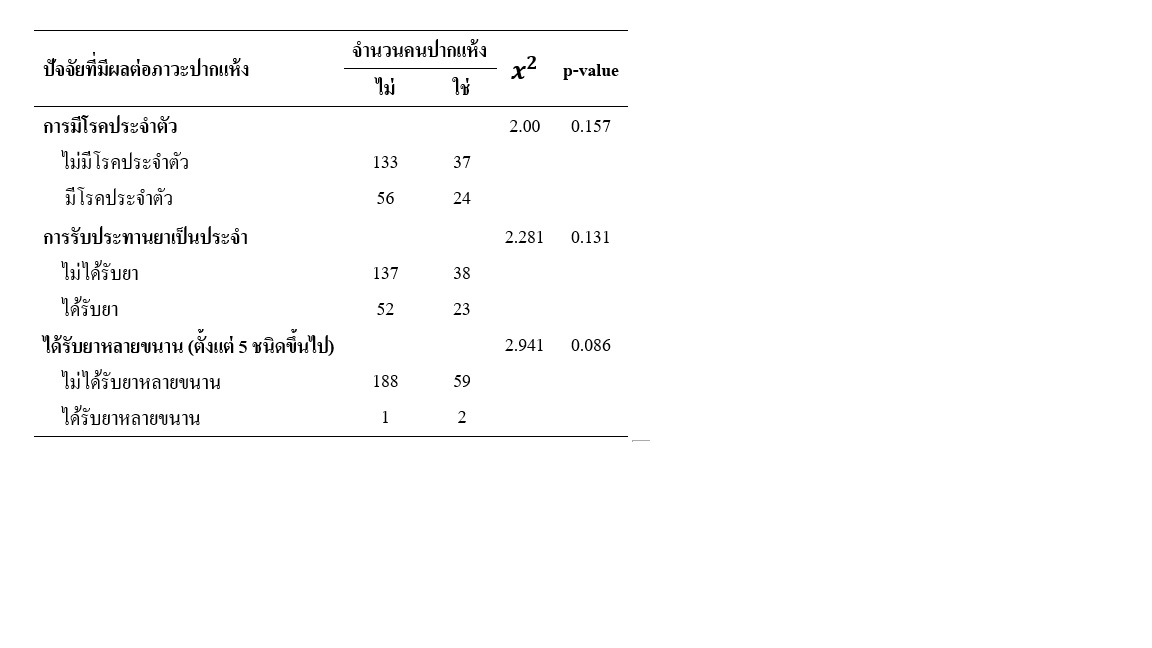
98 years, with dry mouth, 61 people thought. was 24.40% with a mean 14.59 (standard deviation of 4.19 and a score range of 12 - 38 points). The prevalence of dry mouth was 24.4%. The severity of dry mouth tended to increase with age. The prevalence of dry mouth was higher in females than in males. The prevalence of dry mouth increased in people with underlying diseases or with history of drug consumption. In addition, consumption of multiple drugs was significantly associated with increased severity of dry mouth (p=.026).
The present study showed high prevalence of dry mouth in the elderly with underlying medical conditions and multiple medications prescription. Therefore, there should be guidelines for detecting and managing dry mouth, including promoting proper oral health.
Downloads
References
สถาบันวิจัยประชากรและสังคม มหาวิทยาลัยมหิดล. ฐานข้อมูลประชากรผู้สูงอายุ [ออนไลน์] 2561 [อ้างเมื่อ 28 ตุลาคม 2562]. จาก http://www.ipsr.mahidol.ac.th/ipsrbeta/th/Gazette.aspx
สำนักงานสาธารณสุขจังหวัดร้อยเอ็ด. ระบบรายงานข้อมูลสุขภาพ [ออนไลน์] 2561 [อ้างเมื่อ 29 ตุลาคม 2562].จาก https://ret.hdc.moph.go.th/hdc/reports/report.php
Lamster IB, Asadourian L, Carmen TD, Friedman PK. The aging mouth: Differentiating normal aging from disease. Periodontology 2016; 72(1): 96-107.
Han P, Suarez-Durall P, Mulligan R. Dry mouth: A critical topic for older adult patients.
J Prosthodont Res 2015; 59(1): 6-19.
Guggenheimer J, Moore PA. Xerostomia: Etiology, recognition and treatment. J Am Dent Assoc 2003; 134(1): 61-9.
Sreebny LM. Saliva in health and disease: an appraisal and update. Int Dent J 2000; 50(3):
-61.
Field EA, Fear S, Higham SM, Ireland RS, Rostron J, Willetts RM, et al. Age and medication are significant risk factors for xerostomia in an English population, attending general dental practice. Gerodontology 2001; 18(1): 21-4.
Scully C, Bagan JV. Adverse drug reactions in the orofacial region. Crit Rev Oral Biol Med 2004; 15(4): 221-39.
Turner MD, Ship JA. Dry mouth and its effects on the oral health of elderly people. J Am Dent Assoc 2007; 138: S15-20.
Johansson AK, Johansson A, Unell L, Ekbäck G, Ordell S, Carlsson GE. Self-reported dry mouth in Swedish population samples aged 50, 65 and 75 years. Gerodontology 2012; 29(2): 107-15.
Orellana MF, Lagravère MO, Boychuk DGJ, Major PW, Flores-Mir C. Prevalence of xerostomia in population-based samples: A systematic review. J Public Health Dent 2006; 66(2): 152-8.
Ohara Y, Hirano H, Yoshida H, Obuchi S, Ihara K, Fujiwara Y, et al. Prevalence and factors associated with xerostomia and hyposalivation among community-dwelling older people in Japan. Gerodontology 2016; 33(1): 20-7.
Wayne, W. D. (1995). Biostatistics: A foundation of analysis in the health sciences (6th ed.). New York: John Wiley & Sons.
Locker D. Xerostomia in older adults: A longitudinal study. Gerodontology 1995; 12(1):
-25.
Rafaela Soares Rech, F. N. Factors associated with hyposalivation and xerostomia in older. Gerodontology 2019; 1–7.
Gil-Montoya JA, Barrios R, Sánchez-Lara I, Carnero-Pardo C, Fornieles-Rubio F, Montes J, et al. Prevalence of drug-induced xerostomia in older adults with cognitive impairment or dementia: An observational study. Drugs Aging 2016; 33(8): 611–8.
Vissink, A., Spijkervet, F. K. L,Amerongen, A. V. N. Aging and saliva: A review of the literature. Special Care in Dentistry 1996; 16(3), 95–103.
Liu B, Dion MR, Jurasic MM, Gibson G, Jones JA. Xerostomia and salivary hypofunction in vulnerable elders: Prevalence and etiology. Oral Surg Oral Med Oral Pathol Oral Radiol 2012; 114(1): 52-60.
Smith CH, Boland B, Daureeawoo Y, Donaldson E, Small K, Tuomainen J. Effect of aging on stimulated salivary flow in adults. J Am Geriatr Soc 2013; 61(5): 805-8.
Atkinson JC, Margaret Grisius, Ward Massey. Salivary Hypofunction and Xerostomia:Diagnosis and Treatment. Dent Clin North Am 2005; Apr;49(2):309-26.
Downloads
Published
How to Cite
Issue
Section
License
Copyright (c) 2022 Research and Development Health System Journal

This work is licensed under a Creative Commons Attribution-NonCommercial-NoDerivatives 4.0 International License.
เนื้อหาและข้อมูลในบทความที่ลงตีพิมพ์ในวารสารศูนย์ดัชนีการอ้างอิงวารสารไทย ถือเป็นข้อคิดเห็นและความรับผิดชอบของผู้เขียนบทความโดยตรงซึ่งกองบรรณาธิการวารสาร ไม่จำเป็นต้องเห็นด้วย หรือร่วมรับผิดชอบใด ๆบทความ ข้อมูล เนื้อหา รูปภาพ ฯลฯ ที่ได้รับการตีพิมพ์ในวารสารศูนย์ดัชนีการอ้างอิงวารสารไทย ถือเป็นลิขสิทธิ์ของวารสารศูนย์ดัชนีการอ้างอิงวารสารไทย หากบุคคลหรือหน่วยงานใดต้องการนำทั้งหมดหรือส่วนหนึ่งส่วนใดไปเผยแพร่ต่อหรือเพื่อกระทำการใด จะต้องได้รับอนุญาตเป็นลายลักษณ์อักษรจากวารสารศูนย์ดัชนีการอ้างอิงวารสารไทยก่อนเท่านั้น



