
Development of participatory self-management in behavior modification on glycemic control in uncontrolled type 2 diabetes patients, Sisaket province
Keywords:
model development, behavior modification, glycemic control, uncontrolled type 2 diabetesAbstract
This research investigated factors associated with uncontrolled blood levels of type 2 diabetes (type 2 DM) and developed a model for self-management in behavior modification on glycemic control among uncontrolled type 2 DM patients. The research consisted of three phases: phase 1, an analytical case-control study; phase 2, the action research aimed to develop a participatory self-management model to modify glycemic control behavior based on the PDCA model; and phase 3, a quasi-experimental study aimed to assess the effect of the developed model from phase 2. Data were analyzed using multivariable logistic regression, content analysis, and independent t-test statistics.
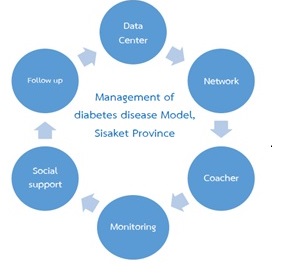
The results indicated three predicted factors of glycemic control in uncontrolled type 2 DM patients including received oral and injectable treatment (Adjusted odds ratio (AOR) = 0.11, 95% Confidence interval (95% CI= 0.02-0.53, P=0.0004), a good level of social support (AOR = 0.13, 95% CI=0.05-0.40, P<0.0001), and a good level of the glycemic control behavior (AOR = 0.28, 95% CI = 0.10-0.78, p= 0.0151). The diabetes management model in Sisaket Province (DNCMSF Model) contains a data center, networking, mentor, monitoring, social support, and patient follow-up. In phase 3, the HbA1C level of the experimental group was 2.18% lower than the comparison group (Mean difference = 2.18, 95% CI = 1.18-3.17). Moreover, the mean scores for the glycemic control behavior, knowledge, perceived risk exposure, and perceived severity in the experimental group were higher than in the comparison group significantly.
Downloads
References
สมาคมเบาหวานแห่งประเทศไทยในพระบรมราชูปถัมภ์สมเด็จพระเทพรัตนราชสุดาฯ สยามบรมราชกุมารี, สมาคมต่อมไร้ท่อแห่งประเทศไทย, กรมการแพทย์ กระทรวงสาธารณสุข และ สำนักงานหลักประกันสุขภาพแห่งชาติ. แนวทางเวชปฏิบัติสำหรับโรคเบาหวาน. กรุงเทพมหานคร : ศรีการพิมพ์. 2558.
Wild S, Roglic G, Green A, Sicree R, King H.Global prevalence of diabetes: estimates for the year 2000 and projection for 2030. Diabetes Care (serial online) 2004; 27:1047-1053.
DeFronzo, R. A., et al.. Type 2 diabetes mellitus. Nature Reviews Disease Primers, 1, 15019. doi:10.1038/nrdp.2015;.19.
Kharroubi, A. T., & Darwish, H. M.. Diabetes mellitus: The epidemic of the century. World journal of diabetes 201; 6(6), 850-867. doi:10.4239/wjd.v6.i6.850.
Davies, M. J., D’Alessio, D. A., Fradkin, J., Kernan, W. N., Mathieu, C., Mingrone, G., . . . Buse, J. B.. Management of Hyperglycemia in Type 2 Diabetes, 2018. A Consensus Report by the American Diabetes Association (ADA) and the European Association for the Study of Diabetes (EASD). Diabetes Care 2018; 41(12), 2669. doi:10.2337/dci18-0033.
Riddle, M. C., Gerstein, H. C., Holman, R. R., Inzucchi, S. E., Zinman, B., Zoungas, S., & Cefalu, W. T.. A1C Targets Should Be Personalized to Maximize Benefits While Limiting Risks. Diabetes Care 2018; 41(6), 1121-1124. doi:10.2337/dci18-0018.
สำนักงานสำรวจสุขภาพประชาชนไทย. การสำรวจสุขภาพอนามัยของประชาชนไทยโดยการตรวจร่างกายครั้งที่ 4 พ.ศ. 2551-2552. กรุงเทพมหานคร: กระทรวงสาธารณสุข. 2552.
วรรณี นิธิยานันท์, สาธิต วรรณแสง และชัยชาญ ดีโรจน์วงศ์. สถานการณ์โรคเบาหวานในประเทศไทย 2550. กรุงเทพมหานคร : วิวัฒน์การพิมพ์. 2550.
สำนักนโยบายและยุทธศาสตร์ กระทรวงสาธารณสุข. สาเหตุของโรคไตวาย 2550. ค้นเมื่อ
ธันวาคม 2564, จาก htt//bps.ops.moph.go.th/index.php?mod-bps&doc-5.
ณาเดีย หะยีปะจิ และพิสิษฐ์ พวยฟุ้ง. ปัจจัยที่มีความสัมพันธ์ต่อการควบคุมระดับน้ำตาลในเลือดของผู้ป่วยเบาหวานชนิดที่ 2 ที่มารับบริการตรวจติดตามระดับน้ำตาลที่ กองแพทย์ เทศบาลเมืองเชียงราย. วารสารการพยาบาล การสาธารณสุขและการศึกษา 2562; 20(3): 83-94.
ปิยะวดี ทองโปร่ง. ปัจจัยที่มีความสัมพันธ์กับการควบคุมระดับน้ำตาลในเลือดของผู้ป่วยเบาหวานชนิดที่สองของชุมชนแห่งหนึ่งในจังหวัดอุบลราชธานี. Journal of Ratchathani Innovative Health Sciences 2561; 2(4): 9-22.
ธีรศักดิ์ พาจันทร์, กฤชกันทร สุวรรณพันธุ์, บุญสัน อนารัตน์, & นิรันดร์ ถาละคร.ปัจจัยที่มีความสัมพันธ์กับการควบคุมระดับน้ำตาลในเลือดของผู้ป่วยเบาหวานชนิดที่ 2 อำเภอท่าบ่อ จังหวัดหนองคาย. วารสารศูนย์อนามัยที่ 9: วารสารส่งเสริมสุขภาพและอนามัยสิ่งแวดล้อม 2564; 16(1), 285-298.
ดารารัตน์ อุ่มบางตลาด และศตกมล ประสงค์วัฒนา. (2560). ประสิทธิผลของโปรแกรมการดูแล
ผู้ ป่วยเบาหวานชนิดที่ 2 แบบเข้มต่อความรู้พฤติกรรมการจัดการตนเองและระดับน้ำตาลในเลือดของผู้ป่วยเบาหวานใน PCU อ.บางปะอิน จ.พระนครศรีอยุธยา. Journal of Nursing, Public Health, and Education (ISSN: 2651-1908 Journal Online.), 18(1), 11-23.
วัชราภรณ์ นาฬิกุล, ลำไพร แทนสา และสุรภา พิลาออน. (2563). ผลของโปรแกรมสนับสนุนการจัดการตนเองต่อการควบคุมระดับน้ำตาลในเลือดของผู้ป่วยเบาหวานที่ควบคุมระดับน้ำตาลไม่ได้โรงพยาบาลเปือยน้อย จังหวัดขอนแก่น. วารสารสำนักงานสาธารณสุขจังหวัดขอนแก่น, 2(1), 77-90.
อ้อมฤทัย มั่นในบุญธรรม. (2562). ผลของโปรแกรมปรับเปลี่ยนพฤติกรรมโดยการเสริมสร้างความรอบรู้ด้านสุขภาพในการควบคุมระดับน้ำตาลในเลือดและชะลอไตเสื่อมของผู้ป่วยเบาหวานชนิดที่ 2 โรงพยาบาลส่งเสริมสุขภาพตำบลสำราญ. วารสารสำนักงานสาธารณสุขจังหวัดขอนแก่น. 1(2),121-132.
อภิชาติ กตะศิลา, สุกัญญา ลีทองดี และประเสริฐ ประสมรักษ์. (2560). ผลของโปรแกรมการใช้สมุดบันทึกทางคลินิกร่วมกับแรงสนับสนุนจากเพื่อนเบาหวานต่อพฤติกรรมการดูแลตนเองและการควบคุมระดับน้ำตาลในเลือดของผู้ป่วยเบาหวานชนิดที่ 2 อำเภอมหาชนะชัย จังหวัดยโสธร. วารสารวิทยาศาสตร์และเทคโนโลยีมหาวิทยาลัยอุบลราชธานี. 19(1), 233-243.
สำนักงานสาธารณสุขจังหวัดศรีสะเกษ. รายงานสรุปผลการดำเนินงานโรคไม่ติดต่อ จังหวัดศรีสะเกษ ประจำปี 2559. เอกสารรายงานประจำปี 2559 สำนักงานสาธารณสุขจังหวัดศรีสะเกษ, 2559.
Kemmis, S & McTaggart, R. The Action Research Planer (3rded.). Victoria: Deakin University, 1988.
Downloads
Published
How to Cite
Issue
Section
License
Copyright (c) 2022 Research and Development Health System Journal

This work is licensed under a Creative Commons Attribution-NonCommercial-NoDerivatives 4.0 International License.
เนื้อหาและข้อมูลในบทความที่ลงตีพิมพ์ในวารสารศูนย์ดัชนีการอ้างอิงวารสารไทย ถือเป็นข้อคิดเห็นและความรับผิดชอบของผู้เขียนบทความโดยตรงซึ่งกองบรรณาธิการวารสาร ไม่จำเป็นต้องเห็นด้วย หรือร่วมรับผิดชอบใด ๆบทความ ข้อมูล เนื้อหา รูปภาพ ฯลฯ ที่ได้รับการตีพิมพ์ในวารสารศูนย์ดัชนีการอ้างอิงวารสารไทย ถือเป็นลิขสิทธิ์ของวารสารศูนย์ดัชนีการอ้างอิงวารสารไทย หากบุคคลหรือหน่วยงานใดต้องการนำทั้งหมดหรือส่วนหนึ่งส่วนใดไปเผยแพร่ต่อหรือเพื่อกระทำการใด จะต้องได้รับอนุญาตเป็นลายลักษณ์อักษรจากวารสารศูนย์ดัชนีการอ้างอิงวารสารไทยก่อนเท่านั้น



