
ปัจจัยที่มีอิทธิพลต่อความพร้อมในงานพยาบาลวิชาชีพของนักศึกษาพยาบาล ในสถานการณ์ระบาดของไวรัสโคโรนา
คำสำคัญ:
ความเข้มแข็งในการมองโลก, การปรับตัวในงาน, ความพร้อมในงาน, โคโรนาไวรัส, นักศึกษาพยาบาลบทคัดย่อ
งานวิจัยนี้มีวัตถุประสงค์เพื่อศึกษาความสัมพันธ์ระหว่างปัจจัยส่วนบุคคล ความเข้มแข็งในการมองโลก การปรับตัวในงาน และความพร้อมในงานพยาบาลวิชาชีพของนักศึกษาพยาบาล รวมถึงปัจจัยที่มีอิทธิพลต่อความพร้อมในงานพยาบาลวิชาชีพของนักศึกษาพยาบาลในสถานการณ์ไวรัสโคโรนาเก็บข้อมูลด้วยแบบสอบถามจากการสุ่มอย่างง่ายนักศึกษาพยาบาลชั้นปีที่ 4 จำนวน 165 คน ระหว่างเดือนมิถุนายน ถึง กรกฎาคม 2564 วิเคราะห์ข้อมูลด้วยสถิติเชิงพรรณนา สัมประสิทธิ์สหสัมพันธ์ของเพียร์สัน และการวิเคราะห์ถดถอยแบบพหุคูณแบบขั้นตอน
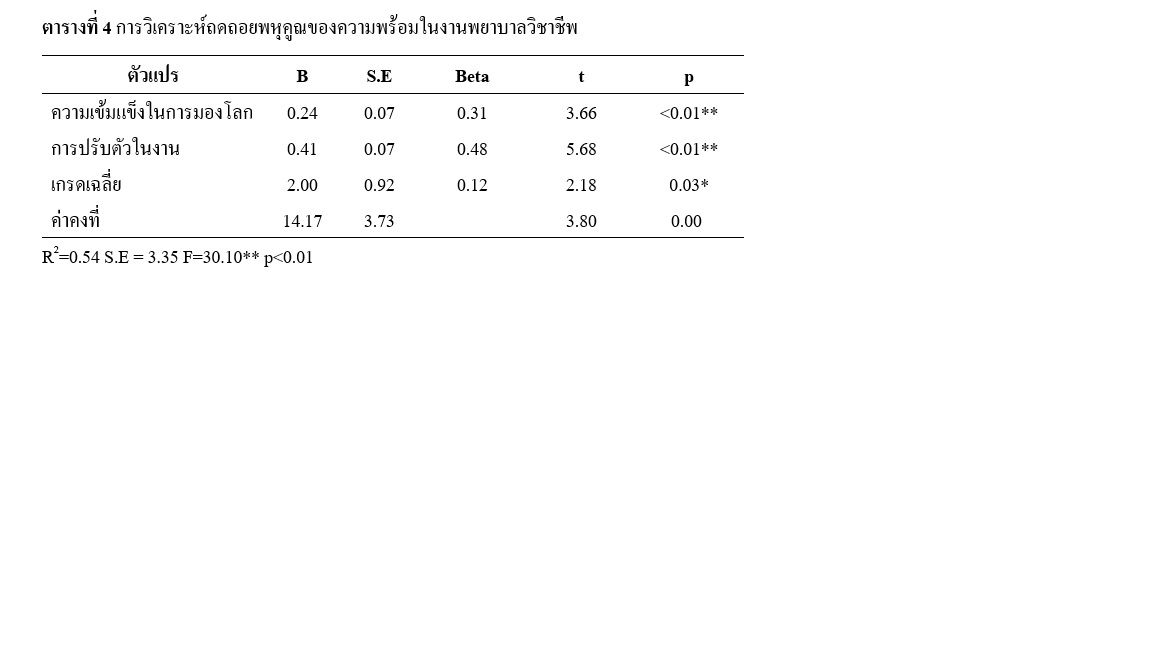
ผลการวิจัย พบว่า กลุ่มตัวอย่างมีค่าเฉลี่ยคะแนนความเข้มแข็งในการมองโลก การปรับตัวในงาน และความพร้อมในบทบาทพยาบาลวิชาชีพอยู่ในระดับมาก (50.60, 61.36 และ 53.32 ตามลำดับ) ความเข้มแข็งในการมองโลกและการปรับตัวในงาน มีความสัมพันธ์ทางบวกกับความพร้อมในงานพยาบาลวิชาชีพอย่างมีนัยสำคัญทางสถิติ (p-value< 0.01) ปัจจัยที่มีอิทธิพลต่อความพร้อมในงานพยาบาลวิชาชีพอย่างมีนัยสำคัญทางสถิติคือ การปรับตัวในงาน ความเข้มแข็งในการมองโลก และเกรดเฉลี่ย สามารถร่วมกันทำนายความพร้อมในงานพยาบาลวิชาชีพได้ร้อยละ 54 (p-value< 0.01)
ผลการวิจัยชี้ให้เห็นว่า ในสถานการณ์การระบาดของโคโรนาไวรัส ควรจัดกิจกรรมการเรียนการสอนที่เพิ่มการปรับตัวในงานและความเข้มแข็งในการมองโลกให้กับนักศึกษาก่อนสำเร็จการศึกษา เพื่อให้เกิดความพร้อมในงานพยาบาลวิชาชีพมากขึ้น
Downloads
เอกสารอ้างอิง
Dlamini CP, Mtshali NG, Dlamini CH, Mahanya S, Shabangu T, Tsabedze Z. New graduates' readiness for practice in Swaziland: an exploration of stakeholders' perspectives. Journal of Nursing Education and Practice 2014; 4(5): 148-158.
López-Entrambasaguas OM, Martínez-Yebenes R, Calero-García MJ, Granero-Molina J, Martínez-Linares JM. Newly Qualified Nurses' Perception of Their Competency Achievement on Leaving University: A Qualitative Study. International Journal of Environmental Research and Public Health 2019; 16: 4284.
Antonovsky A. Unraveling the Mystery of Health: How people manage stress and stay well. Jossey-Bass; San Francisco CA, USA 1987.
Jeong YJ, Koh CK. Female nursing graduate students' stress and health: the mediating effects of sense of coherence and social support. BMC nursing 2021; 20(1): 40.
Fusz K, Tóth Á, Varga B, Rozmann N, Oláh A, Tudományegyetem P. Different work schedules of nursing Hungary and their effects on health. Ideggyógyászati Szle. Clinical Neuroscience 2017; 70: 136–139.
Ando M, Kawano M. Relationships among moral distress, sense of coherence, and job satisfaction. Nursing Ethics 2018; 25(5): 571–579.
Skodova Z, Lajciakova P. The effect of personality traits and psychosocial training on burnout syndrome among healthcare students, Nurse Education Today 2013; 33(11): 1311-1315.
Vifladt A, Simonsen BO, Lydersen S, Farup PG. The association between patient safety culture and burnout and sense of coherence: A cross-sectional study in restructured and not restructured intensive care units. Intensive and Critical Care Nursing 2016; 36: 26-34.
Rahimi H, Baghsheykhi F, Azizi E, Jafari SH. Association of Psychological Capital and Job Adaptability in the Nurses of Kashan University of Medical Sciences Hospital, Iran. Iran Journal of Nursing. 2019; 32(118): 29-39.
Wiese LK, Love T, Goodman R. Responding to a simulated disaster in the virtual or live classroom: Is there a difference in BSN student learning? Nurse Education in Practice 2021; 55: 103170.
Wallace, J. Nursing student work-study internship program: an academic partnership. Journal of Nursing Education 2016; 55(6): 357-359.
Harrison, H., Birks, M., Franklin, R. C., & Mills, J. Fostering graduate nurse practice readiness in context. Collegian 2020; 27(1) :115-124.
Duchscher JE. Transition shock: The initial stage of role adaptation for newly graduated registered nurses. Journal of Advanced Nursing 2009; 65(5): 1103-1113.
Walker A, Storey KM, Costa BM, Leung RK. Refinement and validation of the Work Readiness Scale for graduate nurses. Nursing Outlook 2015; 63(6): 632-638.
Faul F, Erdfelder E, Lang AG, Buchner A. G*Power3: A flexible statistical power analysis program for the social, behavioral, and biomedical sciences. Behavior research methods 2007; 39(2): 175–191.
Super S, Wagemakers MA, Picavet HS, Verkooijen KT, Koelen MA. Strengthening sense of coherence: opportunities for theory building in health promotion. Health Promotion International 2016; 31: 869-878.
Fusz K, Tóth Á, Varga B, Rozmann N, Oláh A, Tudományegyetem P. Different work schedules of nurses in Hungary and their effects on health. Clinical Neuroscience 2017; 70: 136–139.
Masanotti GM, Paolucci S, Abbafati E, Serratore C, Caricato M. Sense of Coherence in Nurses: A Systematic Review. Journal of Environmental Research and Public Health 2020; 17(6): 1861.
Boromarajonani Sawanpracharak Nakhonsawan. Bachelor of Nursing Science Program (2017) 2019.
Casey K, Fink R, Jaynes C, Campbell L, Cook P, Wilson V. Readiness for practice: The senior practicum experience. Journal of Nursing Education 2011; 50(11): 646–652.
Colomer-Pérez N, Joan J. Paredes-Carbonell, Sarabia-Cobo C, Gea-Caballero V. Sense of coherence, academic performance and professional vacation in Certified Nursing Assistant students. Nurse Education Today 2019; Aug 79: 8-13.
Tano R, Miura H, Oshima K, Noritake K, Fukuda H. The Relationship between the Sense of Coherence of Dental Hygiene Students in Their Graduation Year and Their View of the Profession and Attitude to Work: A Cross-Sectional Survey in Japan. International Journal of Environmental Research and Public Health 2020; 17: 9594.
ดาวน์โหลด
เผยแพร่แล้ว
รูปแบบการอ้างอิง
ฉบับ
ประเภทบทความ
สัญญาอนุญาต
ลิขสิทธิ์ (c) 2022 วารสารวิจัยและพัฒนาระบบสุขภาพ

อนุญาตภายใต้เงื่อนไข Creative Commons Attribution-NonCommercial-NoDerivatives 4.0 International License.
เนื้อหาและข้อมูลในบทความที่ลงตีพิมพ์ในวารสารศูนย์ดัชนีการอ้างอิงวารสารไทย ถือเป็นข้อคิดเห็นและความรับผิดชอบของผู้เขียนบทความโดยตรงซึ่งกองบรรณาธิการวารสาร ไม่จำเป็นต้องเห็นด้วย หรือร่วมรับผิดชอบใด ๆบทความ ข้อมูล เนื้อหา รูปภาพ ฯลฯ ที่ได้รับการตีพิมพ์ในวารสารศูนย์ดัชนีการอ้างอิงวารสารไทย ถือเป็นลิขสิทธิ์ของวารสารศูนย์ดัชนีการอ้างอิงวารสารไทย หากบุคคลหรือหน่วยงานใดต้องการนำทั้งหมดหรือส่วนหนึ่งส่วนใดไปเผยแพร่ต่อหรือเพื่อกระทำการใด จะต้องได้รับอนุญาตเป็นลายลักณอักษรจากวารสารศูนย์ดัชนีการอ้างอิงวารสารไทยก่อนเท่านั้น



