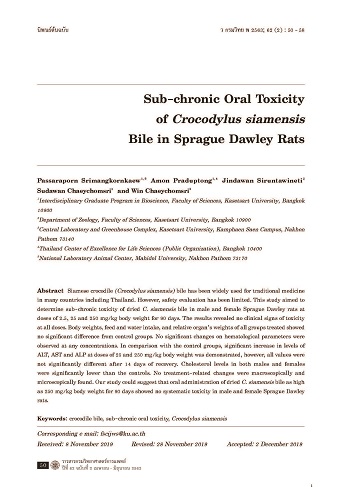
Sub-chronic Oral Toxicity of Crocodylus siamensis Bile in Sprague Dawley Rats
Keywords:
crocodile bile, sub-chronic oral toxicity, Crocodylus siamensisAbstract
Siamese crocodile (Crocodylus siamensis) bile has been widely used for traditional medicine in many countries including Thailand. However, safety evaluation has been limited. This study aimed to determine sub-chronic toxicity of dried C. siamensis bile in male and female Sprague Dawley rats at doses of 2.5, 25 and 250 mg/kg body weight for 90 days. The results revealed no clinical signs of toxicity at all doses. Body weights, feed and water intake, and relative organ’s weights of all groups treated showed no significant difference from control groups. No significant changes on hematological parameters were observed at any concentrations. In comparison with the control groups, significant increase in levels of ALT, AST and ALP at doses of 25 and 250 mg/kg body weight was demonstrated, however, all values were not significantly different after 14 days of recovery. Cholesterol levels in both males and females were significantly lower than the controls. No treatment-related changes were macroscopically and microscopically found. Our study could suggest that oral administration of dried C. siamensis bile as high as 250 mg/kg body weight for 90 days showed no systematic toxicity in male and female Sprague Dawley rats.
References
China Pharmacopoeia Commission. Pharmacopoeia of the People's Republic of China. Beijing, China: Chemical Industry Press; 1997.
Picheinsutthorn C, Jeerawong V. Animal medicinal materials. In: Hand out of Thai medicinal pharmacy Vol. III. Bangkok: Amarin Press; 2003. p. 150-167.
Organization for Economic Co-operation and Development (OECD). OECD guidelines for the testing of chemicals No. 420: acute oral toxicity – fixed dose procedure [online]. 2001; [cited 2020 Apr 26]; [14 screens]. Available from: URL: https://ntp.niehs.nih.gov/iccvam/suppdocs/feddocs/oecd/oecd_gl420.pdf.
Srimangkornkaew P, Praduptong A, Siruntawineti J, Chaeychomsri S, Chaeychomsri W. Acute oral toxicity of Crocodylus siamensis bile in sprague dawley rats. Bull Dept Med Sci 2020; 62(1): 16-25.
Chaeychomsri W, Siruntawineti J, Osotsila I. Process suitable for the preservation of crocodile gall bladder for adding value to product. In: Proceeding of the 35th congress on science and technology of Thailand; 2009 Oct 15–17; Chonburi, Thailand. Bangkok, Thailand: The Science Society of Thailand Under the Patronage of His Majesty the King; 2009. p. 569-576.
Chaeychomsri W, Siruntawineti J. Process for preparation of crocodile blood powder and its product, Thai Petty Patent No. 5074. Bangkok, Thailand: Kasetsart University; 2006.
Organization for Economic Co-operation and Development (OECD). OECD guidelines for the testing of chemicals test No. 408: repeated dose 90-days oral toxicity study in rodents [online]. 2018; [cited 2019 Oct 20]; [16 screens]. Available from: URL: https://www.oecd-ilibrary.org/docserver/9789264070707-en.pdf?expires=1589271810&id=id&accname=guest&checksum=8BF6058D341C0664D65F9A5B948F0A99.
Suvarna SK, Layton C, Bancroft JD. Bancroft’s theory and practice of histological techniques. 8th ed. London, England: Elsevier; 2018.
Hofmann AF. The continuing importance of bile acids in liver and intestinal disease. Arch Intern Med 1999; 159(22): 2647-58.