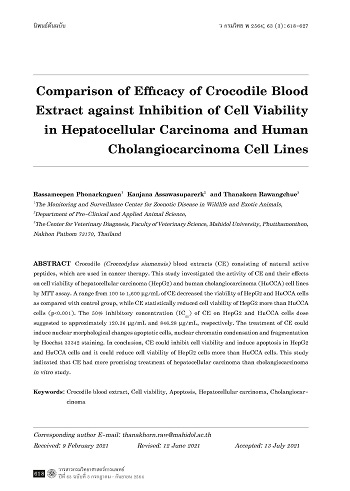
Comparison of Efficacy of Crocodile Blood Extract against Inhibition of Cell Viability in Hepatocellular Carcinoma and Human Cholangiocarcinoma Cell Lines
Keywords:
Crocodile blood extract, Cell viability, Apoptosis, Hepatocellular carcinoma, Cholangiocar-cinomaAbstract
Crocodile (Croccodylus siamensis) blood extracts (CE) consisting of natural active peptides, which are used in cancer therapy. This study investigated the activity of CE and their effects on cell viability of hepatocellular carcinoma (HepG2) and human cholangiocarcinoma (HuCCA) cell lines by MTT assay. A range from 100 to 1,600 μg/mL of CE decreased the viability of HepG2 and HuCCA cells as compared with control group, while CE statistically reduced cell viability of HepG2 more than HuCCA cells (p<0.001). The 50% inhibitory concentration (IC50) of CE on HepG2 and HuCCA cells dose suggested to approximately 120.36 μg/mL and 846.28 μg/mL, respectively. The treatment of CE could induce nuclear morphological changes apoptotic cells, nuclear chromatin condensation and fragmentation by Hoechst 33342 staining. In conclusion, CE could inhibit cell viability and induce apoptosis in HepG2 and HuCCA cells and it could reduce cell viability of HepG2 cells more than HuCCA cells. This study indicated that CE had more promising treatment of hepatocellular carcinoma than cholangiocarcinoma in vitro study.
References
Srivatanakul P, Sriplung H, Deerasamee S. Epidemiology of liver cancer: an overview. Asian Pac J Cancer Prev 2004; 5(2): 118-25.
Srivatanakul P, Parkin DM, Jiang YZ, Khlat M, Kao-lan UT, Sontipong S, et al. The role of infection by Opisthorchis viverrini, hepatitis B virus, and aflatoxin exposure in the etiology of liver cancer in Thailand. A correlation study. Cancer 1991; 68(11): 2411-7.
Srivatanakul P. Epidemiology of liver cancer in Thailand. Asian Pac J Cancer Prev 2001; 2(2): 117-21.
Hejna M, Pruckmayer M, Raderer M. The role of chemotherapy and radiation in the management of biliary cancer: a review of the literature. Eur J Cancer 1998; 34(7): 977-86.
Sirica AE. Cholangiocarcinoma: molecular targeting strategies for chemoprevention and therapy. Hepatology 2005; 41(1): 5-15.
Battle TE, Arbiser J, Frank DA. The natural product honokiol induces caspase-dependent apoptosis in B-cell chronic lymphocytic leukemia (B-CLL) cells. Blood 2005; 106(2): 690-7.
Preecharram S, Daduang S, Bunyatratchata W, Araki T, Thammasirirak S. Antimicrobial activity from Siamese crocodile (Crocodylus siamensis) serum. Afr J Biotechnol 2008; 7(17): 3121-8.
Preecharram S, Jearranaiprepame P, Daduang S, Termsiripong Y, Somdee T, Fukamizo T, et al. Isolation and characterisation of crocosin, an antibacterial compound from crocodile (Crocodylus siamensis) plasma. Anim Sci J 2010; 81(3): 393-401.
Pata S, Yaraksa N, Daduang S, Temsiripong Y, Svasti J, Araki T, et al. Characterization of the novel antibacterial peptide Leucrocin from crocodile (Crocodylus siamensis) white blood cell extracts. Dev Comp Immunol 2011; 35(5): 545-53.
Hoskin DW, Ramamoorthy A. Studies on anticancer activities of antimicrobial peptides. Biochim Biophys Acta 2008; 1778(2): 357-75.
Patathananone S, Thammasirirak S, Daduang J, Chung JG, Termsiripong Y, Daduang S. Bioactive compounds from crocodile (Crocodylus siamensis) white blood cells induced apoptotic cell death in HeLa cells. Environ Toxicol 2016; 31(8): 986-97.
Ou Y, Ho WS. Crocodile blood extract induces the apoptosis of lung cancer cells through PTEN activity. Oncol Rep 2016; 36(3): 1457-66.
Maraming P, Klaynongsruang S, Boonsiri P, Maijaroen S, Daduang S, Chung JG, et al. Antitumor activity of RT2 peptide derived from crocodile leukocyte peptide on human colon cancer xenografts in nude mice. Environ Toxicol 2018; 33(9): 972-7.
Phosri S, Jangpromma N, Chang LC, Tan GT, Wongwiwatthananukit S, Maijaroen S, et al. Siamese crocodile white blood cell extract inhibits cell proliferation and promotes autophagy in multiple cancer cell lines. J Microbiol Biotechnol 2018; 28(6): 1007-21.
Merchant ME, Leger N, Jerkins E, Mills K, Pallansch MB, Paulman RL, et al. Broad spectrum antimicrobial activity of leukocyte extracts from the American alligator (Alligator mississippiensis). Vet Immunol Immunopathol 2006; 110(3-4): 221-8.
Bridges CC, Battle JR, Zalups RK. Transport of thiol-conjugates of inorganic mercury in human retinal pigment epithelial cells. Toxicol Appl Pharmacol 2007; 221(2): 251-60.
Bragazzi MC, Cardinale V, Carpino G, Venere R, Semeraro R, Gentile R, et al. Cholangiocarcinoma: epidemiology and risk factors. Transl Gastrointest Cancer 2012; 1(1): 21-32.
Yaraksa N, Anunthawan T, Theansungnoen T, Daduang S, Araki T, Dhiravisit A, et al. Design and synthesis of cationic antebacterial peptide based on Leucrocin I sequence, antibacterial peptide from crocodile (Crocodylus siamensis) white blood cell extracts. J Antibiot (Tokyo) 2014; 67(3): 205-12.
Anunthawan T, de la Fuente-NÚnez C, Hancock REW, Klaynongsruang S. Cationic amphipathic peptides KT2 and RT2 are taken up into bacterial cells and kill planktonic and biofilm bacteria. Biochim Biophys Acta 2015; 1848(6): 1352-8.
Barksdale SM, Hrifko EJ, van Hock ML. Cathelicidin antimicrobial peptide from Alligator missisippiensis has antibacterial activity against multi-drug resistant Acinetobacter baumanii and Klebsiella pneumoniae. Dev Comp Immunol 2017; 70: 135-44.