Investigation of Mutagenic Activity of Thai Cannabis sativa L. Extract
Keywords:
Cannabis sativa L. extract, Mutagenic activity, Thai strain Cannabis sativa L.Abstract
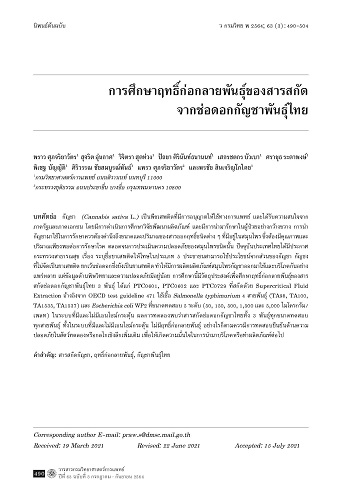
Cannabis sativa L. is an addictive plant, which has been allowed for medical use in Thailand. This species has been recently drawn attention by the public conducting studies, research and development, and producing herbal products for medical purpose. The amount of active ingredients, the efficacy of the treatment and the safety for consumers should be taken into serious consideration. This herb has been legalized for medical purpose and daily consumption. The notification is enacted in the ministerial regulation regarding the names of narcotics in category 5, people can take advantage of any parts of cannabis and hemp (except trichromes of cannabis), which are not classified as a drug. However, toxicity and safety data are still limited. This study, therefore, aimed to investigate the mutagenic activity of the fomale Infovescence extracts from three of Thai cannabis, including PTC0601, PTC0602 and PTC0729 extracted using supercritical fluid extraction and then investigated the mutagenic activity using method complied with OECD GLP test guideline 471. The four strains of Salmonella typhimurium (TA98, TA100, TA1535, TA1537) and Escherichia coli (WP2) were treated with five different doses of the extracts at 50, 150, 500, 1,500 and 5,000 μg/plate with and without metabolic activation enzymes. The results showed that the three trichrome extracts did not produce significant revertant colonies in all strains of bacteria and all concentrations of the extracts (both non- and enzymatic activation). However, in-depth testing or mechanisms for safety in animal model should be confirmed in order to ensure that the Thai cannabis extracts can be consumed or continue to make products.
References
ประกาศกระทรวงสาธารณสุข เรื่อง ระบุชื่อยาเสพติดให้โทษในประเภท 5 (พ.ศ. 2563). ราชกิจจานุเบกษา เล่ม 137 ตอนพิเศษ ๒๙๐ ง (วันที่ 14 ธันวาคม 2563). หน้า 33.
ประกาศกระทรวงสาธารณสุข ฉบับที่ 424 (พ.ศ. 2564) เรื่อง กำหนดอาหารที่ห้ามผลิต นำเข้า หรือจำหน่าย. ราชกิจจานุเบกษา เล่ม 138 ตอนพิเศษ 45 ง (วันที่ 25 กุมภาพันธ์ 2564). หน้า 32.
ศูนย์วิจัยกสิกรไทย. “กัญชา” จะกลายเป็นพืชเศรษฐกิจไทย ได้หรือไม่? [ออนไลน์]. 2563; [สืบค้น 14 ม.ค. 2563]; [2 หน้า]. เข้าถึงได้ที่ : URL : https://kasikornresearch.com/th/analysis/k-social-media/Pages/FB-Cannabis-14-01-20.aspx.
Small E, Cronquist A. A practical and natural taxonomy for Cannabis. Taxon 1976; 25(4) : 405-35.
ราชบัณฑิตยสถาน. อนุกรมวิธานพืช อักษร ก. พิมพ์ครั้งที่ 2. กรุงเทพฯ : ราชบัณฑิตยสถาน; 2547.
Anderson LC. Leaf variation among Cannabis species from a controlled garden. Bot Mus Leafl 1980; 28(1) : 61-9.
Hanus LO, Meyer SM, Munoz E, Taglialatela-Scafati O, Appendino G. Phytocannabinoids : a unified critical inventory. Nat Prod Rep 2016; 33(12) : 1357-92.
Hill AJ, Williams CM, Whalley BJ, Stephens GJ. Phytocannabinoids as novel therapeutic agents in CNS disorders. Pharmacol Ther 2012; 133(1) : 79-97.
Daris B, Tancer Verboten M, Knez Z, Ferk P. Cannabinoids in cancer treatment : therapeutic potential and legislation. Bosn J Basic Med Sci 2019; 19(1) : 14-23.
Szafl arski JP, Bebin EM, Cutter G, DeWolfe J, Dure LS, Gaston TE, et al. Cannabidiol improves frequency and severity of seizures and reduces adverse events in an open-label add-on prospective study. Epilepsy Behav 2018; 87 : 131-6.
Vuckovic S, Srebro D, Vujovic KS, Vucetic C, Prostran M. Cannabinoids and pain : new insights from old molecules. Front Pharmacol 2018; 9 : 1259. (19 pages).
National Academies of Sciences, Engineering, and Medicine; Health and Medicine Division; Board on Population Health and Public Health Practice; Committee on the Health Effects of Marijuana : An Evidence Review and Research Agenda. The health effects of cannabis and cannabinoids : the current state of evidence and recommendations for research. Washington, DC : National Academies Press; 2017.
OECD Guideline for the Testing of Chemicals. Test No. 471 : bacterial reverse mutation test. [online]. 2020; [cited 2020 Jun 28]; [11 screens]. Available from : URL : https://www.oecdilibrary.org/environment/test-no-471-bacterial-reverse-mutation-test_9789264071247-en.
Marx TK, Reddeman R, Clewell AE, Endres JR, Béres E, Vértesi A, et al. An assessment of the genotoxicity and subchronic toxicity of a supercritical fluid extract of the aerial parts of hemp. J Toxicol 2018; 2018 : 8143582. (26 pages).
Dziwenka M, Coppock R, Alexander M, Palumbo E, Ramirez C, Lermer S. Safety assessment of a hemp extract using genotoxicity and oral repeat-dose toxicity studies in Sprague-Dawley rats. Toxicol Rep 2020; 7 : 376-85.
Jeun JA, Cho HJ, Jun HJ, Lee JH, Jia YY, Cho KS, et al. Mutagenic and antimutagenic effects of hemp seed oil evaluated by Ames Salmonella testing. Korean J Food Sci Tech 2011; 43(3) : 396-400.
พราว ศุภจริยาวัตร. การศึกษาฤทธิ์ก่อกลายพันธุ์ของสารสกัดกัญชาที่สกัดด้วยวิธีของไหลวิกฤตยิ่งยวด. ใน : เอกสารการประชุมวิชาการพิษวิทยาแห่งชาติครั้งที่ 10. วันที่ 28-29 ตุลาคม 2563. กรุงเทพฯ : สมาคมพิษวิทยาแห่งประเทศไทย; 2563. หน้า 41-53.