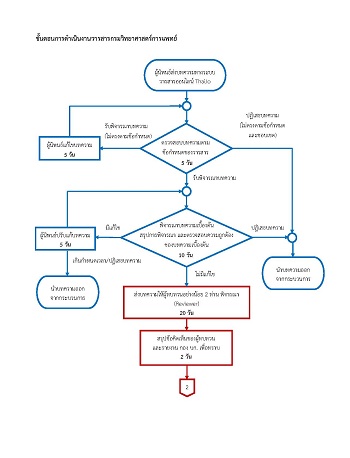
Development and Validation for Determination of Adventitious Viruses in Vero Cells Used for Vaccine Production by Using Indicator Cells
Keywords:
Vero cells, Adventitious viruses, Vaccine productionAbstract
A Vero cell substrate used to produce vaccines requires strict quality control. The determination of adventitious viruses by using indicator cells is one of the tests according to the WHO requirements. Therefore, the objectives of this study were to develop and validate a testing method to determine adventitious viruses in Vero cells. The optimal concentration of three indicator cells including Vero 76, MRC-5 and Vero cells (the same species used in the vaccine production) and the titers of two representative measles virus and bovine parainfl uenza virus type 3 (BPIV3) were analyzed. In this study, a Vero cell culture (1 × 10⁷ cells/mL) was used for detection of viral contamination with co-culture in three indicator cells by observation of cytopathic eff ect (CPE), hemadsorption and hemagglutination. The results showed that this method had specifi city that was positive to measles virus and BPIV3 at the limitation of lowest titers of 0.1 and 0.01 CCID50/mL, respectively. It is thus indicated that this method could be benefi cial to determine the contamination of adventitious viruses in Vero cells used for vaccine production in laboratory.
References
Kiesslich S, Kamen AA. Vero cell upstream bioprocess development for the production of viral vectors and vaccines. Biotechnol Adv. [serial online]. 2020; [cited 2021 Oct 17]; 44: [9 screens]. Available from: URL: https://www.sciencedirect.com/science/article/pii/S0734975020301105?via%3Dihub.
Barrett PN, Mundt W, Kistner O, Howard MK. Vero cell platform in vaccine production: moving towards cell culture-based viral vaccines. Expert Rev Vaccines 2009; 8(5): 607-18.
World Health Organization. Recommendations for the evaluation of animal cell cultures as substrates for the manufacture of biological medicinal products and for the characterization of cell banks Annex 3, TRS No 978. [online]. 2013; [cited 2021 Mar 2]; [110 screens]. Available from: URL: https://www.who.int/publications/m/item/animal-cell-culture-trs-no-978-annex3.
Sadeghi M, Kapusinszky B, Yugo DM, Phan TG, Deng X, Kanevsky I, et al. Virome of US bovine calf serum. Biologicals 2017; 46: 64-7.
Marcus-Sekura C, Richardson JC, Harston RK, Sane N, Sheets RL. Evaluation of the human host range of bovine and porcine viruses that may contaminate bovine serum and porcine trypsin used in the manufacture of biological products. Biologicals 2011; 39(6): 359-69.
Schirtzinger EE, Suddith AW, Hause BM, Hesse RA. First identification of porcine parvovirus 6 in North America by viral metagenomic sequencing of serum from pigs infected with porcine reproductive and respiratory syndrome virus. Virol J. [serial online]. 2015; [cited 2021 Mar 2]; 12: [10 screens]. Available from: URl: https://www.ncbi.nlm.nih.gov/pmc/articles/PMC4609089/pdf/12985_2015_Article_401.pdf.
European Medicines Agency. Quality of biotechnological products: viral safety evaluation of biotechnology products derived from cell lines of human or animal origin, ICH Q5A (R1). [online]. 1997; [cited 2021 Oct 17]; [29 screens]. Available from: URL: https://www.ema.europa.eu/en/ichq5a-r1-quality-biotechnological-products-viral-safety-evaluation-biotechnology-products-derived.
Food and Drug Administration. Guidance for industry-Characterization and qualification of cell substrates and other biological materials used in the production of viral vaccines for infectious diseases indications. [online]. 2010; [cited 2021 Oct 17]; [50 screens]. Available from: URL: https://www.fda.gov/media/78428/download.
Gombold J, Karakasidis S, Niksa P, Podczasy J, Neumann K, Richardson J, et al. Systematic evaluation of in vitro and in vivo adventitious virus assays for the detection of viral contamination of cell banks and biological products. Vaccine 2014; 32(24): 2916-26.
Appendix 4 Analytical method validation. In: World Health Organization. Annex 4 Supplementary guidelines on good manufacturing practices: validation, TRS No. 937. Geneva: World Health Organization; 2006. p. 136-140.
European Medicines Agency. ICH harmonised tripartite guideline, Validation of analytical procedures: text and methodology Q2(R1). [online]. 2005 [cited 2021 Oct 17]; [17 screens]. Available from: URL: https://database.ich.org/sites/default/files/Q2%28R1%29%20Guideline.pdf.
Nims RW. Detection of adventitious viruses in biologicals--a rare occurrence. Dev Biol (Basel) 2006; 123: 153-64.
Matumoto M. Multiplication of measles virus in cell cultures. Bacteriol Rev 1966; 30(1): 152-76.
Morris C, Lee YS, Yoon S. Adventitious agent detection methods in bio-pharmaceutical applications with a focus on viruses, bacteria, and mycoplasma. Curr Opin Biotechnol 2021; 71: 105-14.
เซลล์เพาะเลี้ยง Vero สำหรับการผลิตวัคซีนใน: ระเบียบกรมวิทยาศาสตร์การแพทย์ว่าด้วยอัตราค่าบำรุงการตรวจวิเคราะห์และให้บริการ ฉบับที่ 6 (พ.ศ. 2564). ราชกิจจานุเบกษา เล่ม 138 ตอนพิเศษ 80 ง (วันที่ 9 เมษายน 2564). หน้า 10.
Downloads
Published
How to Cite
Issue
Section
License
Copyright (c) 2021 BULLETIN OF THE DEPARTMENT OF MEDICAL SCIENCES

This work is licensed under a Creative Commons Attribution-NonCommercial-NoDerivatives 4.0 International License.