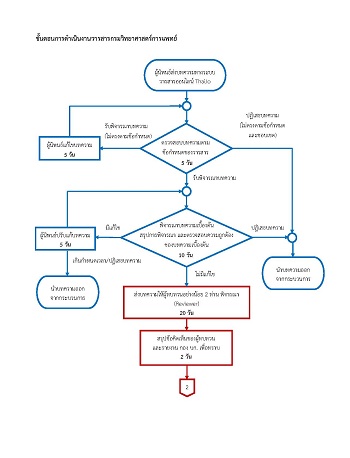
Development of Tyrosine Kinase Inhibitor Screening Assay for Anti-cancer Agents
Keywords:
Cancer, Tyrosine kinase inhibitor screening assay, Tyrosine kinase inhibitors, Cancer therapeutic targetsAbstract
Tyrosine kinases play a key role in various cellular signaling pathways, linking to proliferation, migration, invasion and angiogenesis of cancer cells. Many of these are therapeutic targets for the treatment of cancers. This study aimed to develop the tyrosine kinase inhibitor assay for compound library screening. The assay development was started by investigating the expression levels of genes associated with these proteins in four cancer cell lines by quantitative real-time PCR, and measuring the tyrosine kinase activity of each cell lysate by ELISA. HeLa cell was chosen for the development. We further optimized the assay conditions, and the following were found: cell lysate, 0.125 mg/mL; peptide substrate,
0.25 μg/well; ATP, 25 nM; and incubation time of 30 minutes was suitable for the kinase reaction. The assay
system was verifi ed by using anti-cancer agents. The results showed that tyrosine kinase inhibitors decreased the assay signal. We also validated this assay by quantitative measurement of signal variability. It was shown that all parameters met the acceptance criteria, indicating that this assay was reproducible and suitable for screening. This developed assay was also used to test 180 medicinal plant extracts, and the active extracts were further tested by MTT and transmembrane assays. The results showed that some extracts exhibited potential anti-cancer activity in cell lines. Thus, the developed assay could be used for screening of tyrosine kinase inhibitors in a large number of samples.
References
Sung H, Ferlay J, Siegel RL, Laversanne M, Soerjomataram I, Jemal A, et al. Global cancer statistics 2020: GLOBOCAN estimates of incidence and mortality worldwide for 36 cancers in 185 countries. CA Cancer J Clin 2021; 71(3): 209-49.
กลุ่มข้อมูลข่าวสารสุขภาพ. สถิติสาธารณสุข พ.ศ. 2562. นนทบุรี: กองยุทธศาสตร์และแผนงาน สำนักงานปลัดกระทรวงสาธารณสุข; 2563. หน้า 78-79.
Padma VV. An overview of targeted cancer therapy. BioMedicine. [serial online]. 2015; [cited 2021 Oct 21]; 5(4): [6 screens]. Available from: URL: https://biomedicine.cmu.edu.tw/doc/17-1.pdf.
Gocek E, Moulas AN, Studzinski GP. Non-receptor protein tyrosine kinases signaling pathways in normal and cancer cells. Crit Rev Clin Lab Sci 2014; 51(3): 125-37.
Du Z, Lovly CM. Mechanisms of receptor tyrosine kinase activation in cancer. Mol Cancer. [serial online]. 2018; [cited 2021 Oct 21]; 17: [13 screens]. Available from: URL: https://doi.org/10.1186/s12943-018-0782-4.
Pottier C, Fresnais M, Gilon M, Jérusalem G, Longuespée R, Sounni NE. Tyrosine kinase inhibitors in cancer: breakthrough andchallenges of targeted therapy. Cancers. [serial online]. 2020; [cited 2021 Oct 21]; 12(3): [17 screens]. Available from: URL: https://doi.org/10.3390/cancers12030731.
Metibemu DS, Akinloye OA, Akamo AJ, Ojo DA, Okeowo OT, Omotuyi IO. Exploring receptor tyrosine kinases-inhibitors in cancer treatments. Egypt J Med Hum Genet. [serial online]. 2019; [cited 2021 Oct 21]; 20(1): [16 screens]. Available from: URL: https://doi.org/10.1186/s43042-019-0035-0.
Gopalakrishna R, Chen ZH, Gundimeda U, Wilson JC, Anderson WB. Rapid filtration assays for protein kinase C activity and phorbol ester binding using multiwell plates with fitted filtration discs. Anal Biochem 1992; 206(1): 24-35.
Nakayama GR, Nova MP, Parandoosh Z. A scintillating microplate assay for the assessment of protein kinase activity. J Biomol Screen 1998; 3(1): 43-8.
Park YW, Cummings RT, Wu L, Zheng S, Cameron PM, Woods A, et al. Homogeneous proximity tyrosine kinase assays: scintillation proximity assay versus homogeneous time-resolved fluorescence. Anal Biochem 1999; 269(1): 94-104.
Kumar EA, Charvet CD, Lokesh GL, Natarajan A. High-throughput fl uorescence polarization assay to identify inhibitors of Cbl(TKB)-protein tyrosine kinase interactions. Anal Biochem 2011; 411(2): 254-60.
Rodems SM, Hamman BD, Lin C, Zhao J, Shah S, Heidary D, et al. A FRET-based assay platform for ultra-high density drug screening of protein kinases and phosphatases. Assay Drug Dev Technol 2002; 1(1): 9-19.
Koresawa M, Okabe T. High-throughput screening with quantitation of ATP consumption: a universal non-radioisotope, homogeneous assay for protein kinase. Assay Drug Dev Technol 2004; 2(2): 153-60.
King IC, Feng M, Catino JJ. High throughput assay for inhibitors of the epidermal growth factor receptor-associated tyrosine kinase. Life Sci 1993; 53(19): 1465-72.
Baumann CA, Zeng L, Donatelli RR, Maroney AC. Development of a quantitative, high-throughput cell-based enzyme-linked immunosorbent assay for detection of colonystimulating factor-1 receptor tyrosine kinase inhibitors. J Biochem Bioph Methods 2004; 60(1): 69-79.
Zhang XH, Guo XN, Zhong L, Luo XM, Jiang HL, Lin LP, et al. Establishment of the active catalytic domain of human PDGFRß tyrosine kinase-based ELISA assay for inhibitor screening. Biochim Biophys Acta 2007; 1770(10): 1490-7.
Angeles TS, Steffl er C, Bartlett BA, Hudkins RL, Stephens RM, Kaplan DR, et al. Enzymelinked immunosorbent assay for trkA tyrosine kinase activity. Anal Biochem 1996; 236(1): 49-55.
Bauer SM, Gehringer M, Laufer SA. A direct enzyme-linked immunosorbent assay (ELISA) for the quantitative evaluation of Janus kinase 3 (JAK3) inhibitors. Anal Methods 2014; 6(21): 8817-22.
Spandidos A, Wang X, Wang H, Seed B. PrimerBank: a resource of human and mouse PCR primer pairs for gene expression detection and quantifi cation. Nucleic Acids Res. [serial online]. 2009; [cited 2021 Oct 21]; 38: [8 screens]. Available from URL: https://doi.org/10.1093/nar/gkp1005.
Barber RD, Harmer DW, Coleman RA, Clark BJ. GAPDH as a housekeeping gene: analysis of GAPDH mRNA expression in a panel of 72 human tissues. Physiol Genomics 2005; 21(3): 389-95.
Ghosh G, Yan X, Kron SJ, Palecek SP. Activity assay of epidermal growth factor receptor tyrosine kinase inhibitors in triple-negative breast cancer cells using peptide-conjugated magnetic beads. Assay Drug Dev Technol 2013; 11(1): 44-51.
Iversen PW, Beck B, Chen YF, Dere W, Devanarayan V, Eastwood BJ, et al. HTS assay validation. In: Assay guidance manual.[online]. 2012; [cited 2021 Oct 21]: [26 screens]. Available from: URL: https://www.ncbi.nlm.nih.gov/books/NBK83783.
Zhang JH, Chung TD, Oldenburg KR. A simple statistical parameter for use in evaluation and validation of high throughput screening assays. J Biomol Screen 1999; 4(2): 67-73.
Riss TL, Moravec RA, Niles AL, Duellman S, Benink HA, Worzella TJ, et al. Cell viability assays. In: Assay guidance manual. [online]. 2012; [cited 2021 Oct 21]: [25 screens]. Available from: URL: https://www.ncbi.nlm.nih.gov/books/NBK144065.
Hulkower KI, Herber RL. Cell migration and invasion assays as tools for drug discovery. Pharmaceutics 2011; 3(1): 107-24.
Settasupana K, Pruksakorn P, Leunchaichaweng A, Prachasuphap A, Dhepakson P. Cloning, expression and purifi cation of human CXCL12 alpha recombinant protein. Poster session presented at: The 24th Annual Medical Sciences Conference; Thailand. [online]. 2016 Jun 1-3; [cited 2021 Oct 21]: [1 screen]. Available from: URL: http://e-library.dmsc.moph.go.th/ebooks/files/P2-11%20กัญจน์รัชต์.pdf.
Dillenburg-Pilla P, Patel V, Mikelis CM, Zárate-Bladés CR, Doçi CL, Amornphimoltham P, et al. SDF-1/CXCL12 induces directional cell migration and spontaneous metastasis via a CXCR4/Gαi/mTORC1 axis. FASEB J 2015; 29(3): 1056-68.
Hughes JP, Rees S, Kalindjian SB, Philpott KL. Principles of early drug discovery. Br J Pharmacol 2011; 162(6): 1239-49.
Nicholson RI, Gee JMW, Harper ME. EGFR and cancer prognosis. Eur J Cancer 2001; 37(Suppl 4): S9-15.
Miyamoto M, Ojima H, Iwasaki M, Shimizu H, Kokubu A, Hiraoka N, et al. Prognostic signifi cance of overexpression of c-Met oncoprotein in cholangiocarcinoma. Br J Cancer 2011; 105(1): 131-8.
Chung CY, Yeh KT, Hsu NC, Chang JHM, Lin JT, Horng HC, et al. Expression of c-kit protooncogene in human hepatocellular carcinoma. Cancer Lett 2005; 217(2): 231-6.
Nagaraj N, Wisniewski JR, Geiger T, Cox J, Kircher M, Kelso J, et al. Deep proteome and transcriptome mapping of a human cancer cell line. Mol Syst Biol. [serial online]. 2011; [cited 2021 Oct 21]; 7(1): [8 screens]. Available from: URL: https://doi.org/10.1038/msb.2011.81.
Herskovits TT, Gadegbeku B, Jaillet H. On the structural stability and solvent denaturation of proteins. I. Denaturation by the alcohols and glycols. J Biol Chem 1970; 245(10): 2588-98.
Tjernberg A, Markova N, Griffi ths WJ, Hallén D. DMSO-related eff ects in protein characterization. J Biomol Screen 2006; 11(2): 131-7.
Lestari D, Kartika R, Marliana E. Antioxidant and anticancer activity of Eleutherine bulbosa (Mill.) Urb on leukemia cells L1210. J Phys Conf Ser. [serial online]. 2019; [cited 2021 Oct 21]: 1277: [7 screens]. Available from: URL: https://iopscience.iop.org/article/10.1088/1742-6596/1277/1/012022.
Suwarso E. The apoptosis eff ects of ethylacetate extract of Eleutherine bulbosa (Mill.) Urb. against T47D cells. Int J PharmTech Res 2014-2015; 7(3): 535-9.
Widowati W, Wijaya L, Wargasetia T, Bachtiar I, Yelliantty Y, Laksmitawati D. Antioxidant, anticancer, and apoptosis-inducing eff ects of Piper extracts in Hela cells. J Exp Integr Med 2013; 3(3): 225-30.
Boontha S, Taowkaen J, Phakwan T, Worauaicha T, Kamonnate P, Buranrat B, et al. Evaluation of antioxidant and anticancer eff ects of Piper betle L (Piperaceae) leaf extract on MCF-7 cells, and preparation of transdermal patches of the extract. Trop J Pharma Res 2019; 18(6): 1265-72.
Duong TH, Bui XH, Pogam PL, Nguyen HH, Tran TT, Nguyen TAT, et al. Two novel diterpenes from the roots of Phyllanthus acidus (L.) Skeel. Tetrahedron 2017; 73(38): 5634-8.
Geng HC, Zhu HT, Yang WN, Wang D, Yang CR, Zhang YJ. New cytotoxic dichapetalins in the leaves of Phyllanthus acidus: Identifi cation, quantitative analysis, and preliminary toxicity assessment. Bioorg Chem. [serial online]. 2021; [cited 2021 Oct 21]; 114: [6 screens]. Available from: URL: https://doi.org/10.1016/j.bioorg.2021.105125.
Kwan YP, Saito T, Ibrahim D, Al-Hassan FM, Ein Oon C, Chen Y, et al. Evaluation of the cytotoxicity, cell-cycle arrest, and apoptotic induction by Euphorbia hirta in MCF-7 breast cancer cells. Pharm Biol 2016; 54(7): 1223-36.
Silva GL, Kinghorn AD, Lee IS. Special problems with the extraction of plants. In: Cannell RJP, editors. Natural products isolation. New Jersey: Humana Press; 1998. p. 343-363.
Tanaka T, Nonaka GI, Nishioka I. Tannins and related compounds. XL. Revision of the structures of Punicalin and Punicalagin, and isolation and characterization of 2-O-galloylpunicalin from the bark of Punica granatum L. Chem Pharm Bull 1986; 34(2): 650-5.
Ahmad W, Singh S, Kumar S. Phytochemical screening and antimicrobial study of Euphorbia hirta extracts. J Med Plants Stud 2017; 5(2): 183-6.
Downloads
Published
How to Cite
Issue
Section
License
Copyright (c) 2022 BULLETIN OF THE DEPARTMENT OF MEDICAL SCIENCES

This work is licensed under a Creative Commons Attribution-NonCommercial-NoDerivatives 4.0 International License.