Epidemiology of SARS-CoV-2 Beta Variant (B.1.351) and Risk Factors for Severe Illness in the Southernmost Provinces of Thailand, April-September 2021
Keywords:
COVID-19, Beta variant, Risk factors for severe illness, Southernmost provinces of ThailandAbstract
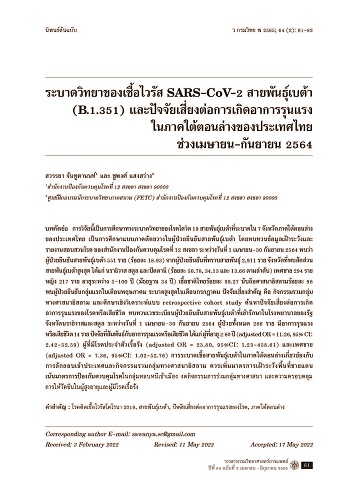
This study aimed to explore the epidemiology of the SARS-CoV-2 Beta variant (B.1.351) outbreak in the seven southernmost provinces of Thailand. A cross-sectional study was conducted on confirmed Beta variant cases. The surveillance and case investigation data of the Office of Disease Prevention and Control 12 Songkhla were reviewed from 1 April to 30 September 2021. The Beta variant was confirmed in 551 cases (18.93%) out of 2,911 lineage-known SARS-CoV-2 cases. The top three highest proportions of Beta-variant cases were found in Narathiwat, Satun and Pattani provinces at 50.78%, 34.13% and 13.66%, respectively. Of all cases, 294 were male and 217 were female. The age range was 1–100 years (median 34 years). Most of cases were Thai (99.27%), most of whom were Muslim (96%). The first cluster of Beta variant was found in May 2021, while the peak of cases occurred in July 2021. Risk factors of the outbreak were gatherings in Islamic activities. The retrospective cohort study was conducted by reviewing outpatient cards and investigation documents of 286 patients (including 14 severely ill cases or deaths) who were diagnosed with Beta variant in Narathiwat and Satun from 1 April to 30 September 2021. The risk factors of severe or dead cases were age over 60 years (adjusted OR = 11.26, 95%CI: 2.42–52.59), chronic lung diseases (adjusted OR = 23.80, 95%CI: 1.23–458.61) and male gender (adjusted OR = 7.36, 95%CI: 1.02–52.76). Risk factors of the Beta variant outbreak were illegal influx across the Thai-Malaysian border and Islamic gatherings. Thus, the following should be undertaken: strengthening border surveillance to prevent illegal influx; banning religious gatherings, and improving vaccination coverage in elderly and chronically ill persons.
References
World Health Organization. Coronavirus disease (COVID-19). [online]. 2021; [cited 2021 Dec 24]. Available from: URL: https://www.who.int/emergencies/diseases/novel-coronavirus-2019/question-andanswers-hub/q-a-detail/coronavirusdisease-covid-19.
Tang YW, Schmitz JE, Persing DH, Stratton CW. Laboratory diagnosis of COVID-19: current issues and challenges. J Clin Microbiol 2020; 58(6): e00512-20.
World Health Organization. Origin of SARS-CoV-2. [online]. 2020; [cited 2021 Aug 14]; [2 screens]. Available from: URL: https://apps.who.int/iris/bitstream/handle/10665/332197/WHO-2019-nCoV-FAQ-Virus_origin-2020.1-eng.pdf.
World Health Organization. WHO-convened global study of origins of SARS-CoV-2: China part. [online]. 2021; [cited 2021 Aug 14]; [120 screens]. Available from: URL: https://www.who.int/publications/i/item/whoconvened-global-study-of-origins-of-sarscov-2-china-part.
ProMED-mail. Novel coronavirus (02): Thailand ex China (HU) WHO. Archive Number: 20200113.6886644. [online]. 2020; [cited 2022 Jan 19]. Available from: URL: https://promedmail.org/promedpost/?id=20200113.6886644.
Cov-lineages.org. Lineage list. [online]. 2019; [cited 2022 Jan 19]. Available from: URL: https://cov-lineages.org/lineage_list.html.
World Health Organization. Episode #39-update on virus variants. [online]. 2021; [cited 2022 Jan 14]. Available from: URL: https://www.who.int/emergencies/diseases/novel-coronavirus-2019/mediaresources/science-in-5/episode-39---update-on-virus-variants.
World Health Organization. Tracking SARS-CoV-2 variants. [online]. 2021; [cited 2022 Jan 19]. Available from: URL: https://www.who.int/activities/tracking-SARS-CoV-2-variants.
World Health Organization. Naming the coronavirus disease (COVID-19) and the virus that causes it. [online]. 2020; [cited 2022 Jan 14]; [2 screens]. Available from: URL: https://www.who.int/emergencies/diseases/novel-coronavirus-2019/technical-guidance/naming-the-coronavirusdisease-(covid-2019)-and-the-virusthat-causes-it.
Liu Y, Rocklöv J. The reproductive number of the Delta variant of SARS-CoV-2 is far higher compared to the ancestral SARS-CoV-2 virus. J Travel Med 2021; 28(7): taab124. (3 pages).
Manatu H. Covid-19 variants update. [online]. 2021; [cited 2021 Nov 28]; [67 screens]. Available from: URL: https://www.health.govt.nz/system/files/documents/pages/variants-update-27-april-2022_0.pdf.
Paredes MI, Lunn SM, Famulare M, Frisbie LA, Painter I, Burstein R, et al. Associations between SARS-CoV-2 variants and risk of COVID-19 hospitalization among confirmed cases in Washington State: a retrospective cohort study. Clin Infect Dis 2022; ciac279. (19 pages).
Phiriyasart F, Chantutanon S, Salaeh F, Roka A, Thepparat T, Kaesaman S, et al. Outbreak investigation of coronavirus disease (COVID-19) among Islamic missionaries in southern Thailand, April 2020. OSIR Journal 2020; 13(2): 48-54.
Chailek C, Taweewigyakarn P, Yimchoho N, Saritapirak N, Namwat C, Sawanpanyalert N. Epidemiological characteristics and medical visits of the first 58 COVID-19 deaths, January–June 2020, Thailand. OSIR Journal 2021; 14(1): 1-11.
Team E. The epidemiological characteristics of an outbreak of 2019 novel coronavirus diseases (COVID-19)-China, 2020. China CDC Wkly 2020; 2(8): 113-22.
Centers for Disease Control and Prevention. COVID-19. [online]. 2022; [cited 2022 May 08]. Available from: URL: https://www.cdc.gov/coronavirus/2019-ncov.
Mysiak K. The relationship between significant, power, sample size & effect size. [online]. 2020; [cited 2022 May 08]; [9 screens]. Available from: URL: https://towardsdatascience.com/the-relationshipbetween-significant-power-sample-sizeeffect-size-899fcf95a76d.
Downloads
Published
How to Cite
Issue
Section
License
Copyright (c) 2022 BULLETIN OF THE DEPARTMENT OF MEDICAL SCIENCES

This work is licensed under a Creative Commons Attribution-NonCommercial-NoDerivatives 4.0 International License.