Thailand’s Situation of Microbial Contamination in Traditional and Herbal Medicines in 2021
Thailand’s Situation of Microbial Contamination in Traditional and Herbal Medicines
Keywords:
Microbial contamination, Herbal medicine, Traditional medicineAbstract
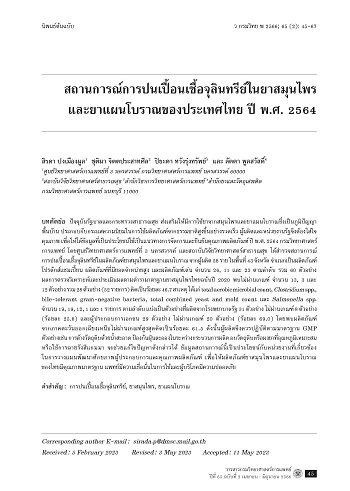
The Thai government and the Ministry of Public Health are currently promoting the use of herbal and traditional medicines, as the trend for natural products is growing rapidly. As a result, it is important for manufacturers and state agencies to ensure the quality of these products. In the fiscal year 2021, the Regional Medical Sciences Center 3 Nakhonsawan and the National Institute of Health surveyed the microbial contamination in herbal and traditional medicinal products from 58 entrepreneurs across 43 provinces. The products selected for testing included product champions, best-selling products and outstanding products, with a total of 60 samples, including 26, 11 and 23 samples from each category, respectively. The survey tested for microbial contamination using the Thai Herbal Pharmacopoeia 2020 (THP 2020) and found that 28 out of 60 samples (46.7%) failed to comply with the THP standard, with 13, 3, and 12 samples from each category, respectively. The results showed that 19, 19, 12, 1 and 1 samples were contaminated with total aerobic microbial count, Clostridium spp., bile-tolerant gram-negative bacteria, total combined yeasts and moulds count and Salmonella spp. Respectively. Among these samples, 31 samples were collected from government hospitals and 29 samples were obtained from private manufacturers, of which 8 (25.8%) and 20 (69%) samples, respectively, did not comply to the standard. The result revealed that the products from the Northeastern region showed poor quality since 61.5% of products did not meet the criteria. To address these issues, manufacturers should consider GMP process such as washing raw materials with clean water, protecting from dust during production, drying raw materials at optimum temperatures, or using gamma irradiation. This survey provides important information for relevant agencies to improve the quality of local entrepreneurs' products to meet the official standard and ensure consumer safety.
References
บัญชียาหลักแห่งชาติ. บัญชียาจากสมุนไพร ปรับปรุงล่าสุดถึง ประกาศคณะกรรมการพัฒนาระบบยาแห่งชาติ เรื่อง บัญชียาหลักแห่งชาติ. พ.ศ. 2556. [ออนไลน์]. 2556; [สืบค้น 23 พ.ย. 2565]; [108 หน้า]. เข้าถึงได้จาก: URL: http://ndi.fda.moph.go.th/uploads/main_drug_file/20171021185635.pdf.
กระทรวงสาธารณสุข, องค์การภาครัฐ-เอกชน. แผนแม่บทแห่งชาติว่าด้วยการพัฒนาสมุนไพรไทย ฉบับที่ 1 พ.ศ. 2560-2564. นนทบุรี: กรมพัฒนาการแพทย์แผนไทยและการแพทย์ทางเลือก กระทรวงสาธารณสุข; 2559.
สำนักงานคณะกรรมการกฤษฎีกา. พระราชบัญญัติยา พ.ศ. 2510. [ออนไลน์]. 2510; [สืบค้น 23 พ.ย. 2565]; [50 หน้า]. เข้าถึงได้จาก: URL: https://www.fda.moph.go.th/sites/drug/LawDrug/drug2510-krisdika-v2020.pdf.
ประกาศสำนักงานคณะกรรมการอาหารและยา เรื่อง หลักเกณฑ์การพิจารณาขึ้นทะเบียนตำรับยาแผนโบราณเกี่ยวกับมาตรฐานการปนเปื้อนเชื้อจุลินทรีย์และโลหะหนัก. ราชกิจจานุเบกษา เล่ม 122 ตอนพิเศษ 43 ง (วันที่ 16 มิถุนายน 2548). หน้า 28.
ประกาศกระทรวงสาธารณสุข เรื่อง เกณฑ์มาตรฐานค่าความบริสุทธ์ หรือคุณลักษณะอื่นอันมีความสำคัญต่อคุณภาพสำหรับตำรับผลิตภัณฑ์สมุนไพรที่ขึ้นทะเบียนแจ้งรายละเอียด หรือจดแจ้ง พ.ศ. 2564. ราชกิจจานุเบกษา เล่ม 138 ตอนพิเศษ 294 ง (วันที่ 1 ธันวาคม 2564). หน้า 6.
Aung MS, Matsuda A, Urushibara N, Kawaguchiya M, Ohashi N, Matsuda N, et al. Clonal diversity of Clostridium perfringens human clinical isolates with various toxin gene profiles based on multilocus sequence typing and alpha-toxin (PLC) typing. Anaerobe 2021; 72: 102473.
Koneman EW, Allen SD, Janda WM, Winn WC, Schreckenberger PC. Color atlas and textbook of diagnostic microbiology. 5th ed. Philadelphia: Lippincott; 1997.
Bacteria: Clostridium perfringens. In: Juneja VK, Taneja NK, Thakur S. Reference module in food science. Amsterdam: Elsevier; 2023.
Appendix 10 Microbiological test, 10.2 Microbial limit tests, 10.5 Limits for Microbial Contamination., Ministry of Public Health. In: Department of Medical Sciences. Thai Herbal Pharmacopoeia 2020. Bangkok: The Agricultural Co-operative Federation of Thailand; 2020. p.862-889, 891-894.
กรมวิทยาศาสตร์การแพทย์ กระทรวงสาธารณสุข. วิธีมาตรฐานสำหรับการวิเคราะห์อาหาร เล่มที่ 3. กรุงเทพฯ: โรงพิมพ์สำนักงานพระพุทธศาสนาแห่งชาติ; 2558. หน้า 125-126.
ระเบียบกรมวิทยาศาสตร์การแพทย์ ว่าด้วยอัตราค่าบำรุงการตรวจวิเคราะห์และให้บริการ พ.ศ. 2562. ลำดับที่ 33.2 การตรวจยืนยันเชื้อแบคทีเรียไร้อากาศ. ราชกิจจานุเบกษา เล่มที่ 136 ตอนพิเศษ 130 ง. (วันที่ 22 พฤษภาคม 2562).
Heikinheimo A, Korkeala H. Multiplex PCR assay for toxinotyping Clostridium perfringens isolates obtained from Finnish broiler chickens. Lett Appl Microbiol 2005; 40(6): 407-11.
Meer RR, Songer JG. Multiplex polymerases chain reaction assay for genotyping Clostridium perfringens. Am J Vet Res 1997; 58(7): 702-5.
Jepson M, Titball RW. Structure and function of clostridial phospholipase C. Microbes Infect 2000; 2(10): 1277-84.
ปิยะดา หวังรุ่งทรัพย์, ชุติมา จิตตประสาทศีล, ธนิตชัย คำแถลง, นัฐพงษ์ ชื่นบาน, สมชาย แสงกิจพร, ทายาท ศรียาภัย. การจำแนกชนิดของยีนสร้างสารพิษของ Clostridium perfringens ที่แยกได้จากสมุนไพรด้วยวิธีมัลติเพล็กซ์พีซีอาร์. ว มหาวิทยาลัยศรีนครินทรวิโรฒ (สาขาวิทยาศาสตร์และเทคโนโลยี) 2564; 13(26): 60-72.
Cannabis Research UK. Bile-tolerant gramnegative bacteria. [online]. [cited 2023 Apr 5]. Available from: URL: https://cannabisresearchuk.com/testing/bile-tolerant_gramnegative_bacteria.html.
อารีรัตน์ ลออปัญญา, วิเชียร ธานินทร์ธราธาร, อนัญญา เหลืองอรุณ. แนวทางการป้องกันการปนเปื้อนเชื้อจุลินทรีย์ในผลิตภัณฑ์ยาจากสมุนไพร. กรุงเทพฯ: กองควบคุมยา สำนักงานคณะกรรมการอาหารและยา; 2548.
Bacterial endospores. In: Brock TD, Madigan MT. Biology of microorganisms. 6th ed. New Jersey: Prentice Hall; 1991.
จิตรา ชัยวัฒน์, จิรานุช แจ่มทวีกุล, สันติพงศ์ วงศ์เพ็ญทักษ์, ปรัชญาพร อินทองแก้ว. ความปลอดภัยของยาจากสมุนไพรในบัญชียาหลักแห่งชาติ. ว กรมวิทย พ 2557; 56(3): 123-34.
Sornchaithawatwong C, Tadtong S, Tangkiatkumjai M. The prevalence of acceptable quality herbal products in Thailand. Journal of Herbal Medicine 2020; 24: 100391. (6 pages).
ปรัชญาพร อินทองแก้ว, ประภาพรรณ สุขพรรณ์, อนัญญา สุพันธุ์วณิช, จิรานุช แจ่มทวีกุล. การตรวจสอบการปนเปื้อนโลหะหนักและเชื้อจุลินทรีย์ ในยากวาด ยาเป่าคอ และยานัตถุ์. ใน: บทคัดย่อจากการประชุมวิชาการวิทยาศาสตร์การแพทย์ ประจำปีงบประมาณ พ.ศ. 2561. วันที่ 28-30 มิถุนายน 2561, ศูนย์การประชุม อิมแพ็ค ฟอรั่ม เมืองทองธานี. นนทบุรี: กรมวิทยาศาสตร์การแพทย์ กระทรวงสาธารณสุข; 2561.
อุไลลักษณ์ เทพวัลย์. การศึกษาปัญหาและพฤติกรรมการใช้ยาสมุนไพรและผลิตภัณฑ์์เสริมอาหารในผู้้สูงอายุโรคความดันโลหิตสูงในตำนาโป่ง อำเภอเมืองเลย จังหวัดเลย. ผลงานวิชาการ โรงพยาบาลเลย 2565; 1(1): 26-33.
de Sousa Lima CM, Fujishima MAT, de Paula Lima B, Mastroianni PC, de Sousa FFO, da Silva JO. Microbial contamination in herbal medicines: a serious health hazard to elderly consumers. BMC Complement Med Ther 2020; 20: 17. (9 pages).
เมธาวี ศรีรัตนโชติชัย, สุภาภรณ์ สุดหนองบัว, วิทยา กุลสมบูรณ์, ชื่นจิตร กองแก้ว. การจัดการประสบการณ์ไม่พึงประสงค์จากการใช้ยาสมุนไพรโดยมุมมองของผู้บริโภค. ว เภสัชกรรมไทย 2561; 10(2): 421-36.
Downloads
Published
How to Cite
Issue
Section
License
Copyright (c) 2023 BULLETIN OF THE DEPARTMENT OF MEDICAL SCIENCES

This work is licensed under a Creative Commons Attribution-NonCommercial-NoDerivatives 4.0 International License.