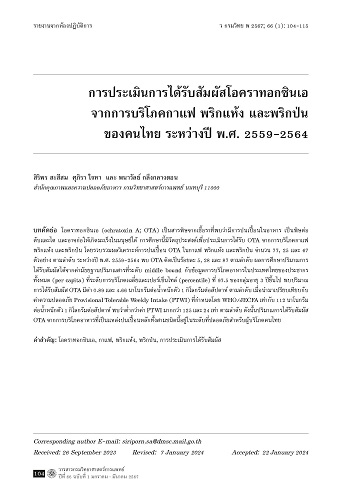
Dietary Exposure Assessment to Ochratoxin A from the Consumption of Coffee, Dried Chili and Ground Chili among Thai People During 2016–2021
Dietary Exposure Assessment of Ochratoxin A in Food
Keywords:
Ochratoxin A, Coffee, Dried chilli, Ground dried chilli, Exposure assessmentAbstract
Ochratoxin A (OTA) is a mycotoxin, found to be contaminated in a variety of food commodities. It causes adverse effects on liver and kidney and is classified as a human carcinogen. The objective of this study was to assess the exposure of OTA in consumption of coffee, dried chili and ground dried chili (77, 25 and 67 samples, respectively). The results of OTA found at 5, 28 and 87 percent, in the order, were detected. The dietary exposure of OTA was assessed from median concentration using middle-bound approach average and 97.5th percentile consumption, per capita, of Thai population over three years old. The estimations of average and 97.5th percentile exposures were 0.89 and 4.66 ng/kg body weight/week, respectively. Comparison of the exposure with Provisional Tolerable Weekly Intake (PTWI) at 112 ng/kg body weight/week established by WHO/JECFA resulted in about 125 and 24 times lower than the PTWI value, respectively. Therefore, the dietary exposure of OTA from these three main categories of food contaminations reveals a safety level for Thai consumers.
References
World Health Organization. Mycotoxins. [online]. 2018; [cited 2022 Jan 15]; [4 screens]. Available from: URL: https://www.who.int/news-room/fact-sheets/detail/mycotoxins.
Food and Agriculture Organization of the United Nations. Mycotoxins of world-wide importance. [online]. 1994; [cited 2022 Apr 30]; [5 screens]. Available from: URL: https://www.fao.org/3/y1390e/y1390e04.htm.
Aoyama K, Nakajima M, Tabata S, Ishikuro E, Tanaka T, Norizuki H, et al. Four-year surveillance for ochratoxin a and fumonisins in retail foods in Japan. J Food Prot 2010; 73(2): 344-52.
Jørgensen K. Occurrence of ochratoxin A in commodities and processed food--a review of EU occurrence data. Food Addit Contam 2005; 22(Suppl 1): 26-30.
Nguyen MT, Tozlovanu M, Tran TL, Pfohl-Leszkowicz A. Occurrence of aflatoxin B1, citrinin and ochratoxin A in rice in five provinces of the central region of Vietnam. Food Chemistry 2007; 105(1): 42-7.
Jalili M, Jinap S. Natural occurrence of aflatoxins and ochratoxin A in commercial dried chili. Food Control 2012; 24(1-2): 160-4.
สุพี วนศิรากุล, เนตรา สมบูรณ์แก้ว, อัจฉราพร ศรีจุดานุ, อมรา ชินภูติ. ศึกษาการปนเปื้อนของเชื้อราและสารโอคราทอกซินเอในผลไม้อบแห้งและการลดปริมาณสารพิษโดยใช้วิธีทางกายภาพ. ว วิชาการเกษตร 2557; 32(2): 188-200.
นลินทิพย์ รอดสีเสน. การวัดปริมาณโอคราทอกซิน เอและบี ที่ปนเปื้อนในพริกแห้ง [วิทยานิพนธ์]. ภาควิชาพิษวิทยา, คณะวิทยาศาสตร์. เชียงใหม่: มหาวิทยาลัยเชียงใหม่; 2559.
ประกาศกระทรวงสาธารณสุข ฉบับที่ 414 (พ.ศ. 2563) ออกตามความในพระราชบัญญัติอาหาร พ.ศ. 2522 เรื่องมาตรฐานอาหารที่มีสารปนเปื้อน. ราชกิจจานุเบกษา เล่มที่ 137 ตอนพิเศษ 118 ง (วันที่ 20 พฤษภาคม 2563). หน้า 17.
EUR-Lex Access to European Union law. Commission Regulation (EU) 2023/915 of 25 April 2023 on maximum levels for certain contaminants in food and repealing Regulation (EC) No 1881/2006. [online]. 2023; [cited 2023 Jun 30]. Available from: URL: https://eur-lex.europa.eu/eli/reg/2023/915/oj.
World Health Organization, International Agency For Research on Cancer. IARC monographs on the evaluation of carcinogenic risks to humans. [online]. 2002; [cited 2022 Jan 15]. Available from: URL: https://publications.iarc.fr/_publications/media/download/2618/a48798b1acf1f630be9fcbb30ffb2d56b790c08d.pdf.
วราพร รัตนเสนา. การใช้ Saccharomyces cerevisiae ดูดซับสารพิษ aflatoxin B1 และ ochratoxin A [วิทยานิพนธ์]. สาขาวิชาวิทยาศาสตร์และเทคโนโลยีการอาหาร, คณะวิทยาศาสตร์และเทคโนโลยี. กรุงเทพฯ: มหาวิทยาลัยธรรมศาสตร์; 2557.
INCHEM International Peer Reviewed Chemical Safety Information. Ochratoxin A. [online]. 2001; [cited 2023 Nov 5]. Available from: URL: https://inchem.org/documents/jecfa/jecmono/v47je04.htm.
World Health Organization. Ochratoxin A. In: 68th meeting of the Joint FAO/WHO Expert Committee on Food Additives (JECFA).
[online]. 2007; [cited 2022 Apr 30]; [74 screens]. Available from: URL: https://apps.who.int/food-additives-contaminants-jecfa-database/Home/Chemical/1905.
EFSA Panel on Contaminants in the Food Chain (CONTAM). Risk assessment of ochratoxin A in food. EFSA Journal. [online]. 2020; [cited 2022 Apr 5]; 18(5): [150 screens]. Available from: URL: https://efsa.onlinelibrary.wiley.com/doi/epdf/10.2903/j.efsa.2020.6113.
AOAC official method 2004.10 Ochratoxin A in green coffee. In: Latimer GW, editor. Official methods of analysis of AOAC international. 20th ed. Washington, DC: AOAC International; 2019. p. 70-72.
สำนักมาตรฐานสินค้าเกษตรและอาหารแห่งชาติ. ข้อมูลการบริโภคอาหารของประเทศไทย. [ออนไลน์]. 2559. [สืบค้น 1 มี.ค. 2565]. เข้าถึงได้ที่: URL: https://www.m-society.go.th/ewtadmin/ewt/mso_web/article_attach/19305/20675.pdf.
European Food Safety Authority. Margin ofexposure 2023. [online]. 2023; [cited 2023 Jun2]. Available from: URL: https://www.efsa.europa.eu/en/topics/topic/margin-exposure.
Downloads
Published
How to Cite
Issue
Section
License
Copyright (c) 2024 BULLETIN OF THE DEPARTMENT OF MEDICAL SCIENCES

This work is licensed under a Creative Commons Attribution-NonCommercial-NoDerivatives 4.0 International License.