
Fibroblast activation protein inhibitor (FAPI) เพท-ซีที และ เพท-เอ็มอาร์ไอ: สารเภสัชรังสีชนิดใหม่เพื่อการสร้างภาพทางการแพทย์ระดับโมเลกุลในโรคมะเร็ง
คำสำคัญ:
Fibroblast activation protein inhibitor, การสร้างภาพทางการแพทย์ระดับโมเลกุล, มะเร็ง, เพท-ซีที, เพท-เอ็มอาร์ไอบทคัดย่อ
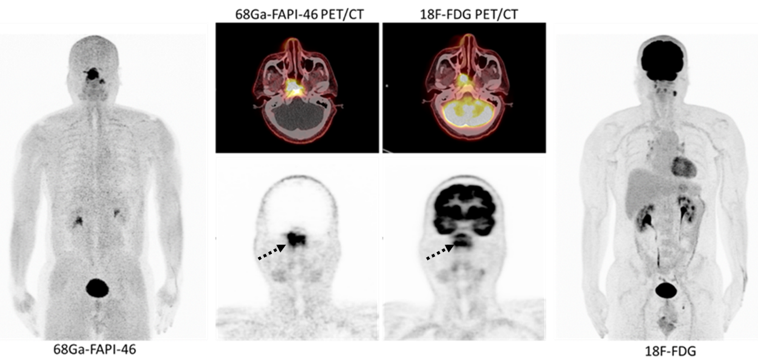
Fibroblast activation protein (FAP) เป็น type II membrane-bound glycoprotein ที่มีการแสดงออกมากกว่าปกติบนผิวเซลล์ที่เรียกว่า cancer associated fibroblasts (CAFs) ซึ่งมีบทบาทสำคัญในทุกระยะของเซลล์มะเร็ง ตั้งแต่การกลายจากเซลล์ปกติไปเป็นเซลล์มะเร็ง การเจริญเติบโตของก้อนมะเร็ง รวมไปถึง การลุกลามและแพร่กระจายโรค โดยปกติแล้วจะไม่พบ FAP ในเนื้อเยื่อปกติของผู้ใหญ่แต่ในทางกลับกันจะพบว่ามีการแสดงออกของไกลโคโปรตีนชนิดนี้ได้สูงใน เนื้อเยื่อที่มีการซ่อมแซมบาดแผล มีการอักเสบเรื้อรัง ข้ออักเสบ พังผืด มะเร็งชนิด carcinoma ซึ่งมีเซลล์บุผิวเป็นเซลล์ต้นกำเนิด และ มะเร็งชนิด sarcoma ซึ่งมีเซลล์เนื้อเยื่อเกี่ยวพันเป็นเซลล์ต้นกำเนิด จึงมีการคิดค้นและพัฒนาสารเภสัชรังสีที่จำเพาะต่อ FAP คือ fibroblast activating protein inhibitor; FAPI โดยติดฉลากกับไอโซโทป 68Ga และถ่ายภาพด้วยเพท-ซีที โดยตรวจผู้ป่วยมะเร็งชนิดต่าง ๆ พบว่าสาร 68Ga-FAPI สามารถตรวจจับก้อนมะเร็งและตำแหน่งที่มีการแพร่กระจายได้ดีซึ่งช่วยในการเปลี่ยนแปลงแนวทางการรักษาและยังสามารถให้ข้อมูลเพิ่มเติมจากการตรวจ 18F-FDG เพท-ซีที ซึ่งเป็นการตรวจวินิจฉัยภาพทางการแพทย์ระดับโมเลกุลที่แพร่หลายในมะเร็งวิทยาในปัจจุบัน นอกจากนี้ยังมีการนำไปพัฒนาต่อยอดเพื่อนำไปใช้ในการวินิจฉัยและรักษา
Downloads
เอกสารอ้างอิง
Pomper M, VanBrocklin H, Anderson C. What is molecular imaging? J Nucl Med. 2008;49(supplement 1):163P.
Kircher MF, Hricak H, Larson SM. Molecular imaging for personalized cancer care. Mol Oncol. 2012;6(2):182-195. https://doi.org/10.1016/j.molonc.2012.02.005
Weissleder R, Pittet MJ. Imaging in the era of molecular oncology. Nature. 2008;452(7187):580-589. https://doi.org/10.1038/nature06917
Brennen WN, Isaacs JT, Denmeade SR. Rationale behind targeting fibroblast activation protein-expressing carcinoma-associated fibroblasts as a novel chemotherapeutic strategy. Mol Cancer Ther. 2012;11(2):257-266. https://doi.org/10.1158/1535-7163.MCT-11-0340
Franco OE, Shaw AK, Strand DW, Hayward SW. Cancer associated fibroblasts in cancer pathogenesis. Semin Cell Dev Biol. 2010;21(1):33-39. https://doi.org/10.1016/j.semcdb.2009.10.010
Kratochwil C, Flechsig P, Lindner T, et al. 68Ga-FAPI PET/CT: Tracer Uptake in 28 Different Kinds of Cancer. J Nucl Med. 2019;60(6):801-805. https://doi.org/10.2967/jnumed.119.227967
Meyer C, Dahlbom M, Lindner T, et al. Radiation Dosimetry and Biodistribution of 68Ga-FAPI-46 PET Imaging in Cancer Patients. J Nucl Med Off Publ Soc Nucl Med. 2020;61(8):1171-1177. https://doi.org/10.2967/jnumed.119.236786
Chen H, Pang Y, Wu J, et al. Comparison of [68Ga]Ga-DOTA-FAPI-04 and [18F] FDG PET/CT for the diagnosis of primary and metastatic lesions in patients with various types of cancer. Eur J Nucl Med Mol Imaging. 2020;47(8):1820-1832. https://doi.org/10.1007/s00259-020-04769-z
Chen H, Zhao L, Ruan D, et al. Usefulness of [68Ga]Ga-DOTA-FAPI-04 PET/CT in patients presenting with inconclusive [18F]FDG PET/CT findings. Eur J Nucl Med Mol Imaging. 2021;48(1):73-86. https://doi.org/10.1007/s00259-020-04940-6
Koerber SA, Staudinger F, Kratochwil C, et al. The Role of 68Ga-FAPI PET/CT for Patients with Malignancies of the Lower Gastrointestinal Tract: First Clinical Experience. J Nucl Med Off Publ Soc Nucl Med. 2020;61(9):1331-1336. https://doi.org/10.2967/jnumed.119.237016
Alterio D, Marvaso G, Ferrari A, Volpe S, Orecchia R, Jereczek-Fossa BA. Modern radiotherapy for head and neck cancer. Semin Oncol. 2019;46(3):233-245. https://doi.org/10.1053/j.seminoncol.2019.07.002
Castaldi P, Leccisotti L, Bussu F, Miccichè F, Rufini V. Role of (18)F-FDG PET-CT in head and neck squamous cell carcinoma. Acta Otorhinolaryngol Ital Organo Uff Della Soc Ital Otorinolaringol E Chir Cerv-facc. 2013;33(1):1-8.
Hentschel M, Appold S, Schreiber A, et al. Serial FDG-PET on patients with head and neck cancer: implications for radiation therapy. Int J Radiat Biol. 2009;85(9):796-804. https://doi.org/10.1080/09553000903039180
Syed M, Flechsig P, Liermann J, et al. Fibroblast activation protein inhibitor (FAPI) PET for diagnostics and advanced targeted radiotherapy in head and neck cancers. Eur J Nucl Med Mol Imaging. 2020;47(12):2836-2845. https://doi.org/10.1007/s00259-020-04859-y
Torre LA, Bray F, Siegel RL, Ferlay J, Lortet-Tieulent J, Jemal A. Global cancer statistics, 2012. CA Cancer J Clin. 2015;65(2):87-108. https://doi.org/10.3322/caac.21262
Altekruse SF, Devesa SS, Dickie LA, McGlynn KA, Kleiner DE. Histological classification of liver and intrahepatic bile duct cancers in SEER registries. J Regist Manag. 2011;38(4):201-205.
Massarweh NN, El-Serag HB. Epidemiology of Hepatocellular Carcinoma and Intrahepatic Cholangiocarcinoma. Cancer Control J Moffitt Cancer Cent. 2017;24(3):1073274817729245. https://doi.org/10.1177/1073274817729245
Bennett GL, Krinsky GA, Abitbol RJ, Kim SY, Theise ND, Teperman LW. Sonographic detection of hepatocellular carcinoma and dysplastic nodules in cirrhosis: correlation of pretransplantation sonography and liver explant pathology in 200 patients. AJR Am J Roentgenol. 2002;179(1):75-80. https://doi.org/10.2214/ajr.179.1.1790075
Lee YJ, Lee JM, Lee JS, et al. Hepatocellular carcinoma: diagnostic performance of multidetector CT and MR imaging-a systematic review and meta-analysis. Radiology. 2015;275(1):97-109. https://doi.org/10.1148/radiol.14140690
Kim CK, Lim JH, Lee WJ. Detection of hepatocellular carcinomas and dysplastic nodules in cirrhotic liver: accuracy of ultrasonography in transplant patients. J Ultrasound Med Off J Am Inst Ultrasound Med. 2001;20(2):99-104. https://doi.org/10.7863/jum.2001.20.2.99
Bruix J, Reig M, Rimola J, et al. Clinical decision making and research in hepatocellular carcinoma: pivotal role of imaging techniques. Hepatol Baltim Md. 2011;54(6):2238-2244. https://doi.org/10.1002/hep.24670
Ho CL, Yu SCH, Yeung DWC. 11C-acetate PET imaging in hepatocellular carcinoma and other liver masses. J Nucl Med Off Publ Soc Nucl Med. 2003;44(2):213-221.
Iwata Y, Shiomi S, Sasaki N, et al. Clinical usefulness of positron emission tomography with fluorine-18-fluorodeoxyglucose in the diagnosis of liver tumors. Ann Nucl Med. 2000;14(2):121-126. https://doi.org/10.1007/BF02988591
Khan MA, Combs CS, Brunt EM, et al. Positron emission tomography scanning in the evaluation of hepatocellular carcinoma. J Hepatol. 2000;32(5):792-797. https://doi.org/10.1016/s0168-8278(00)80248-2
Trojan J, Schroeder O, Raedle J, et al. Fluorine-18 FDG positron emission tomography for imaging of hepatocellular carcinoma. Am J Gastroenterol. 1999;94(11):3314-3319. https://doi.org/10.1111/j.1572-0241.1999.01544.x
Mertens JC, Rizvi S, Gores GJ. Targeting cholangiocarcinoma. Biochim Biophys Acta Mol Basis Dis. 2018;1864(4 Pt B):1454-1460. https://doi.org/10.1016/j.bbadis.2017.08.027
Zou B, Liu X, Zhang B, et al. The Expression of FAP in Hepatocellular Carcinoma Cells is Induced by Hypoxia and Correlates with Poor Clinical Outcomes. J Cancer. 2018;9(18):3278-3286. https://doi.org/10.7150/jca.25775
Guo W, Pang Y, Yao L, et al. Imaging fibroblast activation protein in liver cancer: a single-center post hoc retrospective analysis to compare [68Ga]Ga-FAPI-04 PET/CT versus MRI and [18F]-FDG PET/CT. Eur J Nucl Med Mol Imaging. 2021;48(5):1604-1617. https://doi.org/10.1007/s00259-020-05095-0
Siegel RL, Miller KD, Jemal A. Cancer statistics, 2019. CA Cancer J Clin. 2019;69(1):7-34. https://doi.org/10.3322/caac.21551
Leppänen J, Lindholm V, Isohookana J, et al. Tenascin C, Fibronectin, and Tumor-Stroma Ratio in Pancreatic Ductal Adenocarcinoma. Pancreas. 2019;48(1):43-48. https://doi.org/10.1097/MPA.0000000000001195
Spill F, Reynolds DS, Kamm RD, Zaman MH. Impact of the physical microenvironment on tumor progression and metastasis. Curr Opin Biotechnol. 2016;40:41-48. https://doi.org/10.1016/j.copbio.2016.02.007
Valkenburg KC, de Groot AE, Pienta KJ. Targeting the tumour stroma to improve cancer therapy. Nat Rev Clin Oncol. 2018;15(6):366-381. https://doi.org/10.1038/s41571-018-0007-1
von Ahrens D, Bhagat TD, Nagrath D, Maitra A, Verma A. The role of stromal cancer-associated fibroblasts in pancreatic cancer. J Hematol OncolJ Hematol Oncol. 2017;10:76. https://doi.org/10.1186/s13045-017-0448-5
Röhrich M, Naumann P, Giesel FL, et al. Impact of 68Ga-FAPI PET/CT Imaging on the Therapeutic Management of Primary and Recurrent Pancreatic Ductal Adenocarcinomas. J Nucl Med Off Publ Soc Nucl Med. 2021;62(6):779-786. https://doi.org/10.2967/jnumed.120.253062
Loktev A, Lindner T, Burger EM, et al. Development of Fibroblast Activation Protein-Targeted Radiotracers with Improved Tumor Retention. J Nucl Med Off Publ Soc Nucl Med. 2019;60(10):1421-1429. https://doi.org/10.2967/jnumed.118.224469
Watabe T, Liu Y, Kaneda-Nakashima K, et al. Theranostics Targeting Fibroblast Activation Protein in the Tumor Stroma: 64Cu- and 225Ac-Labeled FAPI-04 in Pancreatic Cancer Xenograft Mouse Models. J Nucl Med Off Publ Soc Nucl Med. 2020;61(4):563-569. https://doi.org/10.2967/jnumed.119.233122
Lindner T, Loktev A, Altmann A, et al. Development of Quinoline-Based Theranostic Ligands for the Targeting of Fibroblast Activation Protein. J Nucl Med Off Publ Soc Nucl Med. 2018;59(9):1415-1422. https://doi.org/10.2967/jnumed.118.210443
ดาวน์โหลด
เผยแพร่แล้ว
รูปแบบการอ้างอิง
ฉบับ
ประเภทบทความ
สัญญาอนุญาต
บทความที่ได้รับการตีพิมพ์เป็นลิขสิทธิ์ของราชวิทยาลัยจุฬาภรณ์
ข้อความที่ปรากฏในบทความแต่ละเรื่องในวารสารวิชาการเล่มนี้เป็นความคิดเห็นส่วนตัวของผู้เขียนแต่ละท่านไม่เกี่ยวข้องกับราชวิทยาลัยจุฬาภรณ์ และคณาจารย์ท่านอื่น ในราชวิทยาลัยฯ แต่อย่างใด ความรับผิดชอบองค์ประกอบทั้งหมดของบทความแต่ละเรื่องเป็นของผู้เขียนแต่ละท่าน หากมีความผิดพลาดใด ๆ ผู้เขียนแต่ละท่านจะรับผิดชอบบทความของตนเองแต่ผู้เดียว


