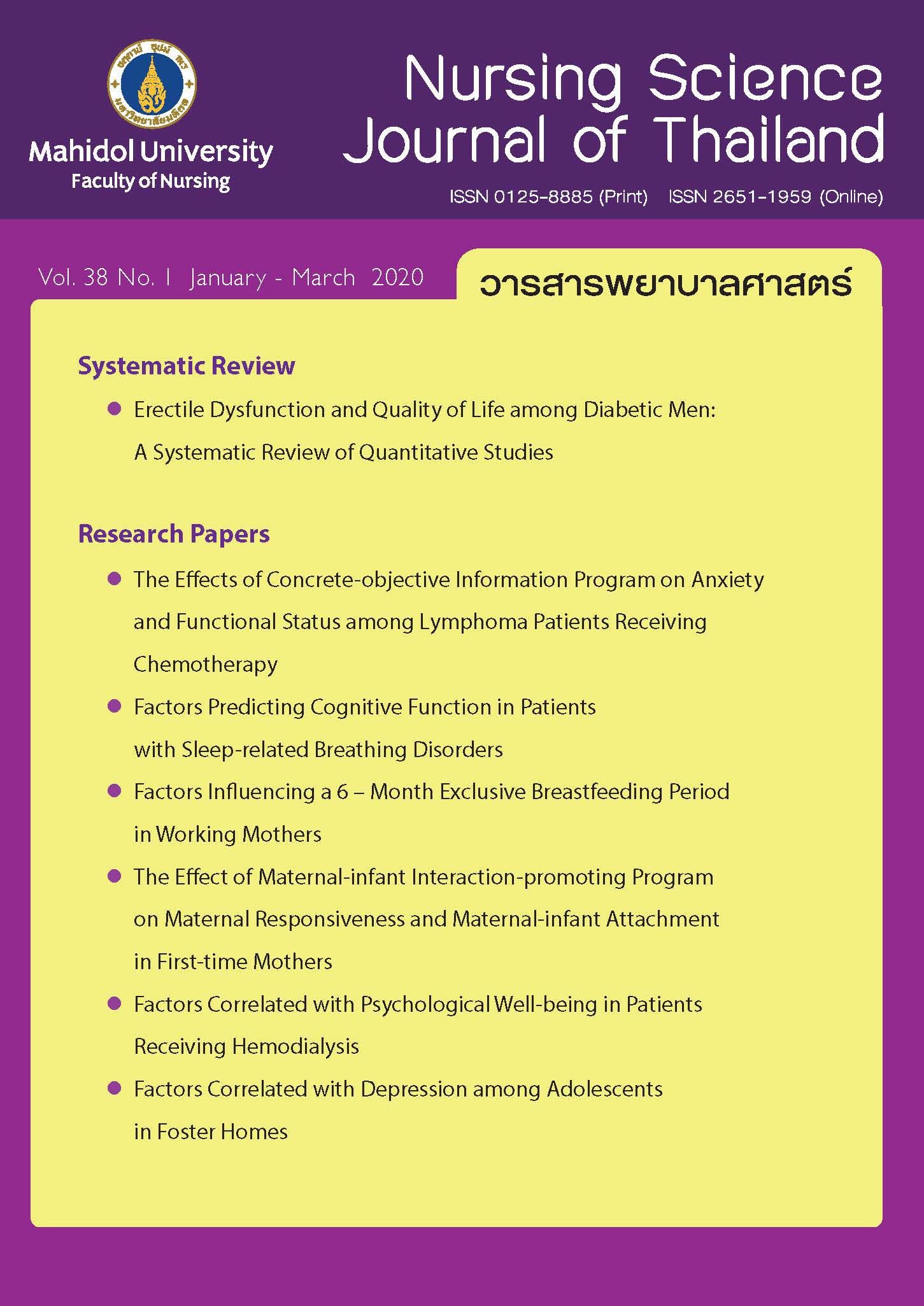
ผลของโปรแกรมส่งเสริมปฏิสัมพันธ์ระหว่างมารดา-ทารกต่อการตอบสนองของมารดาต่อความต้องการของทารก และความรักใคร่ผูกพันระหว่างมารดา-ทารกในมารดาที่มีบุตรคนแรก
Article Sidebar
Main Article Content
บทคัดย่อ
วัตถุประสงค์: เพื่อศึกษาผลของโปรแกรมส่งเสริมปฏิสัมพันธ์ระหว่างมารดา-ทารกต่อการตอบสนองของมารดาต่อความต้องการของทารก และความรักใคร่ผูกพันระหว่างมารดา-ทารกในมารดาที่มีบุตรคนแรก
รูปแบบการวิจัย: การวิจัยกึ่งทดลอง ประเภทศึกษาสองกลุ่มวัดผลหลังการทดลอง
วิธีดำเนินการวิจัย: กลุ่มตัวอย่างเป็นมารดาที่มีบุตรคนแรก และทารกในหอผู้ป่วยหลังคลอด โรงพยาบาลมหาวิทยาลัยแห่งหนึ่งในกรุงเทพมหานคร จำนวน 51 คู่ แบ่งเป็นมารดาและทารกกลุ่มควบคุม 25 คู่ และกลุ่มทดลอง 26 คู่ กลุ่มควบคุมได้รับการพยาบาลตามปกติ ส่วนกลุ่มทดลองได้รับการพยาบาลตามปกติร่วมกับโปรแกรมส่งเสริมปฏิสัมพันธ์ระหว่างมารดา-ทารก เก็บรวบรวมข้อมูลโดยใช้แบบสอบถามข้อมูลส่วนบุคคล แบบสอบถามการตอบสนองของมารดาต่อความต้องการของทารก และแบบสอบถามความรักใคร่ผูกพันของมารดาหลังคลอด วิเคราะห์ข้อมูลด้วยสถิติเชิงพรรณนา การทดสอบค่าที และสถิติแมน-วิทนีย์ ยู
ผลการวิจัย: กลุ่มทดลองมีคะแนนเฉลี่ยการตอบสนองของมารดาต่อความต้องการของทารกและความรักใคร่ผูกพันระหว่างมารดา-ทารกหลังการทดลอง สูงกว่ากลุ่มควบคุมอย่างมีนัยสำคัญทางสถิติที่ 1 เดือนหลังคลอด (Z = 5.878, p < .05 และ t = 6.116, p < .05 ตามลำดับ)
สรุปและข้อเสนอแนะ: โปรแกรมส่งเสริมปฏิสัมพันธ์ระหว่างมารดา-ทารกในระยะหลังคลอด ช่วย ส่งเสริมให้มารดาที่มีบุตรคนแรกสามารถอ่านสื่อสัญญาณทารกที่บอกความต้องการของตนเอง ทำให้มารดาตอบสนองความต้องการของทารกได้ดี เพิ่มความรักใคร่ผูกพันระหว่างมารดา-ทารกมากกว่าการได้รับการพยาบาลตามปกติ เมื่อทารกอายุ 1 เดือน ดังนั้นพยาบาลสามารถนำโปรแกรมไปใช้เพื่อส่งเสริมให้มารดาที่มีบุตรคนแรกสามารถตอบสนองความต้องการของทารกได้อย่างเหมาะสม และเกิดความรักใคร่ผูกพันระหว่างมารดา-ทารก และควรให้คำปรึกษามารดาที่มีปัญหาในช่วงแรกหลังจำหน่ายออกจากโรงพยาบาล
Article Details
ลิขสิทธิ์: วารสารพยาบาลศาสตร์เป็นเจ้าของลิขสิทธิ์ในการเผยแพร่ผลงานที่ตีพิมพ์ ห้ามผู้ใดนำบทความที่ได้รับการตีพิมพ์ในวารสารพยาบาลศาสตร์ไปเผยแพร่ในลักษณะต่างๆ ดังต่อไปนี้ การส่งบทความไปตีพิมพ์เผยแพร่ที่อื่น การนำบทความเผยแพร่ออนไลน์ การถ่ายเอกสารบทความเพื่อกิจกรรมที่ไม่ใช่การเรียนการสอน ยกเว้นเสียแต่ได้รับอนุญาตจากวารสารพยาบาลศาสตร์

Disclaimer: เนื้อหาบทความหรือข้อคิดเห็นใดๆ ในวารสารพยาบาลศาสตร์ ถือเป็นความรับผิดชอบของผู้เขียน กองบรรณาธิการไม่จำเป็นต้องเห็นด้วยและไม่มีส่วนรับผิดชอบแต่อย่างใด
เอกสารอ้างอิง
Shin H, Park YJ, Kim MJ. Predictors of maternal sensitivity during the early postpartum period. J Adv Nurs. 2006;55(4):425-34. doi: 10.1111/j.1365-2648.2006.03943.x.
Leigh P, Nievar MA, Nathans L. Maternal sensitivity and language in early childhood: a test of the transactional model. Percept Mot Skills. 2011;113(1):281-99. doi: 10.2466/10.17.21.28.PMS.113.4.281-299.
Shin H, Park YJ, Ryu H, Seomun GA. Maternal sensitivity: a concept analysis. J Adv Nurs. 2008;64(3):304-14. doi: 10.1111/j.1365-2648.2008.04814.x.
Klein PS, Rye H. Interaction-oriented early intervention in Ethiopia: the MISC approach. Infants Young Child. 2004;17(4):340-54. doi: 10.1097/00001163-200410000-00007.
Bigelow AE, MacLean K, Proctor J, Myatt T, Gillis R, Power M. Maternal sensitivity throughout infancy: continuity and relation to attachment security. Infant Behav Dev. 2010;33(1):50-60. doi: 10.1016/j.infbeh.2009.10.009.
Higley E, Dozier M. Nighttime maternal responsiveness and infant attachment at one year. Attach Hum Dev. 2009;11(4):347–63. doi: 10.1080/14616730903016979.
Choochaem C. Maternal self-efficacy regarding perceptions and responsiveness to newborn cues [master’s thesis]. Bangkok: Ramkhamhaeng University; 2009. 141 p. (in Thai).
Sumner G, Spietze A. NCAST Caregiving /parental-child interaction: teaching manual. Seattle: University of Washington; 1994. 156 p.
Bernard P, Gervais SJ, Allen J, Campomizzi S, Klein O. Integrating sexual objectification with object versus person recognition: the sexualized-body-inversion hypothesis. Psychol Sci. 2012;23(5):469-71. doi: 10.1177/0956797611434748.
Schafer R, Genna CW. Physiologic breastfeeding: a contemporary approach to breast feeding initiation. J Midwifery Womens Health. 2015;60(5):546-53. doi: 10.1111/jmwh.12319.
Klaus MH, Kennell JH. Maternal-infant bonding. 2nd ed. St. Louis, MO: Mosby; 1976. 260 p.
Ong SF, Chan WC, Shorey S, Chong YS, Klainin-Yobas P, He HG. Postnatal experiences and support needs of first-time mothers in Singapore: a descriptive qualitative study. Midwifery. 2014;30(6):772-8. doi: 10.1016/j.midw.2013.09.004.
Kurth E, Kennedy HP, Zemp Stutz E, Kesselring A, Fornaro I, Spichiger E. Responding to a crying infant - you do not learn it overnight: a phenomenological study. Midwifery. 2014;30(6):742-9. doi: 10.1016/j.midw.2013.06.017.
Chantarasena P. Primi para postpartum mother’s ability developments in responsiveness to the newborn’s cues. Khon Kaen: Khon Kaen University; 2008. 105 p. (in Thai).
Naowakhoaksorn T, Punthmatharith B, Naphapunsakul M. The effect of mother-infant interaction promoting program on maternal-infant attachment among adolescent mothers. Songklanagarind Journal of Nursing. 2015;35(2):143-60. (in Thai).
Glass GV. Primary, secondary, and meta-analysis of research. Educ Res. 1976;5(10):3-8. doi: 10.2307/1174772.
Phanthufak M, Phumonsakul S, Chareonpol O. The effect of a maternal role promoting program on maternal-infant attachment, maternal role satisfaction, competency in infant behavioral learning and infant growth. Ramathibodi Nursing Journal. 2009;15(2):149-61. (in Thai).
Cohen J. Statistical power analysis for the behavioral sciences. 2nd ed. New York: Lawrence Erlbaum; 1988. 559 p.
Barnard KE. Nursing child assessment and training: learning resource manual. Seattle, WA: University of Washington; 1978. 232 p.
Amankwaa LC, Younger J, Best A, Pickler R. Psychometric properties of the MIRI [unpublished manuscript]. Richmond, VA: Virginia Commonwealth University; 2002. 15 p.
Oncharoen G, Sinsuksai N, Phahuwatanakorn W, Limruangrong P. Factors influencing maternal responsiveness in first-time mothers. Journal of Nursing Science Chulalongkorn University. 2017;29(2):87-98. (in Thai).
Condon J, Corkindale C. The assessment of parent-to-infant attachment: development of a self-report questionnaire instrument. J Reprod Infant Psychol. 1998;16(1):57-76. doi: 10.1080/02646839808404558.
Condon J. Maternal postnatal attachment scale (measurement instrument) [Internet]. Adelaide: Flinders University; 2015 [cited 2018 Nov 15]. Available from: https://hdl.handle.net/2328/35291.
Songkram N. Design and multimedia development for learning. 1st ed. Bangkok: Chulalongkorn University Press; 2010. 163 p. (in Thai).
Pothichai P, Jenjaiwit P. Interaction promoting program for family with first-born infant. Journal of Nursing Science & Health. 2012;35(1):18-27. (in Thai).
