
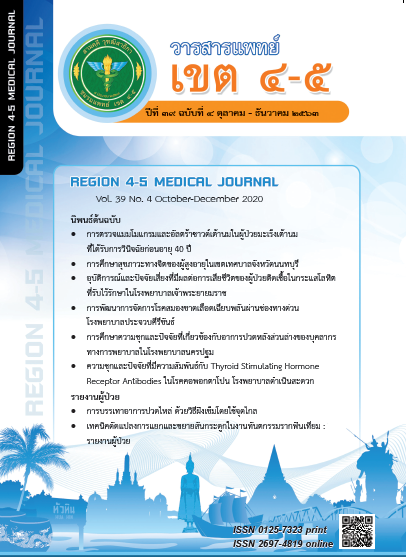
อุบัติการณ์และปัจจัยเสี่ยงที่มีผลต่อการเสียชีวิตของผู้ป่วยติดเชื้อในกระแสโลหิต ที่รับไว้รักษาในโรงพยาบาลเจ้าพระยายมราช
คำสำคัญ:
ติดเชื้อในกระแสโลหิต, อัตราเสียชีวิต, ปัจจัยเสี่ยงบทคัดย่อ
วัตถุประสงค์: เพื่อศึกษาอัตราการเสียชีวิต ลักษณะทางคลินิก การรักษา ผลการรักษา และปัจจัยต่างๆที่มีผลต่อการเสียชีวิตของผู้ป่วยติดเชื้อในกระแสโลหิต
วิธีการศึกษา: เก็บข้อมูลย้อนหลังผู้ป่วยใน แผนกอายุรกรรม ตั้งแต่ 1 มกราคม 2559 ถึง 31 ตุลาคม 2560 และมีการลงวินิจฉัยโรค ตามรหัส ICD 10 ดังนี้ sepsis (A41.0-A41.9), severe sepsis (R65.1) และ septic shock (R57.2) ผู้ป่วยที่เมื่อทบทวนเวชระเบียนแล้วพบว่าการวินิจฉัยไม่เป็นไปตามคำจำกัดความในแนวทางเวชปฏิบัติการดูแลรักษาผู้ป่วย severe sepsis และ septic shock พ.ศ.2558 ของสมาคมเวชบำบัดวิกฤตแห่งประเทศไทยและผู้ป่วยที่มีโรคเรื้อรังระยะสุดท้ายซึ่งมีแผนการรักษาแบบประคับประคองจะถูกคัดออก
ผลการศึกษา: ผู้ป่วย sepsis ทั้งหมด 422 ราย ร้อยละ 67.1 เป็นการติดเชื้อจากชุมชนร้อยละ 86.3 มีโรคประจำตัว ส่วนใหญ่คือเบาหวาน การติดเชื้อระบบทางเดินหายใจพบได้มากที่สุด ตรวจพบเชื้อก่อโรคร้อยละ 73.3 และส่วนใหญ่เป็นแบคทีเรียกรัมลบ ผู้ป่วยมีภาวะอวัยวะทำงานบกพร่องร้อยละ 63 ผู้ป่วยร้อยละ 91.5 ได้รับการตรวจเพาะเชื้อจากเลือดก่อนให้ยาต้านจุลชีพ และร้อยละ 81.3 ได้รับยาต้านจุลชีพภายใน 1 ชั่วโมงหลังวินิจฉัย ผู้ป่วยได้ยาต้านจุลชีพที่มีฤทธิ์ครอบคลุมเชื้อก่อโรคเพียงร้อยละ 54 ผู้ป่วย septic shock 155 คน ร้อยละ 69.7 ได้รับสารน้ำมากกว่า 30 มล./กก. และร้อยละ 98.1 ได้รับยาพยุงความดันโลหิต อัตราเสียชีวิตโดยรวมร้อยละ 34.1
สรุป: การติดเชื้อในกระแสโลหิตเป็นปัญหาสำคัญทางสาธารณสุขและมีอัตราเสียชีวิตสูง การป้องกันการติดเชื้อในโรงพยาบาล การเฝ้าระวังผู้ป่วยที่มีอวัยวะทำงานบกพร่อง ระบบสมองและภาวะเลือดเป็นกรด การให้สารน้ำอย่างเหมาะสมเพื่อให้ได้เป้าหมายคือปัสสาวะออกและไม่เกิดภาวะไตวาย ช่วยลดอัตราเสียชีวิตได้
เอกสารอ้างอิง
1. กองตรวจราชการ กระทรวงสาธารณสุข. เล่มแผนการตรวจราชการกระทรวงสาธารณสุข ประจำปี 2562. เข้าถึงเมื่อ 1 กรกฎาคม 2562. เข้าถึงได้จาก: http://bie.moph.go.th/e-insreport/.
2. Khwannimit B, Bhurayanontachai R. The epidemiology of, and risk factors for, mortality from severe sepsis and septic shock in a tertiary-care universityhospital setting. Epidemiol Infect. 2009; 137(9): 1333–41. doi: 10.1017/S0950268809002027.
3. ยรรยง เสถียรภาพงษ์. ระบาดวิทยาของการติดเชื้อแบคทีเรียในกระแสเลือดในผู้ใหญ่ที่โรงพยาบาลปทุมธานี.วารสารวิชาการสาธารณสุข. 2556; 22(5): 832-41.
4. Lueangarun S, Leelarasamee A. Impact of Inappropriate Empiric Antimicrobial Therapy on Mortality of Septic Patients with Bacteremia: A Retrospective Study. Interdiscip Perspect Infect Dis. 2012; 2012: 765205. doi: 10.1155/2012/765205.
5. Zhou J, Qian C, Zhao M, et al. Epidemiology and Outcome of Severe Sepsis and Septic Shock in Intensive Care Units in Mainland China. PLoS One. 2014;9(9): e107181. doi: 10.1371/journal.pone.0107181.
6. Knaus WA, Draper EA, Wagner EP, et al. APACHE II: a severity of disease classification system. Crit Care Med. 1985; 13(10): 818–29.
7. Vincent JL, Moreno R, Takala J, et al. The SOFA (Sepsis-related Organ Failure Assessment) score to describe organ dysfunction/failure. On behalf of the Working Group on Sepsis-Related Problems of the European Society of Intensive Care Medicine. Intensive Care Med. 1996; 22(7): 707-10. doi: 10.1007/BF01709751.
8. Angkasekwinai N, Rattanaumpawan P, Thamlikitkul V. Epidemiology of sepsis in Siriraj Hospital 2007. J Med Assoc Thai. 2009; 92(Suppl2): S68-78.
9. Kanoksil M, Jatapai A, Peacock SJ, et al. Epidemiology, Microbiology and Mortality Associated with Community-Acquired Bacteremia in Northeast Thailand: A Multicenter Surveillance Study. PLoS ONE. 2013; 8(1): e54714. doi: 10.1371/journal.pone.0054714.
10. Hantrakun V, Somayaji R, Teparrukkul P, et al. Clinical epidemiology and outcomes of community acquired infection and sepsis among hospitalized patients in a resource limited setting in Northeast Thailand: A prospective observational study (Ubon-sepsis). PLoS One. 2018; 13(9): e0204509. doi: 10.1371/journal.pone.0204509.
11. Kumar A, Roberts D, Wood KE, et al. Duration of hypotension before initiation of effective antimicrobial therapy is the critical determinantof survival in human septic shock. Crit Care Med. 2006; 34(6): 1589–96. doi: 10.1097/01.CCM.0000217961.75225.E9.
12. Kumar A, Ellis P, Arabi Y, et al. Initiation of inappropriate antimicrobial therapy results in a fivefold reduction of survival in human septic shock. CHEST. 2009; 136(5): 1237–48. doi: 10.1378/chest.09-0087.
13. Permpikul C, Tongyoo S, Rattanarat R, et al. Impact of septic shock hemodynamic resuscitation guidelines on rapid early volume replacement and reduced mortality. J Med Assoc Thai. 2010; 93(Suppl1): S102-9.
14. นฤพนธ์ ยุทธเกษมสันต์. อุบัติการณ์และปัจจัยที่มีผลต่อการเสียชีวิตของผู้ป่วย sepsis ในโรงพยาบาลหนองคาย. ขอนแก่นเวชสาร. 2551; 32: 340-52.
15. รัฐภูมิ ชามพูนท, ไชยรัตน์ เพิ่มพิกุล, บุญส่ง พัจนสุนทร. การดูแลรักษาผู้ป่วย Severe Sepsis และ Septic Shock (ฉบับร่าง) แนวทางเวชปฏิบัติ. กรุงเทพฯ: สมาคมเวชบำบัดวิกฤต; 2558.
16. Rhodes A, Evans LE, Alhazzani W, et al. Surviving Sepsis Campaign: international guidelines for management of sepsis and septic shock: 2016. Crit Care Med. 2017; 45(3): 486-552. doi: 10.1097/CCM.0000000000002255.
17. Levy MM, Evans LE, Rhodes A. The Surviving Sepsis Campaign Bundle: 2018 update. Intensive Care Med. 2018; 44(6): 925–8. doi: 10.1007/s00134-018-5085-0.
18. Southeast Asia Infectious Disease Clinical Research Network. Causes and outcomes of sepsis in southeast Asia: a multinational multicentre cross-sectional study. Lancet Glob Health. 2017;5(2): e157–67. doi: 10.1016/S2214-109X(17)30007-4.
19. Quenot JP, Binquet C, Kara F, et al. The epidemiology of septic shock in French intensive care units: the prospective multicenter cohort EPISS study. Crit Care. 2013; 17: R65. doi: 10.1186/cc12598.
20. Vincent JL, Sakr Y, Sprung CL, et al. Sepsis in European intensive care units: results of the SOAP study. Crit Care Med. 2006; 34(2): 344–53. doi: 10.1097/01.ccm.0000194725.48928.3a.
21. สิรีธร นิมิตวิไล. ปัจจัยเสี่ยงและผลการรักษาการติดเชื้อในกระแสโลหิตจากชุมชนที่มีสาเหตุจากเชื้อ Escherichia coli (E.coli) ที่สร้างเอนไซม์ Extended Spectrum Beta-Lactamase (ESBL). วารสารแพทย์เขต 4-5. 2557; 33(1): 1-8.
22. Zhang D, Micek ST, Kollef MH. Time to appropriate antibiotic therapy is an independent determinant of postinfection ICU and hospital lengths of stay in patients with sepsis. Crit Care Med. 2015; 43: 2133–40. doi: 10.1097/CCM.0000000000001140.
23. Bagshaw SM, Lapinsky S, Dial S, et al. Acute kidney injury in septic shock: clinical outcomes and impact of duration of hypotension prior to initiation of antimicrobial therapy. Intensive Care Med. 2009; 35(5): 871–81. doi: 10.1007/s00134-008-1367-2.
24. Iscimen R, Cartin-Ceba R, Yilmaz M, et al. Risk factors for the development of acute lung injury in patients with septic shock: an observational cohort study. Crit Care Med. 2008; 36(5): 1518–22. doi: 10.1097/CCM.0b013e31816fc2c0.
25. Page DB, Donnelly JP, Wang HE. Community-, Healthcare- and hospital-acquired severe sepsis hospitalizations in the university health system consortium. Crit Care Med. 2015; 43(9): 1945–51. Doi: 10.1097/CCM.0000000000001164.
26. Li-na Z, Xiao-ting W, Yu-hang A, et al. Epidemiological features, and risk factors of sepsis-associated encephalopathy in intensive care unit patients: 2008–2011. Chin Med J. 2012; 125(5): 828-31.
27. Kim HJ, Son YK, An WS. Effect of sodium bicarbonate administration on mortality in patients with lactic acidosis: a retrospective analysis. PLoS ONE. 2013; 8(6): e65283. doi: 10.1371/journal.pone.0065283.
28. Noritomi DT, Soriano FG, Kellum JA, et al. Metabolic acidosis in patients with severe sepsis and septic shock: A longitudinal quantitative study. Crit Care Med. 2009; 37(10): 2733-9. DOI: 10.1097/ccm.0b013e3181a59165.
29. Chen XF, Ye JL, Zhu ZY. The use of sodium bicarbonate in stages in treating hypoperfusion induced lactic acidemia in septic shock. Zhonghua Wei Zhong Bing Ji Jiu Yi Xue. 2013; 25(1): 24–7. doi: 10.3760/cma.j.issn.2095-4352.2013.01.007.
30. Sood MM, Shafer LA, Ho J, et al. Early reversible acute kidney injury is associated with improved survival in septic shock. J Crit Care. 2014; 29(5): 711-7. doi: 10.1016/j.jcrc.2014.04.003.
31. Bagshaw SM, George C, Bellomo R. Early acute kidney injury and sepsis: a multicentre evaluation. Crit Care. 2008; 12(2): R47. doi: 10.1186/cc6863.
32. Singer M, Deutschman CS, Seymour CW, et al. The Third International Consensus Definitions for Sepsis and Septic Shock (Sepsis-3). JAMA. 2016; 315(8): 801–10. doi: 10.1001/jama.2016.0287.
ดาวน์โหลด
เผยแพร่แล้ว
รูปแบบการอ้างอิง
ฉบับ
ประเภทบทความ
สัญญาอนุญาต
ลิขสิทธิ์บทความเป็นของผู้เขียนบทความ แต่หากผลงานของท่านได้รับการพิจารณาตีพิมพ์ลงวารสารแพทย์เขต 4-5 จะคงไว้ซึ่งสิทธิ์ในการตีพิมพ์ครั้งแรกด้วยเหตุที่บทความจะปรากฎในวารสารที่เข้าถึงได้ จึงอนุญาตให้นำบทความในวารสารไปใช้ประโยชน์ได้ในเชิงวิชาการโดยจำเป็นต้องมีการอ้างอิงถึงชื่อวารสารอย่างถูกต้อง แต่ไม่อนุญาตให้นำไปใช้ในเชิงพาณิชย์