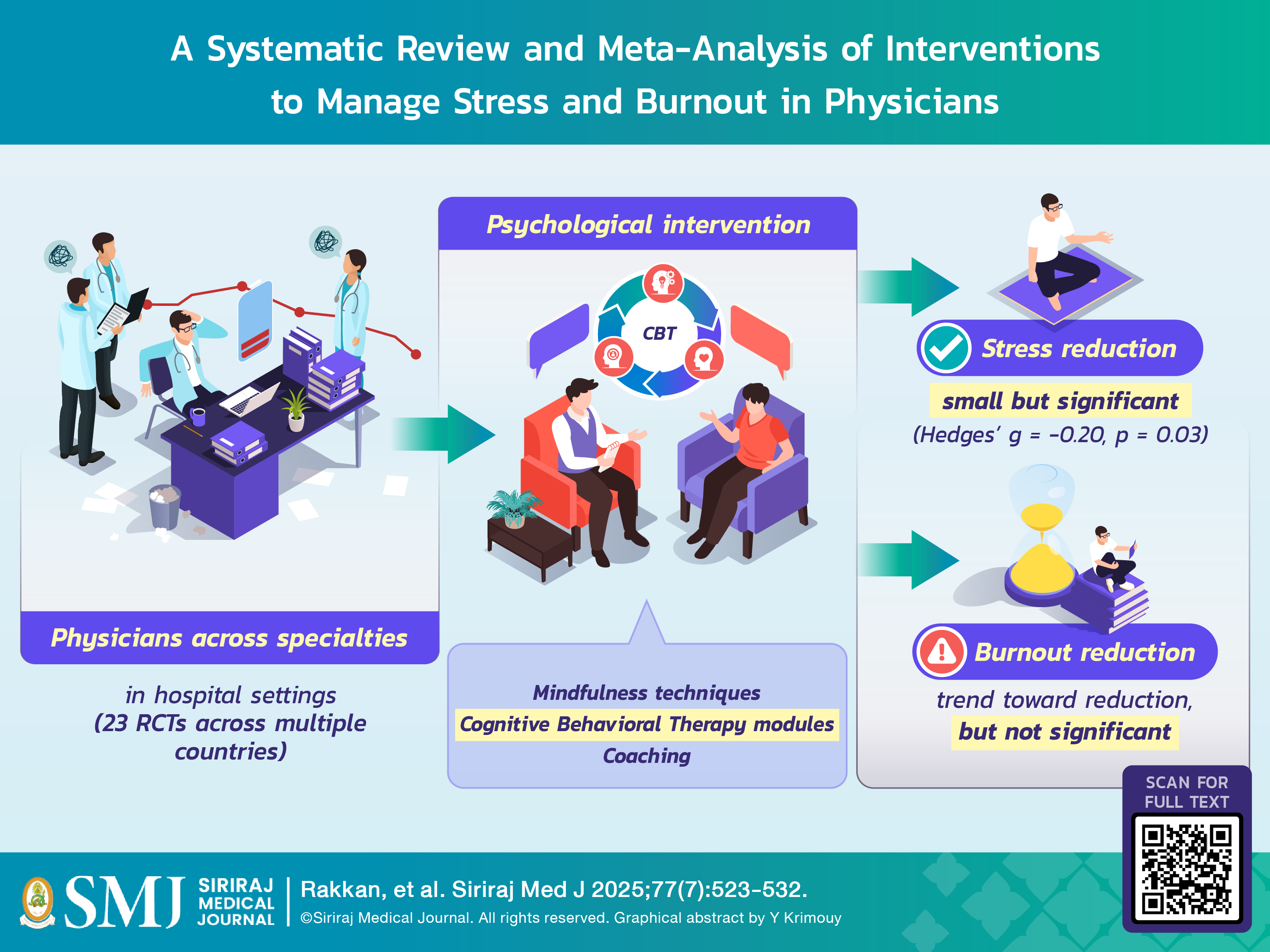
A Systematic Review and Meta-Analysis of Interventions to Manage Stress and Burnout in Physicians
DOI:
https://doi.org/10.33192/smj.v77i7.273470Keywords:
Burnout interventions, stress interventions, physiciansAbstract
Objective: To assess interventions aimed at reducing stress and burnout among physicians.
Materials and Methods: A systematic review and meta-analysis was performed in line with PRISMA guidelines. Randomized controlled trials published in English up to December 2022 were identified through searches in medical databases, including PubMed, EMBASE, and CINAHL. The primary outcomes were stress and burnout levels.
Results: A total of 13 studies investigated interventions to reduce stress and burnout, including mindfulness and non-mindfulness-based approaches. Non-mindfulness interventions included professional coaching, group-coaching programs, and training in humanism and professionalism. Outcomes were assessed at two time points: immediately post-intervention and at the final follow-up. Stress-reduction interventions significantly decreased stress levels (Hedges’ g = -0.20, 95% CI: -0.37 to -0.02, p = 0.03; I² = 6.66%). In contrast, burnout-reduction interventions showed a non-significant trend toward improvement (Hedges’ g = -0.08, 95% CI: -0.32 to 0.17, p = 0.53; I² = 43.89%).
Conclusion: Stress-reduction interventions are effective in lowering stress among physicians. However, improvements in burnout remain limited, possibly due to variations in intervention effectiveness across studies. Further research should focus on long-term follow-ups to address the well-being and resilience of healthcare professionals.
References
Stress at work - HSE [Internet]. hse.gov.uk. 2018 [cited 30 October 2018]. Available from: http://www.hse.gov.uk/stress/index.htm
Michie S. Causes and management of stress at work. Occup Environ Med. 2002;59(1):67–72.
Thorsteinsson EB, Brown RF, Richards C. The Relationship between Work-Stress, Psychological Stress and Staff Health and Work Outcomes in Office Workers. Psychology. 2014;05(10):1301–11.
Oginska-Bulik N. Occupational stress and its consequences in healthcare professionals: The role of type D personality. Int J Occup Med Environ Health. 2006;19(2):113–22.
Weinberg A, Creed F. Stress and psychiatric disorder in healthcare professionals and hospital staff. Lancet. 2000;355(9203):533–7.
Giga SI, Noblet AJ, Faragher B, Cooper CL. The UK perspective: A review of research on organisational stress management interventions. Australian Psychologist. 2003.
Ruotsalainen JH, Verbeek JH, Mariné A, Serra C. Preventing occupational stress in healthcare workers. Cochrane Database of Systematic Reviews. 2015, Issue 4.
Regehr C, Glancy D, Pitts A, Leblanc VR. Interventions to reduce the consequences of stress in physicians: a review and meta-analysis. The Journal of Nervous and Mental Disease. 2014;202(5):353–9.
Grime PR. Computerized cognitive behavioural therapy at work: a randomized controlled trial in employees with recent stress-related absenteeism. Occup Med (Lond). 2004; 54:353–359.
Mache S, Baresi L, Bernburg M, Vitzthum K, Groneberg D. Being prepared to work in gynecology medicine: evaluation of an intervention to promote junior gynecologists’ professionalism, mental health and job satisfaction. Arch Gynecol Obstet. 2017;295(1):153-162.
West CP, Dyrbye LN, Rabatin JT, Call TG, Davidson JH, Multari A, Romanski SA, Hellyer JM, Sloan JA, Shanafelt TD. Intervention to promote physician well-being, job satisfaction, and professionalism: a randomized clinical trial. JAMA Intern Med. 2014;174(4):527-33.
Bernburg M, Baresi L, Groneberg D, Mache S. Does psychosocial competency training for junior physicians working in pediatric medicine improve individual skills and perceived job stress. Eur J Pediatr. 2016;175:1905-12.
Axisa C, Nash L, Kelly P, Willcock S. Burnout and distress in Australian physician trainees: Evaluation of a wellbeing workshop. Australas Psychiatry. 2019;27(3):255-61.
Ireland MJ, Clough B, Gill K, Langan F, O'Connor A, Spencer L. A randomized controlled trial of mindfulness to reduce stress and burnout among intern medical practitioners. Med Teach. 2017;39(4):409-14.
Mache S, Bernburg M, Baresi L, Groneberg D. Mental health promotion for junior physicians working in emergency medicine: evaluation of a pilot study. Eur J Emerg Med. 2018;25(3):191-8.
Lebares CC, Guvva EV, Olaru M, Sugrue LP, Staffaroni AM, Delucchi KL, et al. Efficacy of Mindfulness-Based Cognitive Training in Surgery: Additional Analysis of the Mindful Surgeon Pilot Randomized Clinical Trial. JAMA Netw Open. 2019;2(5):e194108.
Fendel JC, Aeschbach VM, Schmidt S, Göritz AS. The impact of a tailored mindfulness-based program for resident physicians on distress and the quality of care: A randomised controlled trial. J Intern Med. 2021;290(6):1233-48.
Lebares CC, Coaston TN, Delucchi KL, Guvva EV, Shen WT, Staffaroni AM, et al. Enhanced Stress Resilience Training in Surgeons: Iterative Adaptation and Biopsychosocial Effects in 2 Small Randomized Trials. Ann Surg. 2021;273(3):424-32.
Ireland MJ, Clough B, Gill K, Langan F, O'Connor A, Spencer L. A randomized controlled trial of mindfulness to reduce stress and burnout among intern medical practitioners. Med Teach. 2017;39(4):409-14.
Amutio A, Martínez-Taboada C, Delgado LC, Hermosilla D, Mozaz MJ. Acceptability and Effectiveness of a Long-Term Educational Intervention to Reduce Physicians' Stress-Related Conditions. J Contin Educ Health Prof. 2015;35(4):255-60.
Brazier A, Larson E, Xu Y, Judah G, Egan M, Burd H, Darzi A. 'Dear Doctor': a randomised controlled trial of a text message intervention to reduce burnout in trainee anesthetists. Anaesthesia. 2022;77(4):405-15.
Kesselheim J, Baker JN, Kersun L, Lee-Miller C, Moerdler S, Snaman JM, et al. Humanism and professionalism training for pediatric hematology-oncology fellows: Results of a multicenter randomized trial. Pediatr Blood Cancer. 2020;67(11):e28308.
Taylor J, McLean L, Richards B, Glozier N. Personalised yoga for burnout and traumatic stress in junior doctors. Postgrad Med J. 2020;96(1136):349-57.
Medisauskaite A, Kamau C. Reducing burnout and anxiety among doctors: Randomized controlled trial. Psychiatry Res. 2019;274:383-90.
Bragard I, Libert Y, Etienne AM, Merckaert I, Delvaux N, Marchal S, et al. Insight on variables leading to burnout in cancer physicians. J Cancer Educ. 2010;25(1):109-15.
Dyrbye LN, Shanafelt TD, Gill PR, Satele DV, West CP. Effect of a Professional Coaching Intervention on the Well-being and Distress of Physicians: A Pilot Randomized Clinical Trial. JAMA Intern Med. 2019;179(10):1406-14.
Dyrbye LN, West CP, Richards ML, Ross HJ, Satele D, Shanafelt TD. A Randomized, Controlled Study of an Online Intervention to Promote Job Satisfaction and Well-Being among Physicians. Burnout Research. 2016;3(3):69-75.
Fainstad T, Mann A, Suresh K, Shah P, Dieujuste N, Thurmon K, et al. Effect of a Novel Online Group-Coaching Program to Reduce Burnout in Female Resident Physicians: A Randomized Clinical Trial. JAMA Netw Open. 2022;5(5):e2210752.
Gunasingam N, Burns K, Edwards J, Dinh M, Walton M. Reducing stress and burnout in junior doctors: the impact of debriefing sessions. Postgrad Med J. 2015;91(1074):182-7.
Huang L, Harsh J, Cui H, Wu J, Thai J, Zhang X, Cheng L, Wu W. A Randomized Controlled Trial of Balint Groups to Prevent Burnout Among Residents in China. Front Psychiatry. 2020;10:957.
Lee S, Rozybakieva Z, Asimov M, Bagiyarova F, Tazhiyeva A, Ussebayeva N, et al. Coping strategy as a way to prevent emotional burnout in primary care doctors: a randomized controlled trial. Arch Balk Med Union. 2020;55(3):398-409.
Verweij H, van Ravesteijn H, van Hooff MLM, Lagro-Janssen ALM, Speckens AEM. Mindfulness-Based Stress Reduction for Residents: A Randomized Controlled Trial. J Gen Intern Med. 2018;33(4):429-36.
West CP, Dyrbye LN, Satele DV, Shanafelt TD. Colleagues Meeting to Promote and Sustain Satisfaction (COMPASS) Groups for Physician Well-Being: A Randomized Clinical Trial. Mayo Clin Proc. 2021;96(10):2606-14.
Page MJ, McKenzie JE, Bossuyt PM, Boutron I, Hoffmann TC, Mulrow CD, et al. The PRISMA 2020 statement: an updated guideline for reporting systematic reviews. BMJ 2021;372:n71.
Kristensen TS, Borritz M, Villadsen E, Christensen KB. The Copenhagen burnout inventory: a new tool for the assessment of burnout. Work & Stress. 2005;19(3):192–207.
Lovibond SH, Lovibond PF. Manual for the Depression Anxiety Stress Scales. 2nd ed. Sydney: Psychology Foundation, 1995.
Stamm BH. The Concise ProQOL Manual. 2nd ed. Pocatello, ID: ProQOL.org, 2010.
Cohen S, Kamarck T, Mermelstein R. A global measure of perceived stress. J Health Soc Behav. 1983;24(4):385-96.
Levenstein S, Prantera C, Varvo V, Scribano ML, Berto E, Luzi C. Development of the Perceived Stress Questionnaire: a new tool for psychosomatic research. J Psychsom Res. 1993;37(1):19–32.
Mind Garden website. Available from: http://www.mindgarden.com. Accessed February 18, 2019.
Khanngern N, Ratta-apha W, Wannarit K. Burnout among Mental Health Professionals in a Tertiary University Hospital. Siriraj Med J [internet]. 2022 Mar. 1 [cited 2025 Apr. 17];74(3):185-92. available from: https://he02.tci-thaijo.org/index.php/sirirajmedj/article/view/256431
Sterne JAC, Savović J, Page MJ, Elbers RG, Blencowe NS, Boutron I, et al. RoB 2: a revised tool for assessing risk of bias in randomised trials. BMJ. 2019;366:l4898.
Higgins JPT, Thomas J, Chandler J, Cumpston M, Li T, Page MJ, Welch VA, editors. Cochrane Handbook for Systematic Reviews of Interventions. Version 6.3 (updated February 2022). Cochrane; 2022. Available from: https://training.cochrane.org/handbook/current
Published
How to Cite
License
Copyright (c) 2025 Siriraj Medical Journal

This work is licensed under a Creative Commons Attribution-NonCommercial-NoDerivatives 4.0 International License.
Authors who publish with this journal agree to the following conditions:
Copyright Transfer
In submitting a manuscript, the authors acknowledge that the work will become the copyrighted property of Siriraj Medical Journal upon publication.
License
Articles are licensed under a Creative Commons Attribution-NonCommercial-NoDerivatives 4.0 International License (CC BY-NC-ND 4.0). This license allows for the sharing of the work for non-commercial purposes with proper attribution to the authors and the journal. However, it does not permit modifications or the creation of derivative works.
Sharing and Access
Authors are encouraged to share their article on their personal or institutional websites and through other non-commercial platforms. Doing so can increase readership and citations.