
Validity of the Gaming Disorder Scale (GAME-S) for Identifying Gaming Disorder in Children and Adolescents
DOI:
https://doi.org/10.33192/smj.v77i11.274309Keywords:
Gaming disorder, sensitivity and specificity, questionnaire, children, adolescentAbstract
Objective: This study aimed to evaluate the validity of the Gaming Disorder Scale (GAME-S) for diagnosing gaming disorder among children and adolescents in Thailand.
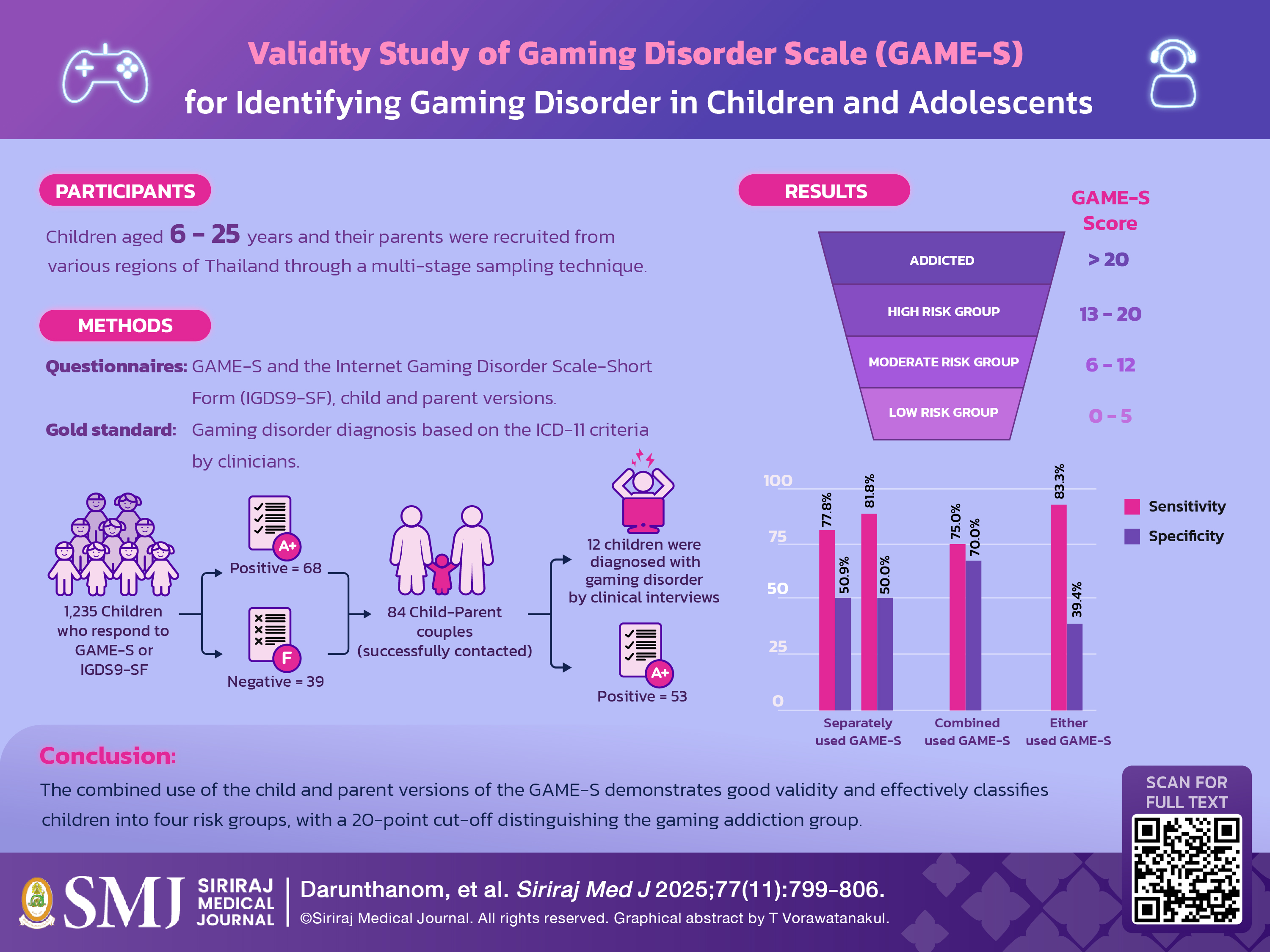
Materials and Methods: A total of 1,235 individuals, aged 6-25 years, and their parents were recruited from various regions of Thailand through a multi-stage sampling technique. Data were collected using both the child and parent versions of the GAME-S. The results were compared with ICD-11 clinical diagnoses of gaming disorder, conducted by trained clinicians. Concurrent validity was evaluated through the Thai version of the Internet Gaming Disorder Scale-Short Form (IGDS9-SF).
Results: A total of 1,235 children and adolescents and their parents participated to assess the correlation between the GAME-S and IGDS9-SF. For GAME-S diagnostic accuracy analysis, 84 child–parent pairs, balanced by gender (mean age = 13.48 years), were included. Sensitivities of the child and parent versions were 77.8% and 81.8%, respectively, while specificity was 50.9% and 50.0%. Combining both versions increased sensitivity to 75.0% and specificity to 70.0%. The GAME-S correlated strongly with IGDS9-SF (child: r=0.823, p=0.01; parent: r=0.82, p=0.01). Latent class analysis identified a four-class model as the best fit. The gaming addiction group was effectively characterized by a cut-off score of 20.
Conclusion: The combined use of both the child and parent versions of the GAME-S demonstrates good validity and is a reliable tool for screening children and adolescents for gaming disorder. Additionally, it can categorize children and adolescents into four risk groups, helping identify individuals and provide appropriate interventions for each group.
References
World Health Organization. Gaming disorder. 2018 [cited 2023 Dec 27]. Available from: https://www.who.int/standards/classifications/frequently-asked-questions/gaming-disorder.
Kim HS, Son G, Roh EB, Ahn WY, Kim J, Shin SH, et al. Prevalence of gaming disorder: A meta-analysis. Addict Behav. 2022;126:107183.
Pornnoppadol C, Sornpaisarn B, Kumkiang K. The development of Game Addiction Screening Test (GAST). J Psychiatr Assoc Thailand. 2014;59(1):3–14.
Pornnoppadol C, Ladawan na Ayudhaya S, Phoasavasdi C, Surapongphiwattana T. Development of Game Addiction Protection Scale (GAME-P). J Psychiatr Assoc Thailand. 2017;62(1):3-16.
Phengpan K. Preventing health problems of childhood addicted to online games. J Ratchathani Innov Health Sci. 2017;1(1):16-30.
Saunders JB, Hao W, Long J, King DL, Mann K, Fauth-Bühler M, et al. Gaming disorder: Its delineation as an important condition for diagnosis, management, and prevention. J Behav Addict. 2017;6(3):271-9.
Yoon S, Yang Y, Ro E, Ahn W-Y, Kim J, Shin S-H, et al. Reliability, convergent, and discriminant validity of gaming disorder scales: A meta-analysis. Front Psychol. 2021;12:764209
Lemmens J, Valkenburg P, Peter J. Development and validation of a game addiction scale for adolescents. Media Psychol. 2009;12(1):77-95.
Pontes HM, Griffiths MD. Measuring DSM-5 internet gaming disorder: Development and validation of a short psychometric scale. Comput Human Behav. 2015;45:137-43.
Király O, Sleczka P, Pontes HM, Urbán R, Griffiths MD, Demetrovics Z. Validation of the Ten-Item Internet Gaming Disorder Test (IGDT-10) and evaluation of the nine DSM-5 Internet Gaming Disorder criteria. Addict Behav. 2017;64:253-60.
Sangkhaphan T, Pornnoppadol C, Hataiyusuk S. Development of the Gaming Disorder Scale (GAME-S). J Psychiatr Assoc Thailand. 2023;68(1):50–61.
Ngamjarus C, Chongsuvivatwong V. n4Studies: Sample size and power calculations for iOS. 2014. /Daniel WW. Biostatistics: A foundation of analysis in the health sciences. 6th ed: John Wiley&Sons, Inc; 1995.
Department of Provincial Administration. Ministry of Interior. Official statistics registration systems 2022 [cited 2024 November 14]. Available from: https://stat.bora.dopa.go.th/stat/statnew/statMONTH/statmonth/#/displayData.
Kolkijkovin V, Wisitpongaree C, Tachakasem P, Pornnoppadol C, Supawattanabodee B. Computer Game Addiction: Risk and Protective Factors in Students in Dusit District, Bangkok. Vajira Med J. 2015;59(3):1-13.
Pornnoppadol C, Pariwatcharakul P. The Development of Internet Gaming Disorder Scale–Short-Form (IGDS9-SF). 2021.
Boonyaprasert U, Kiatrungrit K. Validity and Reliability of the Thai Internet Gaming Disorder Scale 9-item (IGD Scale-9 TH) in adolescents in the psychiatry out-patient unit. J Psychiatr Assoc Thailand. 2021;66(3):243–60.
Abolfotouh MA, Barnawi NA. Prevalence and prediction of video gaming addiction among Saudi adolescents, using the Game Addiction Scale for Adolescents (GASA). Psychol Res Behav Manag. 2024;17:3889–903.
Mihara S, Osaki Y, Kinjo A, Matsuzaki T, Nakayama H, Kitayuguchi T, et al. Validation of the Ten-Item Internet Gaming Disorder Test (IGDT-10) based on the clinical diagnosis of IGD in Japan. J Behav Addict. 2022;11(4):1024–34.
Bujang MA, Adnan TH. Requirements for minimum sample size for sensitivity and specificity analysis. J Clin Diagn Res. 2016;10(10):YE01–6.
Hajian-Tilaki K. Sample size estimation in diagnostic test studies of biomedical informatics. J Biomed Inform. 2014;48:193–204.
Chanpen S, Pornnoppadol C, Vasupanrajit A, Dejatiwongse Na Ayudhya Q. Assessment of the validity and reliability of the Social-Media Addiction Screening Scale (S-MASS). Siriraj Med J [Internet]. 2023 Mar 1 [cited 2025 May 16];75(3):167-80. Available from: https://he02.tci-thaijo.org/index.php/sirirajmedj/article/view/261044
Published
How to Cite
License
Copyright (c) 2025 Siriraj Medical Journal

This work is licensed under a Creative Commons Attribution-NonCommercial-NoDerivatives 4.0 International License.
Authors who publish with this journal agree to the following conditions:
Copyright Transfer
In submitting a manuscript, the authors acknowledge that the work will become the copyrighted property of Siriraj Medical Journal upon publication.
License
Articles are licensed under a Creative Commons Attribution-NonCommercial-NoDerivatives 4.0 International License (CC BY-NC-ND 4.0). This license allows for the sharing of the work for non-commercial purposes with proper attribution to the authors and the journal. However, it does not permit modifications or the creation of derivative works.
Sharing and Access
Authors are encouraged to share their article on their personal or institutional websites and through other non-commercial platforms. Doing so can increase readership and citations.