Development and Psychometric Properties of Short-Video Applications Addiction Questionnaire (S-VAAQ)
DOI:
https://doi.org/10.33192/smj.v78i2.278550Keywords:
adolescent, adult, psychometrics, questionnaire, short-video addictionAbstract
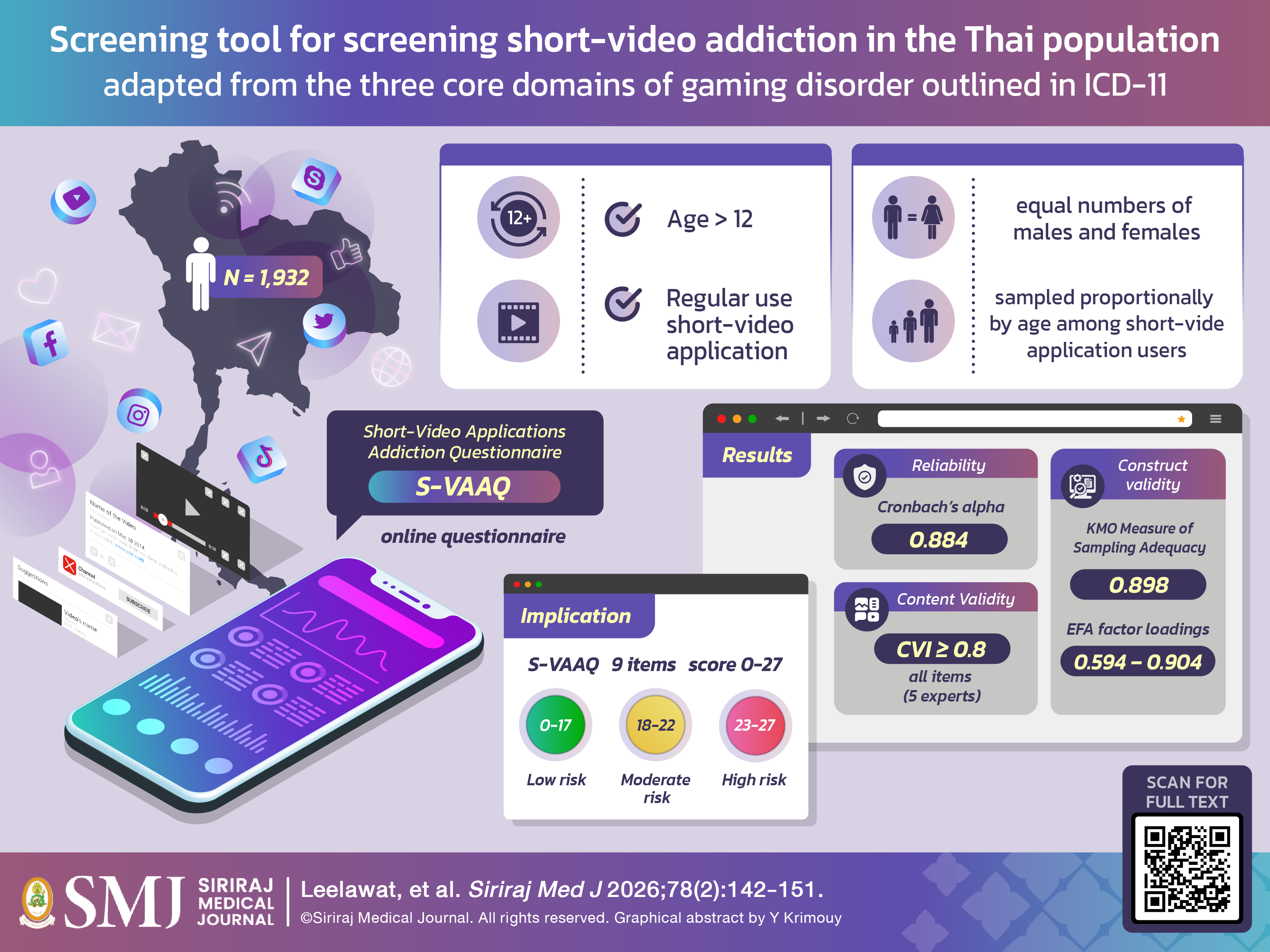
Objective: This cross-sectional study aimed to develop and validate the Short-Video Applications Addiction Questionnaire (S-VAAQ) and evaluate its reliability and validity among Thai individuals aged 13 years and older.
Materials and Methods: The S-VAAQ is a 9-item screening tool adapted from the three core domains of gaming disorder outlined in ICD-11: impaired control over usage, increased priority given to gaming, and continued use despite negative consequences. Items were modified to better reflect short-form video consumption behaviors. Data were collected through an online questionnaire distributed via short-form video platforms and Line, targeting Thai participants aged 13 and above who regularly watched short-form videos and were proficient in Thai. Statistical analyses included content validity index (CVI) assessments by five experts, Cronbach’s alpha for internal consistency, and exploratory factor analysis (EFA).
Results: A total of 1,932 participants aged 13 years and older were included. The median daily duration of short-form video viewing was three hours. All items demonstrated CVI scores exceeding 0.78. The scale exhibited good internal consistency, with a Cronbach’s alpha of 0.884. KMO Measure of Sampling Adequacy of 0.898 and EFA revealed factor loadings ranging from 0.594 to 0.904 supporting the scale’s construct validity.
Conclusions: In conclusion, the S-VAAQ demonstrated good reliability and validity. This instrument can serve as a useful tool for screening short-form video addiction in the Thai population and support further research and intervention strategies.
References
Roj S. TikTok statistics and data for 2022 [Internet]. Thumbsup; 2022 [cited 2024 May 24]. Available from: https://www.thumbsup.in.th/tiktok-statistics-2022
TikTok users by country 2024 [Internet]. Statista; [cited 2024 May 24]. Available from: https://www.statista.com/statistics/1299807/number-of-monthly-unique-tiktok-users/
Sha P, Dong X. Research on adolescents regarding the indirect effect of depression, anxiety, and stress between TikTok use disorder and memory loss. Int J Environ Res Public Health [Internet]. 2021 [cited 2024 May 24];18(16):8820. Available from: https://pubmed.ncbi.nlm.nih.gov/34444569/
Ye JH, Wu YT, Wu YF, Chen MY, Ye JN. Effects of short video addiction on the motivation and well-being of Chinese vocational college students. Front Public Health [Internet]. 2022 [cited 2024 May 24];10:847672. Available from: http://dx.doi.org/10.3389/fpubh.2022.847672
Chanpen S, Pornnoppadol C, Vasupanrajit A, Dejatiwongse Na Ayudhya Q. An assessment of the validity and reliability of the Social-Media Addiction Screening Scale (S-MASS). Siriraj Med J [Internet]. 2023 [cited 2024 May 24];75(3):167–80. Available from: https://he02.tci-thaijo.org/index.php/sirirajmedj/article/view/261044
Andreassen CS, Torsheim T, Brunborg GS, Pallesen S. Development of a Facebook addiction scale. Psychol Rep [Internet]. 2012 [cited 2024 May 24];110(2):501–17. Available from: https://pubmed.ncbi.nlm.nih.gov/22662404/
Mu H, Jiang Q, Xu J, Chen S. Drivers and consequences of short-form video (SFV) addiction amongst adolescents in China: Stress-coping theory perspective. Int J Environ Res Public Health [Internet]. 2022 [cited 2024 May 24];19(21):14173. Available from: https://www.mdpi.com/1660-4601/19/21/14173
Zahra MF, Qazi TA, Ali AS, Hayat N, Hassan TU. How TikTok addiction leads to mental health illness? Examining the mediating role of academic performance using structural equation modeling. J Posit Sch Psychol [Internet]. 2022 [cited 2024 May 24];6(10):1490–502. Available from: https://journalppw.com/index.php/jpsp/article/view/13392
Lu L, Liu M, Ge B, Bai Z, Liu Z. Adolescent addiction to short video applications in the mobile Internet era. Front Psychol [Internet]. 2022 [cited 2024 May 24];13:893599. Available from: [http://dx.doi.org/10.3389/fpsyg.2022.893599
Galanis P, Katsiroumpa A, Moisoglou I, Konstantakopoulou O. The TikTok Addiction Scale: Development and validation. AIMS Public Health. 2024;11(4):1172–97.
Günlü A, Oral T, Yoo S, Chung S. Reliability and validity of the Problematic TikTok Use Scale among the general population. Front Psychiatry [Internet]. 2023 [cited 2024 May 24];14:1068431. Available from: [http://dx.doi.org/10.3389/fpsyt.2023.1068431
Miller M. 40+ TikTok stats digital marketers need to know [Internet]. Search Engine Journal. 2024 Apr 18 [cited 2025 Oct 3]. Available from: https://www.searchenginejournal.com/tiktok-stats/445449/
Jiang Z, Kang T, Chen Y, Chen W, Wu H. Validation of the Short Video Addiction Scale: a psychometric study among Chinese adolescents. Research Square [Preprint]. 2024 [cited 2024 Oct 3]. Available from: https://www.researchsquare.com/article/rs-6259796/v1
World Health Organization [Internet]. Gaming disorder; 2018 [cited 2018 Aug 4]. Available from: https://www.who.int/standards/classifications/frequently-asked-questions/gaming-disorder
China Internet Network Information Center (CNNIC). The 53rd Statistical Report on China's Internet Development. Beijing: CNNIC; 2024 Mar. p. 23. Available from: https://www.cnnic.com.cn/IDR/ReportDownloads/202405/P020240509518443205347.pdf
Iqbal M. TikTok revenue and usage statistics (2025). Business of Apps [Internet]. 2025 [cited 2025 Apr 18]. Available from: https://www.businessofapps.com/data/tik-tok-statistics/
Sangkhaphan T, Pornnoppadol C, Hataiyusuk S. The development of Gaming Disorder Scale (GAME-S). J Psychiatr Assoc Thailand. 2022;68(1):50–61.
Published
How to Cite
License
Copyright (c) 2026 Siriraj Medical Journal

This work is licensed under a Creative Commons Attribution-NonCommercial-NoDerivatives 4.0 International License.
Authors who publish with this journal agree to the following conditions:
Copyright Transfer
In submitting a manuscript, the authors acknowledge that the work will become the copyrighted property of Siriraj Medical Journal upon publication.
License
Articles are licensed under a Creative Commons Attribution-NonCommercial-NoDerivatives 4.0 International License (CC BY-NC-ND 4.0). This license allows for the sharing of the work for non-commercial purposes with proper attribution to the authors and the journal. However, it does not permit modifications or the creation of derivative works.
Sharing and Access
Authors are encouraged to share their article on their personal or institutional websites and through other non-commercial platforms. Doing so can increase readership and citations.