
Urine Output as a Surrogate for Adequate Perfusion During Septic Shock Resuscitation: A Prospective Cohort Study
DOI:
https://doi.org/10.33192/smj.v78i8.280923Keywords:
Septic shock, urine output, serum lactate, tissue perfusion, Cardiopulmonary resuscitationAbstract
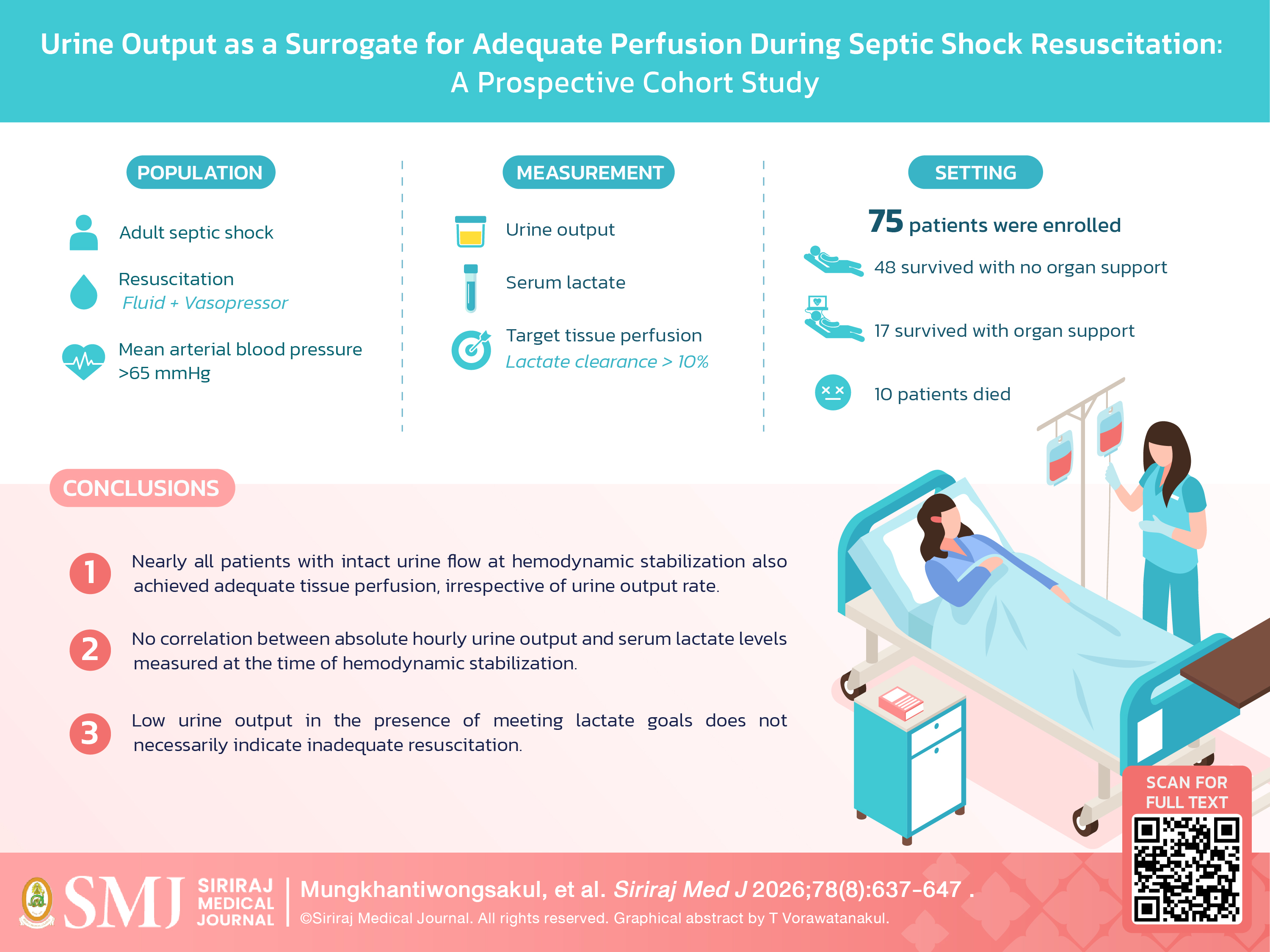
Objective: Septic shock resuscitation targets hemodynamic stabilization (mean arterial pressure 65 mmHg) and tissue perfusion, defined by lactate < 2 mmol/L or lactate clearance > 10%. Because urine output is widely used as an organ perfusion goal, we examined its behavior during resuscitation and its association with lactate kinetics and outcomes.
Materials and Methods: We conducted a prospective cohort study of patients with intact urine flow during resuscitation. Serum lactate was measured at resuscitation start and at hemodynamic stabilization, and hourly urine flow was recorded. The primary outcome was survival without organ support at 28 days after septic shock diagnosis. We assessed correlations between urine flow and lactate clearance at stabilization.
Results: From January to July 2024, 95 patients were screened; 20 were excluded. The remaining 75 achieved hemodynamic stabilization within 12 hours, and all but 2 met tissue oxygenation goals regardless of urine flow rate. The proportion with urine output < 0.5 mL/kg/hour did not differ between survivors and the death/organ support group. In multivariable analysis, urine output at stabilization < 0.4 mL/hour was not associated with unfavorable outcomes, whereas lactate at stabilization > 3 mmol/L was associated with in-hospital mortality and organ support.
Conclusions: During septic shock resuscitation, intact urine flow at hemodynamic restoration may serve as a surrogate of adequate tissue perfusion when infection is controlled. However, lactate remains a key milestone for confirming perfusion restoration.
References
Chiu C, Legrand M. Epidemiology of sepsis and septic shock. Curr Opin Anaesthesiol. 2021;34:71–76.
WHO. Global Report on the Epidemiology and Burden of Sepsis: Current Evidence, Identifying Gaps and Future Directions. World Health Organization; Geneva, Switzerland: 2020.
Tancharoen L, Pairattanakorn P, Thamlikitkul V, Angkasekwinai N. Epidemiology and Burden of Sepsis at Thailand’s Largest University-Based National Tertiary Referral Center during 2019. Antibiotics (Basel). 2022;11(7):899.
Niamsanit S, Sitthikarnkha P, Techasatian L, Saengnipanthkul S, Uppala R. Epidemiology and outcomes of septic shock in Thai children: a nationwide retrospective study from 2015 to 2022. Crit Care. 2024;28(1):401.
Evans L, Rhodes A, Alhazzani W, Antonelli M, Coopersmith C, French C, et al. Surviving Sepsis Campaign: International Guidelines for Management of Sepsis and Septic Shock 2021. Intensive Care Med. 2021;47(11):1181-247.
Rhodes A, Evans L, Alhazzani W, Levy M, Massimo A, Ferrer R, et al. Surviving Sepsis Campaign: International Guidelines for Management of Sepsis and Septic Shock: 2016. Intensive Care Med. 2017;43(3):304-77.
Shime N, Nakada T, Yatabe T, Yamakawa K, Aoki Y, Inoue S, et al. The Japanese Clinical Practice Guidelines for Management of Sepsis and Septic Shock 2024. Acute Med Surg. 2025;12(1):
e70037.
Permpikul C, Sringam P, Tongyoo S. Therapeutic goal achievements during severe sepsis and septic shock resuscitation and their association with patients’ outcomes. J Med Assoc Thai. 2014;97(Suppl 3):S176-83.
Kellum JA, Lameire N, Aspelin P, Barsoum RS, Burdmann EA, Goldstein SL, et al. Kidney Disease: Improving Global Outcomes (KDIGO) Acute Kidney Injury Work Group. KDIGO Clinical Practice Guideline for Acute Kidney Injury. Kidney International Supplements. 2012;2(1):1-138.
Maurer LR, Martin ND. Sepsis management of the acute care surgery patient: What you need to know. J Trauma Acute Care Surg. 2025;98(4):533-40.
Markart S. Hermann A, Chiari F, Heinz G. Speidl WS, Lenz M, et al. Urinary Output as a Predictor of Mortality in Cardiogenic Shock: An Explorative Retrospective Analysis. J Clin Med. 2024;13(24):7706.
Sarma D, Tabi M, Rabinstein AA, Kashani K, Jentzer JC. Urine Output and Mortality in Patients Resuscitated from out of Hospital Cardiac Arrest. J Intensive Care Med. 2023;38(6):544-52.
Hu T, Qiao Z, Mei Y. Urine Output Is Associated With Inhospital Mortality in Intensive Care Patients With Septic Shock: A Propensity Score Matching Analysis. Front Med (Lausanne). 2021;8:737654.
Leedahl DD, Frazee EN, Schramm GE, Dierkhising RA, Bergstralh EJ, Chawla LS, et al. Derivation of urine output thresholds that identify a very high risk of AKI in patients with septic shock. Clin J Am Soc Nephrol. 2014;9(7):1168-74.
Glassford NJ, Bellomo R. The Role of Oliguria and the Absence of Fluid Administration and Balance Information in Illness Severity Scores. Acute Crit Care. 2017;32(2):106-23.
Bianchi NA, Altarelli M, Monard C, Kelevina T, Chaouch A, Schneider AG. Identification of an optimal threshold to define oliguria in critically ill patients: an observational study. Crit Care. 2023;27(1):207.
Thwaites L, Nasa P, Abbenbroek B, Dat VQ, Finfer S, Kwizera A, et al. Management of adult sepsis in resource-limited settings: global expert consensus statements using a Delphi method. Intensive Care Med. 2025;51(1):21-38.
Moussa MD, Scolletta S, Fagnoul D, Pasquier P, Brasseur A, Taccone FS, et al.Effects of fluid administration on renalperfusion in critically ill patients. Crit Care. 2015;19(1):250.
Pfortmueller CA, Dabrowski W, Wise R, van Regenmortel N, Malbrain MLNG. Fluid accumulation syndrome in sepsis and septic shock: pathophysiology, relevance and treatment-a comprehensive review. Ann Intensive Care. 2024;14(1):115.
Messmer AS, Zingg C, Müller M, Gerber JL, Schefold JC, Pfortmueller CA. Fluid Overload and Mortality in Adult Critical Care Patients-A Systematic Review and Meta-Analysis of Observational Studies. Crit Care Med. 2020;48(12):1862-70.
Prescott HC, Osterholzer JJ, Langa KM, Angus DC, Iwashyna TJ. Late mortality after sepsis: propensity matched cohort study. BMJ. 2016;353:i2375.
Daviaud F, Grimaldi D, Dechartres A, Charpentier J, Geri G, Marin N, et al. Timing and causes of death in septic shock. Ann Intensive Care. 2015;5(1):16.
Permpikul C, Sivakorn C, Tongyoo S. In-Hospital Death after Septic Shock Reversal: A Retrospective Analysis of In-Hospital Death among Septic Shock Survivors at Thailand’s Largest National Tertiary Referral Center. Am J Trop Med Hyg. 2021;104(1):395-402.
Published
How to Cite
License
Copyright (c) 2026 Siriraj Medical Journal

This work is licensed under a Creative Commons Attribution-NonCommercial-NoDerivatives 4.0 International License.
Authors who publish with this journal agree to the following conditions:
Copyright Transfer
In submitting a manuscript, the authors acknowledge that the work will become the copyrighted property of Siriraj Medical Journal upon publication.
License
Articles are licensed under a Creative Commons Attribution-NonCommercial-NoDerivatives 4.0 International License (CC BY-NC-ND 4.0). This license allows for the sharing of the work for non-commercial purposes with proper attribution to the authors and the journal. However, it does not permit modifications or the creation of derivative works.
Sharing and Access
Authors are encouraged to share their article on their personal or institutional websites and through other non-commercial platforms. Doing so can increase readership and citations.