Photobiomodulation for Autism Spectrum Disorder in Children and Adolescents: A Scoping Review of Core Symptom Outcomes and Safety
DOI:
https://doi.org/10.33192/smj.v78i8.282022Keywords:
Photobiomodulation, Autism spectrum disorder, Children, Adolescents, SafetyAbstract
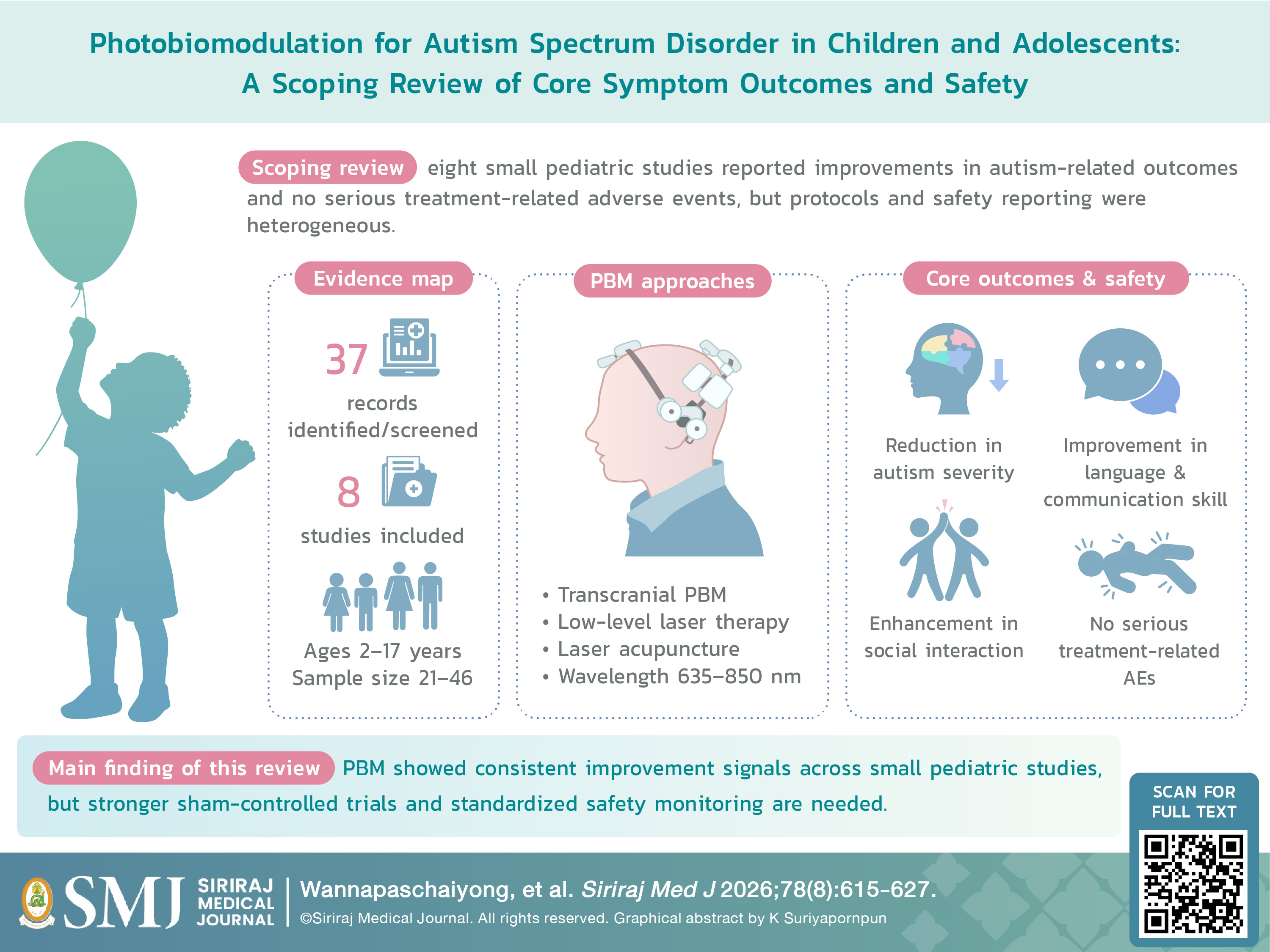
Objective: Photobiomodulation (PBM) has emerged as a potential noninvasive intervention for autism spectrum disorder (ASD), but pediatric evidence remains limited and fragmented. This scoping review aimed to map the current literature on PBM for children and adolescents with ASD, focusing on core symptom outcomes and safety.
Materials and Methods: PubMed/MEDLINE, Scopus, Embase, and the Cochrane Library were searched from inception to February 1, 2026. The searches identified 53 records, comprising 51 database records and 2 records from supplementary searching. After deduplication and screening, 8 reports representing 6 independent cohorts were included.
Results: The included studies involved children and adolescents aged 2 to 17 years, with sample sizes ranging from 21 to 46 participants. PBM modalities included transcranial photobiomodulation, low-level laser therapy, and laser acupuncture, with wavelengths ranging from 635 to 850 nm. Treatment schedules ranged from 8 sessions over 4 weeks to home-based treatment for up to 6 months. The reports described improvement in selected autism-related outcomes. Controlled studies reported greater improvements in autism severity, language, communication, and social interaction outcomes, including a between-group Childhood Autism Rating Scale difference of 7.23 points in one trial. No serious treatment-related adverse events were reported; however, safety monitoring and adverse-event ascertainment were incomplete and inconsistent.
Conclusion: PBM appears promising but remains investigational for children and adolescents with ASD. Further rigorous sham-controlled trials with standardized outcome measures and clearer safety reporting are needed.
References
Lord C, Charman T, Havdahl A, Carbone P, Anagnostou E, Boyd B, et al. The Lancet Commission on the future of care and clinical research in autism. Lancet. 2022;399(10321):271- 334.
World Health Organization. Autism. 2025. Available at: https:// www.who.int/news-room/fact-sheets/detail/autism-spectrum- disorders (Accessed on Apr 16, 2026).
Shaw KA, Williams S, Patrick ME, Valencia-Prado M, Durkin MS, Howerton EM, et al. Prevalence and early identification of autism spectrum disorder among children aged 8 years — Autism and Developmental Disabilities Monitoring Network, 16 sites, United States, 2022. MMWR Surveill Summ. 2025;74(2): 1-22.
Asia-Pacific Development Center on Disability. Autism at a Glance in ASEAN Under the Autism Mapping Project in the ASEAN Region: Part II Country Profiles. Bangkok, Thailand: Asia-Pacific Development Center on Disability Foundation; 2020. 428 p.
Teekavanich S, Wannapaschaiyong P. Factors associated with age at diagnosis of autism spectrum disorder in pediatric patients at Sawanpracharak Hospital, Thailand. Siriraj Med J. 2023;75(11): 778-83.
Chantaraseno S, Amornphetchakul T, Wannapaschaiyong P. Socioeconomic factors and clinical characteristics associated with age at autism spectrum disorder diagnosis. Siriraj Med J. 2024;76(9):589-94.
Hyman SL, Levy SE, Myers SM; Council on Children with Disabilities, Section on Developmental and Behavioral Pediatrics. Identification, evaluation, and management of children with autism spectrum disorder. Pediatrics. 2020;145(1):e20193447.
Lin H, Li D, Zhu J, Liu S, Li J, Yu T, et al. Transcranial photobiomodulation for brain diseases: review of animal and human studies including mechanisms and emerging trends. Neurophotonics. 2024;11(1):010601.
Akhtar A, Rahaman SKB. The interplay of oxidative stress, mitochondrial dysfunction, and neuroinflammation in autism spectrum disorder: behavioral implications and therapeutic strategies. Brain Sci. 2025;15(8):853.
Usui N, Kobayashi H, Shimada S. Neuroinflammation and oxidative stress in the pathogenesis of autism spectrum disorder. Int J Mol Sci. 2023;24(6):5487.
Peters MDJ, Marnie C, Tricco AC, Pollock D, Munn Z, Alexander L, et al. Updated methodological guidance for the conduct of scoping reviews. JBI Evid Synth. 2020;18(10):2119-2126.
Tricco AC, Lillie E, Zarin W, O'Brien KK, Colquhoun H, Levac D, et al. PRISMA extension for scoping reviews (PRISMA-ScR): checklist and explanation. Ann Intern Med. 2018;169(7):467-73.
Leisman G, Machado C, Machado Y, Chinchilla-Acosta M. Effects of low-level laser therapy in autism spectrum disorder. Adv Exp Med Biol. 2018;1116:111-30.
Machado C, Machado Y, Chinchilla M, Ariosa-Acuna MC, Foyaca-Sibat H. Low lever laser therapy (LLLT) in autism: age group analysis. Internet J Neurol. 2019;21(1).
Machado C, Machado Y, Chinchilla M, Machado Y. Follow-up assessment of autistic children 12 months after finishing low lever laser therapy. Internet J Neurol. 2020;21(2).
Fradkin Y, De Taboada L, Naeser M, Saltmarche A, Snyder W, Steingold E. Transcranial photobiomodulation in children aged 2-6 years: a randomized sham-controlled clinical trial assessing safety, efficacy, and impact on autism spectrum disorder symptoms and brain electrophysiology. Front Neurol. 2024;15:1221193.
Pallanti S, Di Ponzio M, Grassi E, Vannini G, Cauli G. Transcranial photobiomodulation for the treatment of children with autism spectrum disorder (ASD): a retrospective study. Children (Basel). 2022;9(5):755.
Downloads
Published
How to Cite
License
Copyright (c) 2026 Siriraj Medical Journal

This work is licensed under a Creative Commons Attribution-NonCommercial-NoDerivatives 4.0 International License.
Authors who publish with this journal agree to the following conditions:
Copyright Transfer
In submitting a manuscript, the authors acknowledge that the work will become the copyrighted property of Siriraj Medical Journal upon publication.
License
Articles are licensed under a Creative Commons Attribution-NonCommercial-NoDerivatives 4.0 International License (CC BY-NC-ND 4.0). This license allows for the sharing of the work for non-commercial purposes with proper attribution to the authors and the journal. However, it does not permit modifications or the creation of derivative works.
Sharing and Access
Authors are encouraged to share their article on their personal or institutional websites and through other non-commercial platforms. Doing so can increase readership and citations.