
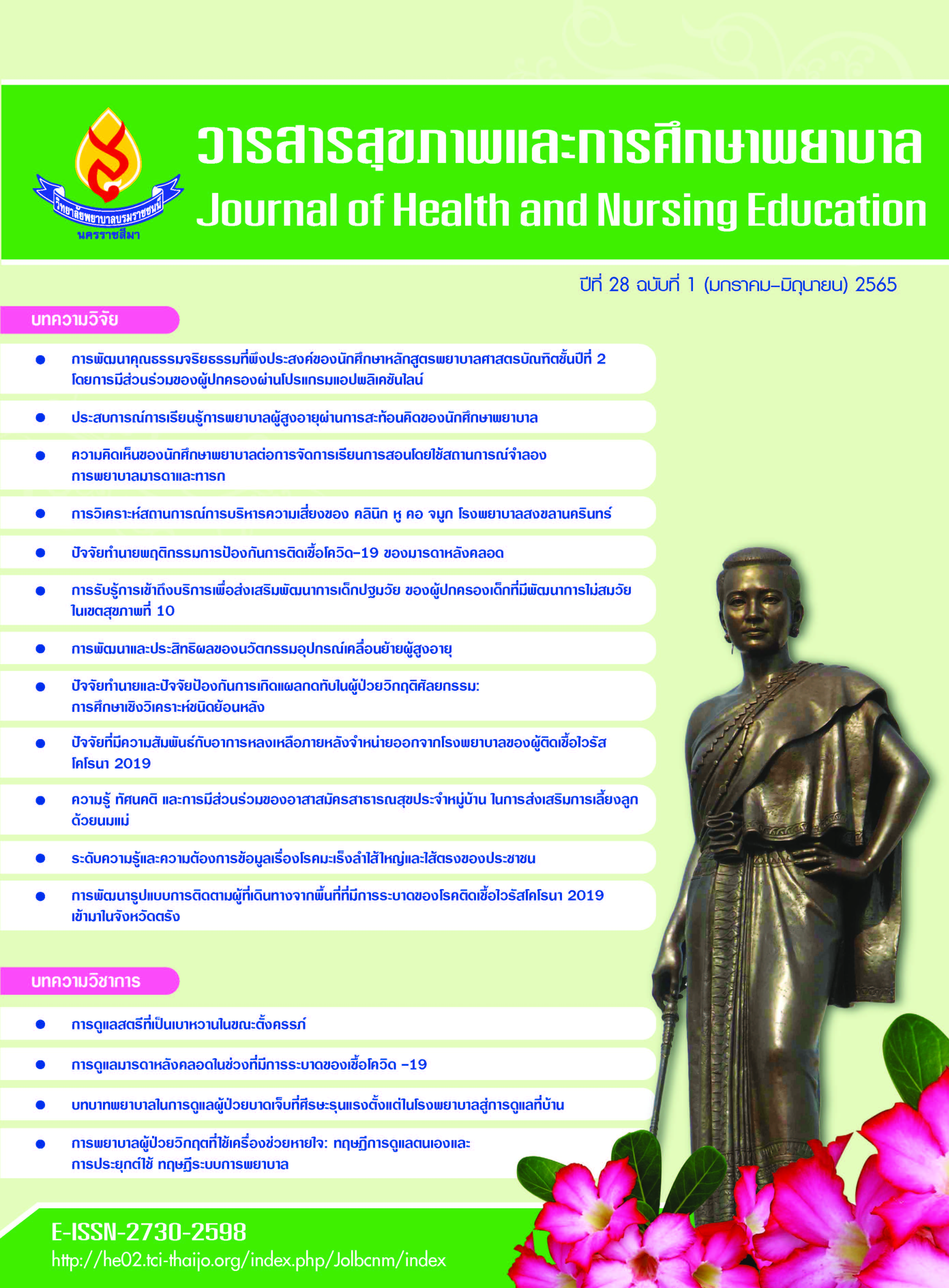
Factors Predicting of Covid 19 Prevention Behaviour Among Postpartum Mothers
Keywords:
health belief perception, prevention behaviors, COVID-19, postpartum mothersAbstract
Postpartum mothers are at risk of being infected by Coronavirus disease 2019 (COVID-19) due to physiological changes which leading to an increased risk of respiratory tract infections. There is limited knowledge about their health behaviors to prevent COVID-19. This predictive research was aimed at studying factors predicting COVID-19 prevention behaviors among postpartum mothers, include individual factors and factors regarding health belief perceptions based on the Health Belief Model (HBM). Research participants were 400 postpartum mothers receiving postnatal care services from hospitals in the central region of Thailand. The participants were recruited using a combination of the multiple-stage sampling and quota sampling methods from six hospitals. Data were collected using the Health Belief Perceptions about COVID-19 Questionnaire and the COVID-19 Preventive Behaviour Questionnaire. The instruments’ reliability was analysed using Cronbach’s alpha coefficient, their reliabilities were determined to be .82 and .78, respectively. Data were analyzed using multiple regressions. The results showed that marital status, monthly income, having a preexisting medical condition, and health perceptions about COVID-19 could predict 45 percent (R2 = 0.45, F(1, 150) = 26.085, p = .01) of postpartum mothers' behaviors regarding preventing COVID-19 infection. The health agencies are responsible for maternal and child health services should t provide support for postpartum mothers and their spouses to ensure they have comprehensive knowledge about COVID-19 prevention knowledge comprehensively, especially with regard to enhancing their ability to effectively assess and deal with the perceived susceptibility, perceived severity, perceived benefits, and perceived barriers related to the COVID-19 prevention.
References
กรมควบคุมโรค กระทรวงสาธารณสุข. (2564). แนวทางปฏิบัติเพื่อการป้องกันโรคติดเชื้อไวรัสโคโรนา 2019 (COVID-19) หรือโควิด-19 สำหรับประชาชนทั่วไปและกลุ่มเสี่ยง. นนทบุรี: กรมควบคุมโรค.
กฤตกร หมั่นสระเกษ, ทัศนีย์ รวิวรกุล, และสุนีย์ ละกำปั่น. (2562). ผลของโปรแกรมการจัดการตนเองต่อการควบคุมระดับน้ำตาลในเลือด ของผู้ป่วยเบาหวานชนิดที่ 2 ที่ใช้อินซูลิน. วารสารสุขภาพและการศึกษาพยาบาล, 25(2), 12-30.
ธัญนิดา เจริญจันทร์, และทิพย์วัลย์ สุรินยา. (2557). ความเชื่อด้านสุขภาพ การรับรู้ความสามารรถของตนเองรูปแบบการอบรมเลี้ยงดูกับพฤติกรรมการดูแลสุขภาพตนเองของนักเรียนชั้นมัธยมศึกษาตอนปลายโรงเรียนสตรีนนทบุรี จังหวัดนนทบุรี. วารสารสังคมศาสตร์และมนุษย์ศาสตร์, 40(1), 69-84.
นงณภัทร รุ่งเนย, เพ็ญแข ดิษฐบรรจง, ภคพร กลิ่นหอม, ศิริพร ครุฑกาศ, และนภาภรณ์ เกตุทอง. (2565). ปัจจัยทำนายพฤติกรรมการเฝ้าระวังและป้องกันการติดเชื้อโรคโควิด-19 ของนักศึกษาพยาบาล. วารสารมหาวิทยาลัยนราธิวาสราชนครินทร์, 14(2), 17-37.
บงกช โมระสกุล, และพรศิริ พันธสี. (2552). ที่ความรู้และพฤติกรรมการป้องกันโรคโควิด-19 ของนักศึกษาพยาบาลชั้นปีที่ 1 วิทยาลัยนานาชาติเซนต์เทเรซา และวิทยาลัยเซนต์หลุยส์. วารสารศูนย์อนามัยที่ 9, 15(37), 179-196.
บุญชม ศรีสะอาด. (2560). การวิจัยเบื้องต้น (พิมพ์ครั้งที่ 10). กรุงเทพฯ: สุวีริยาสาส์น.
พัชรินทร์ เงินทอง. (2564). คำแนะนำในการดูแลสตรีในระยะตั้งครรภ์ ระยะคลอด และระยะหลังคลอดระหว่างการแพร่ระบาดโควิด-19: การทบทวนวรรณกรรมแบบกำหนดขอบเขต. วารสารพยาบาลศาสตร์ มหาวิทยาลัยสยาม, 22(42), 10-13.
ประเทือง ฉ่ำน้อย. (2559). การศึกษาระดับความรู้ การรับรู้และพฤติกรรมการดำเนินงานควบคุมโรคไข้เลือดออกของอาสาสมัครสาธารณสุข กรณีศึกษาอำเภอพานกระต่าย จังหวัดกำแพงเพชร. วารสารควบคุมโรค, 42(2), 138-150.
รังสรรค์ โฉมยา, และกรรณิกา พันธ์ศรี. (2564). ความตระหนักเกี่ยวกับพฤติกรรมการป้องกันการติดต่อโรค ไวรัสโคโรนาสายพันธุ์ใหม่ (โควิด-19): การเปรียบเทียบระหว่างวัย. วารสารมนุษยศาสตร์ และสังคมศาสตร์ มหาวิทยาลัยมหาสารคาม, 39(6), 71-82.
ราชวิทยาลัยสูตินรีแพทย์แห่งประเทศไทย. (2563). แนวทางเวชปฏิบัติของราชวิทยาลัยสูตินรีแพทย์แห่งประเทศไทย เรื่อง การดูแลรักษาสตรีตั้งครรภ์ที่ติดเชื้อโควิด-19. สืบค้นจาก https://covid19.dms.go.th/backend/Content/Content_File/Covid_Health/Attach/25630324214133PM_CPG-Covid-Preg-20Mar20.pdf
ศิริลักษณ์ วรไวย์, สังวรณ์ วรไวย์, ชาติธนา ปัตตาลาโพธิ์, และวรรณา ตรุนจันทร์. (2557). ผลการประยุกต์แบบแผนความเชื่อด้านสุขภาพร่วมกับแรงสนับสนุนทางสังคมในการมารับการตรวจคัดกรองมะเร็งปากมดลูกของสตรี อายุ 30–60 ปี ตำบลกุดใส้จ่อ อำเภอกันทรวิชัย จังหวัดมหาสารคาม. วารสารวิชาการสาธารณสุข, 23(5), 832-841.
สาโรจน์ นาคจู. (2564). พฤติกรรมการป้องกันตนเองจากการติดเชื้อไวรัสโคโรนา 2019 (COVID-19) ของ ประชาชนในกรุงเทพมหานคร. วารสารวิชาการ สถาบันวิทยาการจัดการแห่งแปซิฟิก สาขามนุษยศาสตร์และสังคมศาสตร์, 7(3), 151-160.
Carpenter, C. J. (2010). A meta-analysis of the effectiveness of health belief model variables in predicting behavior. Health Communication, 25(8), 661-669.
Goldfarb, I. T., Clapp, M. A., Soffer, M. D., Shook, L. L., Rushfirth, K., Edlow, A. G., & Bryant, A. S. (2020). Prevalence and severity of coronavirus disease 2019 (COVID-19) illness in symptomatic pregnant and postpartum women stratified by Hispanic ethnicity. Obstetrics and Gynecology, 136(2), 300-323.
Helms, H. M. (2013). Marital relationships in the Twenty-First Century. In G. W. Peterson & K. R. Bush (Eds.) , Handbook of Marriage and the Family (pp. 233–254). Boston, MA: Springer. https://doi.org/10.1007/978-1-4614-3987-5_11
Ngamjarus, C., & Chongsuvivatwong, V. (2014). n4Studies: Application for sample size calculation in epidemiological studies for iOS (Version 1.4.1). Retrieved from https://itunes.apple.com/th/app/n4studies/id680516901?l=th&mt=8
Rosenstock, I. M. (1974). Historical origins of the health belief model. Health Education Monographs, 2(4), 328-335.
Wayne, W. D. (1995). Biostatistics: A foundation of analysis in the health sciences (6th ed.). New York: John Wiley & Sons.
Downloads
Published
Issue
Section
License
Copyright (c) 2022 Journal of Health and Nursing Education

This work is licensed under a Creative Commons Attribution-NonCommercial-NoDerivatives 4.0 International License.
The published articles are copyrighted by Journal of Health and Nursing Education.
The statements that appear in each article in this academic journal are the personal opinions of each author and are not related to the editorial team of the Journal of Health and Nursing Education or Boromarajonani College of Nursing, Nakhon Ratchasima.
Responsibility for all elements of each article belongs to the individual author. If there is any mistake each author is solely responsible for his or her own article.


